



Dancing through the basalt dikes, now the ground is ophiolite
Last week we mentioned some of the volcanic rocks in the Bay Area, and a few of you were surprised to hear that we had them. Yes, there are old volcanoes in our part of California, but we also have volcanic rocks from quite a long way away: mid-ocean ridges! How did seafloor volcanics end up on land? For that, we have to look at the story of ophiolite (not opalite - sorry Swifties).
The California Volcano Monitor is a weekly column written by scientists and collaborators of the California Volcano Observatory. This week's contribution is from Jessica Ball, volcanologist with the U.S. Geological Survey.
An ophiolite is a chunk of the ocean floor and upper mantle (the lithosphere) which formed at a mid-ocean ridge. These rocks are scraped off the top of a subducting tectonic plate and smashed onto the edge of a continent. What's fascinating about them is that ophiolites preserve the order of layers in these rocks - usually pillow basalts, the dikes that erupted them, layers of igneous gabbro, and peridotite. Because they are all magnesium- and iron-rich, these rocks are sometimes called "ultramafic" (mafic is a combination of "magnesium" and "ferric", referring to iron).
During the accretion process, these primary rocks are often metamorphosed and transformed into rocks like serpentinite. That's where ophiolites get their name: óphis is Greek for “serpent” and lite comes from líthos (“stone”). The combination, "serpent stone", refers to the green, shiny, snakeskin-like appearance of the metamorphic rock serpentine, which forms from metamorphosed magnesium-rich peridotite. Serpentinites are distinctive, carrying green and blue hues and often shining in the sun where they're exposed on the surface.
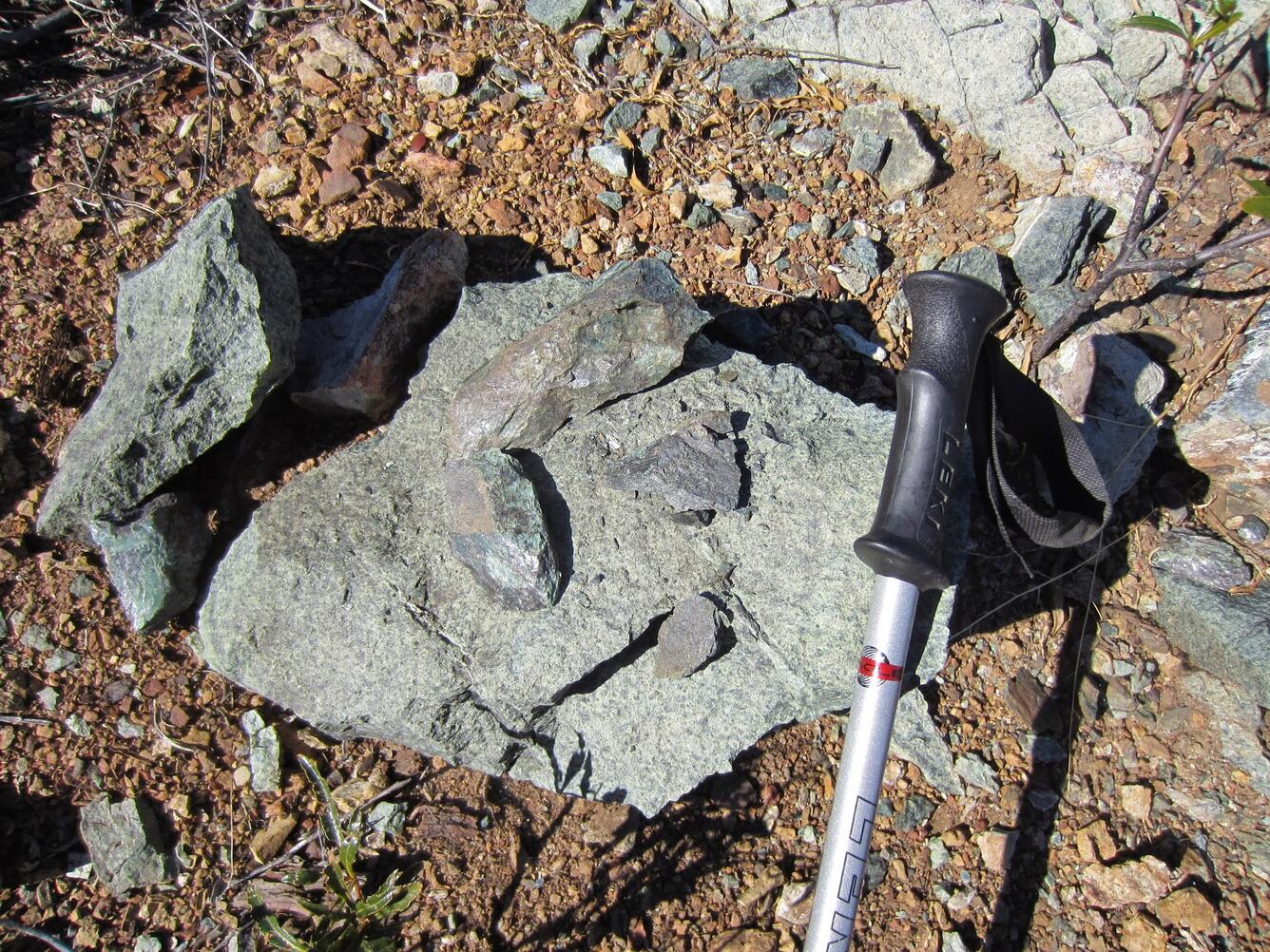
Where can you find ophiolites in California? There are chunks of this ancient seafloor found on the surface near Crescent City, the Klamath Mountains, Healdsburg, Lake Berryessa, west of Yuba City at the foot of the Sierra Nevada, scattered throughout the mountains from Hollister to Santa Maria and, of course, in the Bay Area! Ophiolite blocks exist on Mount Diablo, north of the San Luis Reservoir (Quinto Creek), in the Del Puerto Canyon, and at Mount Umunhum (Sierra Azul). These are collectively called the "Coast Range ophiolite", and most are around 160-170 million years old.

One commenter asked about whether Mount Diablo is a volcano. Because of its ophiolites, the answer is: not quite, but it is volcanic! At Mount Diablo, the ophiolite has been ripped apart, with most of it located to the northwest (Eagle Peak, Mitchell Rock, and Mt. Zion) and some slivers to the north and east along Marsh Creek. There are pillow basalts on Mitchell Peak and serpentinites and diabase (gabbro with very small crystals) most everywhere else, lending Mount Diablo some volcanic cred, if not the distinction of being a volcano itself.