



Hazard-ception: Fires are a hazard for monitoring California's hazardous volcanoes
While volcanoes are certainly one of California's most prominent natural hazards, they are by far one of the least common. Seasonal hazards such as landslides, blizzards, and fires occur in many of the same locations as our volcanoes, as was evident last week with the Pack Fire south of Long Valley.
Burning only a mile or so away from several seismic and GNSS (GPS) stations, the Pack fire was a late-season event that spread quickly. Luckily, rain and snowfall over the weekend dampened the fire's progression, and as of today (November 18) it is largely contained. While the stations weren't impacted this time, they could have been had the fire expanded beyond its current boundaries. Other property - including some structures - was destroyed in the blaze, and nearby communities were threatened and under evacuation orders.
Fires this late in the year are unusual, but they are a reminder that the main threat to our hazard-monitoring equipment is, in fact, other hazards. In the event of a threat to CalVO's monitoring systems, our observatory coordinates with emergency responders to make them aware of the precise locations of our stations and the equipment involved. Because they often have battery backups, these stations could be dangerous to fire personnel if they are damaged or destroyed. If the stations can be shielded by ongoing fire suppression activities, that's great - but we never ask anyone to risk their safety to protect our equipment. Even expensive equipment is replaceable; people are not!
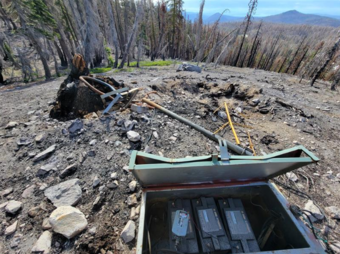
If our equipment is damaged in a fire, as happened in the Lava Fire at Mount Shasta or the Dixie Fire at Lassen (both in 2021), CalVO's next step is to determine if the station can be repaired or salvaged, or whether it can and should be replaced. (In the accompanying photo of a station burned in the Dixie Fire, the above-ground equipment was completely melted, but the buried seismic sensors were safe! USGS photo by Ryan Presser, NCSN) Sometimes, this is an opportunity to move an old station to a new or better spot, or to upgrade outdated equipment. Other times, improvements in the network mean that we can 'retire' a station and return the site to its former state.