



From macro to micro: Geologists study volcanoes at all scales!
Humans interact with geology at the macro scale – that is to say, things we can touch and see with the naked eye. But we can also learn a great deal from the micro scale.
The California Volcano Monitor is a weekly column written by scientists and collaborators of the California Volcano Observatory. This week's contribution is from Dawn Ruth, volcanologist and Electron Microbeam Lab Manager with the U.S. Geological Survey.
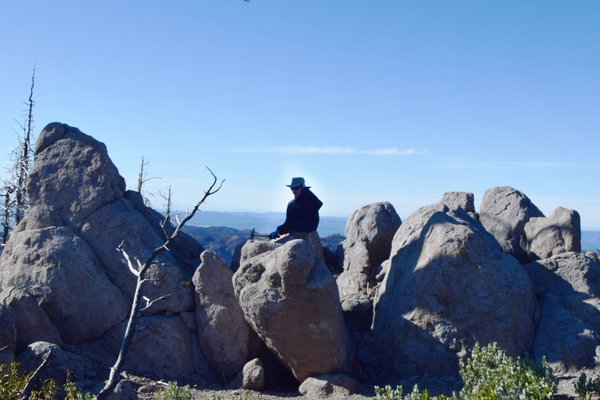
For many volcanologists, our first tools for studying volcanoes were a rock hammer and our eyes. We walk, hike, crawl, and scramble over volcanoes and compare what the rocks look like to learn from the remnants of past eruptions. With this information, we construct the history of the volcano and record it on a geologic map.
Some volcanoes erupt a variety of lavas that are easy to tell apart just by looking at them, each with their own chemical composition. But how do we unlock that information? Other volcanoes erupt the same composition of lava over and over again. How do we tell those lavas apart? This is when we turn to the microscopic scale – studying rocks at a scale we cannot see with our naked eye.
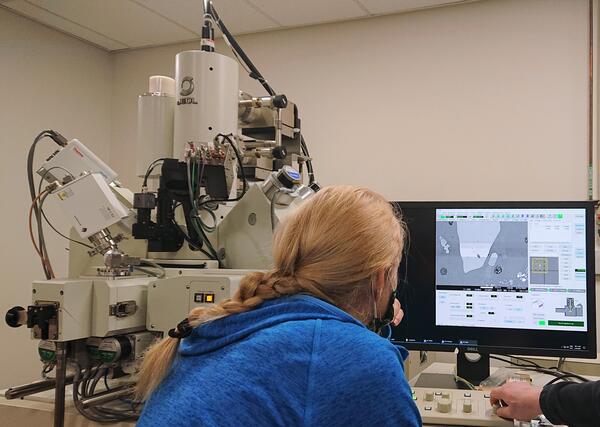
When we move from the macro to the micro, we bring rocks back from the field and subject them to many different kinds of analyses. This might include things like determining the proportions of different chemical elements, imaging glass or crystal textures, or firing beams of electrons at individual crystals. Where a field geologist might map a lava flow over several square kilometers, a lab geologist might measure crystals only a few micrometers in length. (For reference a sheet of paper is ~100 micrometers thick). Lab geologists use that data to dig deeper into the what, where, and when of volcanoes. What is happening both inside and outside the volcano? Where are these processes occurring beneath the surface of the Earth? And when did these processes occur? Learning about the processes that happen before and during eruptions helps us forecast when the volcano will erupt in the future.
This marks the first in a post series where we explore volcanoes at the micro scale!