U.S. flag

An official website of the United States government

Episode 48 of lava fountaining in Halemaʻumaʻu at the summit of Kīlauea  happened on June 1, 2026. Lava fountained from the north vent, reaching a maximum height of 650 ft (200 m). Light to moderate tephra fall was reported at overlooks in Hawaiʻi Volcanoes National Park, as well as on Highway 11 near Nāmakanipaio Campground, Volcano village, Mauna Loa Estates and Ohia Estates. 

The ongoing eruption in Halemaʻumaʻu crater, which began on December 23, 2024, has now surpassed the number of fountaining episodes in the opening years of the Puʻuʻōʻō eruption from 1983-1986 (47), setting a new record number of fountaining episodes in any one Kīlauea eruption. 

More information: Volcano Watch — Kīlauea is all tied up at 47 episodes | U.S. Geological Survey
 

Media
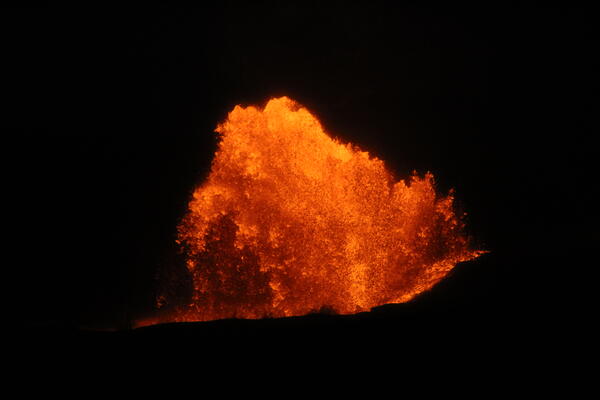
Color photograph of lava fountain at night
In the early morning hours of June 1, 2026, USGS Hawaiian Volcano Observatory scientists reported to Uēkahuna to watch the beginning of Kīlauea summit eruption fountaining episode 48. The fountaining episode began at 4:40 a.m. HST and by the time the scientists arrived around 5:00 a.m. HST, the Halema‘uma‘u north vent already hosted a lava fountain reaching over 330 feet (100 meters) high. USGS photo by M. Zoeller.
Media
Color photograph of lava fountain during the daytime
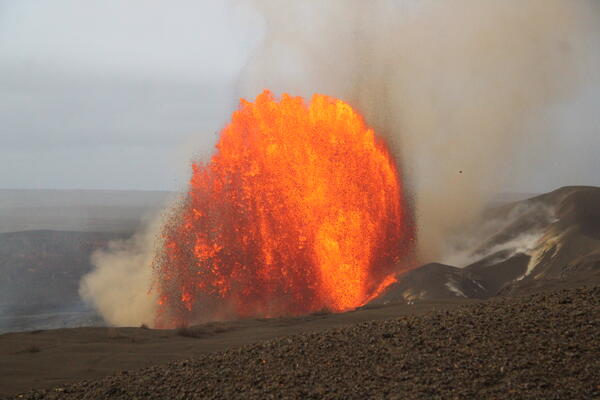
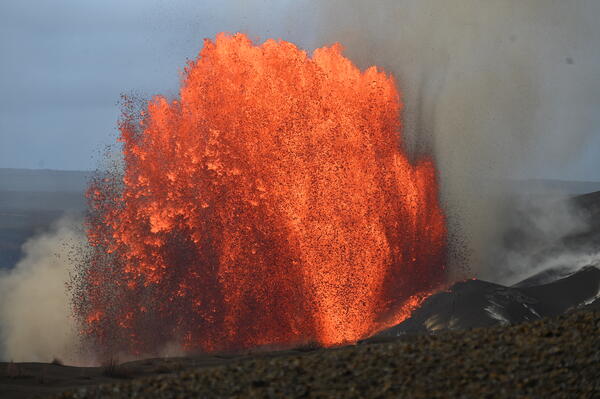
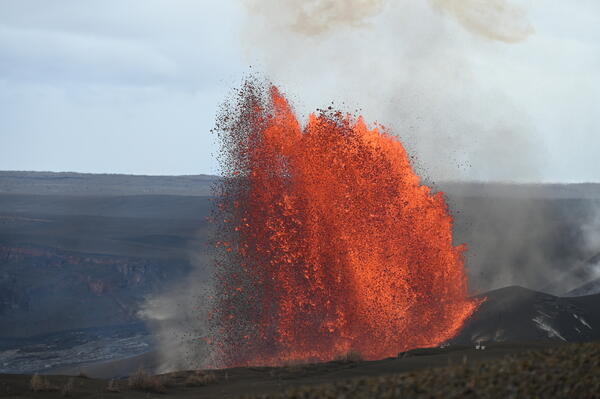
This photo of the Halema‘uma‘u north vent lava fountain was captured shortly after sunrise on June 1, 2026, around the time that activity was peaking during Kīlauea summit eruption fountaining episode 48. Preliminary estimates indicate that the lava fountain reached at least 500 feet (150 meters) in height during the episode. Most tephra was falling within the crater and immediately adjacent on the rim, but some lighter particles were lofted higher and greater distances downwind. USGS photo by M. Zoeller.
Media
Color photograph of volcanic plume
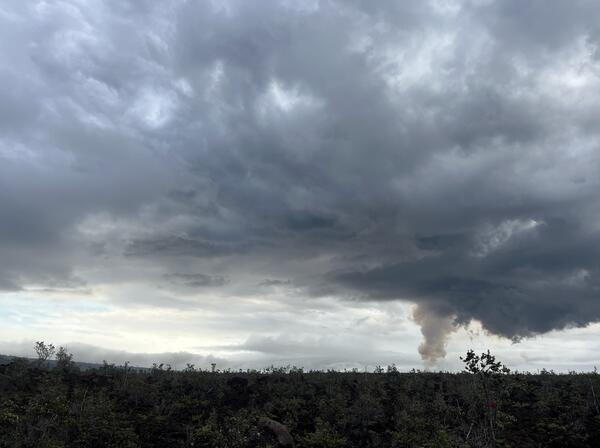
This photo was taken from near the Ka‘ū Desert trailhead within Hawai‘i Volcanoes National Park on June 1, 2026, during episode 48 of lava fountaining at Kīlauea summit. It shows the top of the north vent lava fountain on the skyline to the right and the volcanic plume rising above it. The Ka‘ū Desert Trailhead is about 5.7 miles (9.1 kilometers) west-southwest of Halema‘uma‘u. The fountaining was also audible at that location. USGS photo by N. Deligne.
Media
Color photograph of lava fountain in the distance
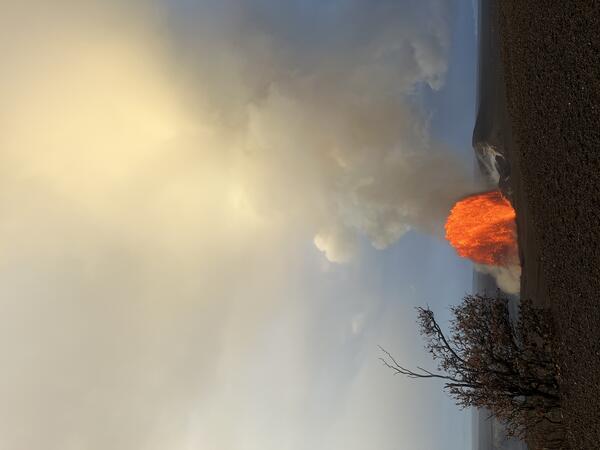
Episode 48 of lava fountaining in the ongoing eruption at Kīlauea summit started on June 1, 2026, at 4:40 a.m. HST. This photo was taken shortly after 6 a.m. from Uēkahuna overlook in Hawai‘i Volcanoes National Park, and shows the north vent lava fountain. As was the case during episodes 44, 45, 46, and 47, only north vent produced a lava fountain during episode 48. USGS photo by N. Deligne.
Media
Color photograph of lava fountain
Lava fountains of episode 48 started at 4:40 a.m. HST from the north vent in Halema‘uma‘u crater at the summit of Kīlauea volcano. Lava fountains have reached a maximum height of almost 650 ft (200 m) at their peak, shown here in a photo taken at 06:19 a.m. HST. USGS photo by L. Gallant. 
Media
Color photograph of lava fountain
During episode 48 of lava fountaining at the summit of Kīlauea on June 1, 2026, the lava fountain from the north vent reached a maximum height of almost 650 ft (200 m) at its peak around 6:30 a.m. HST. This photo was taken at 8:00 a.m. HST, nearly an hour and a half later, and shows a fountain of around 500 ft (152.5 m). USGS photo by L. Gallant.
Media
Color photograph of lava fountain in crater, visitors and rainbow on the rim
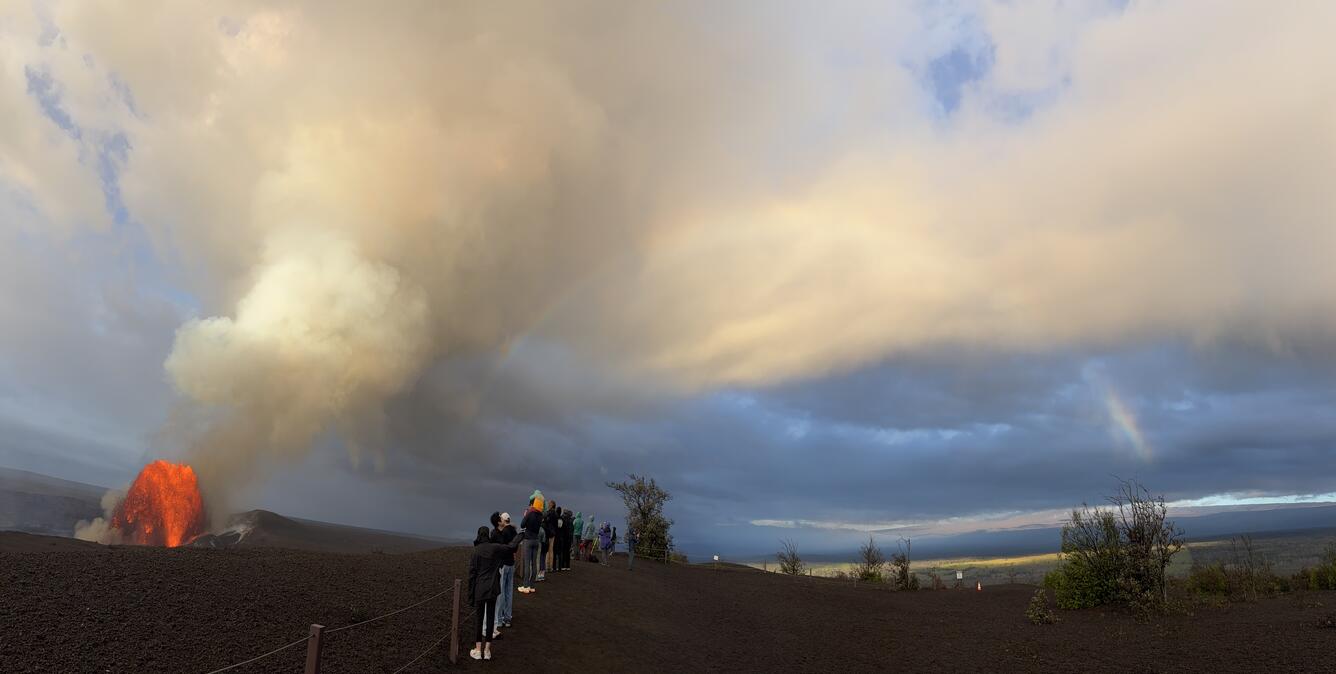
Visitors at Uēkahuna overlook in Hawaiʻi Volcanoes National Park at approximately 6:30 a.m. HST on June 1, 2026, viewed lava fountaining from the north vent during episode 48 of the ongoing Kīlauea summit eruption, framed by a rainbow. USGS photo by L. Gallant. 
Media
Color photograph of lava fountain within crater
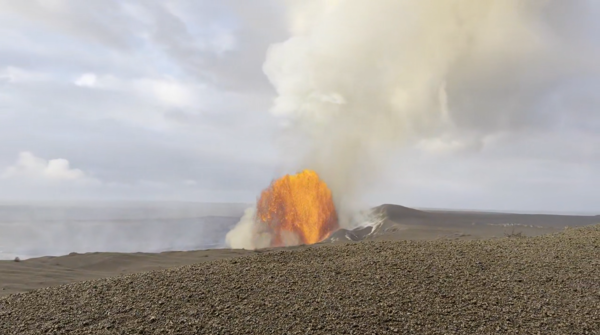
Episode 48 lava fountain from the north vent in Halemaʻumaʻu crater, at the summit of Kīlauea volcano, as viewed from near Uēkahuna overlook in Hawaiʻi Volcanoes National Park. USGS photo by M. Decker. 
Media
Color photograph of ash and Pele hair on white surface
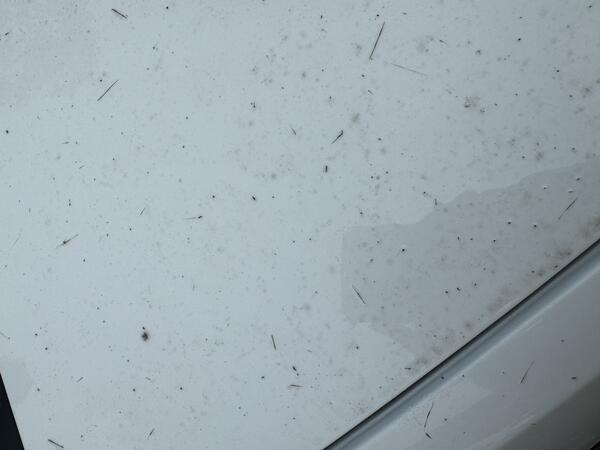
About 5 miles (8 km) east northeast of the eruption location in Halemaʻumaʻu crater at the summit of Kīlauea, ash and Pele's hair accumulated on the hood of a white vehicle during episode 48 of lava fountaining on June 1, 2026. Low-level winds from the northeast distributed most tephra to the southwest, but higher-level winds from the south distributed tephra to the north and east. USGS photo by D. Downs. 
Lava fountains of episode 48 started at 4:40 a.m. HST from the north vent in Halema‘uma‘u crater at the summit of Kīlauea volcano. This video was taken just after 7 a.m. and shows most of the tephra fallout from the lava fountain landing back in the crater. USGS video by L. Gallant.
Episode 48 lava fountain from the north vent in Halemaʻumaʻu crater, at the summit of Kīlauea volcano, as viewed from near Uēkahuna overlook in Hawaiʻi Volcanoes National Park. USGS video by M. Decker. 
Media
Color graphic compilation showing photos of 48 lava fountaining episodes over time
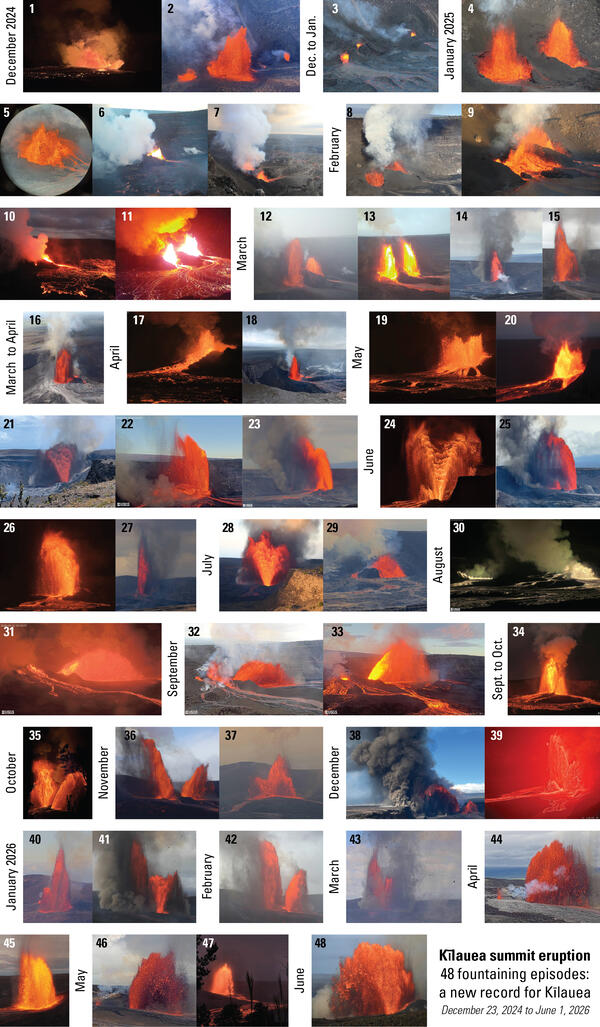
Photo calendar compilation of the 48 lava fountaining episodes that have occurred at Kīlauea's summit eruption. The eruption started on December 23, 2024, and episode 48 occurred on June 1, 2026. The eruption has now surpassed the number of fountaining episodes in the opening years of the Puʻuʻōʻō eruption from 1983-1986 (47), setting a new record number of fountaining episodes in any one Kīlauea eruption in the written record. CThis compilation includes webcam imagery and photos taken by USGS Hawaiian Volcano Observatory scientists on the ground and during helicopter overflights. In all photos except for episode 7, the south vent is on the left and the north vent is on the right. For the episode 7 photo, the north vent is in the center and the south vent is below it to the right. The episode 5 photo only shows north vent. The episode 30 photo also shows a fissure on the south wall that was active in the first few hours of the episode. Since episode 44, only the north vent has produced lava fountains, although the south vent has produced lava overflows in the lead up to fountaining episodes.
Media
Color map showing ground deformation and earthquakes at the summit of a volcano
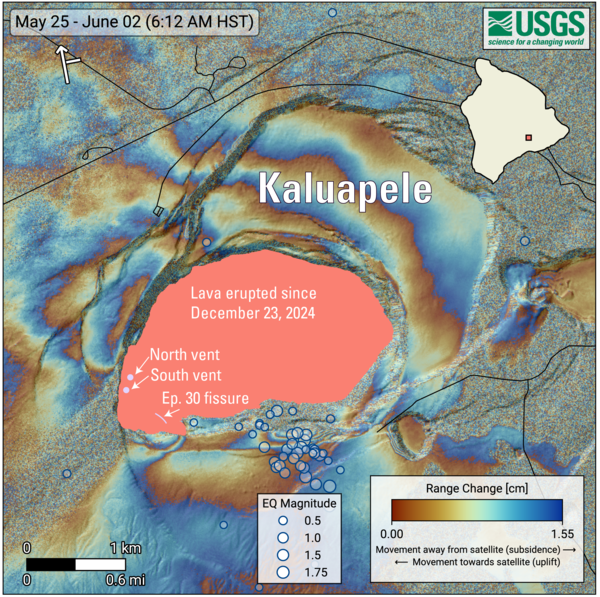
COSMO-SkyMed Second Generation (CSG) interferogram for the period from May 25 to June 2, 2026, covering Kīlauea volcano’s summit region. Each color fringe represents 1.55 centimeters (0.61 inches) of ground movement in the direction between the satellite and the ground (range change). The symbol in the upper left indicates the satellite's orbit direction (arrow) and look direction (bar). Earthquakes are marked with circles with the size proportional to their magnitude. The lava flows covering the crater floor are represented by the pink polygon, the two vents (circles) and the Episode 30 fissure (line) are marked in light pink. As episode 48 of lava fountaining in Halemaʻumaʻu at Kīlauea summit was ending on June 1, 2026, 53 earthquakes, most smaller than magnitude-2, occurred at depths up to 1 mile (1.5 km) below the ground surface beneath the south rim of Halema'uma'u crater. An area along the south rim of Halemaʻumaʻu also rose by several inches (centimeters). The specific cause of that uplift remains uncertain but it could be related to magma movement. 
Media
Color graphic map showing volcanic eruption deposit at the summit of a volcano
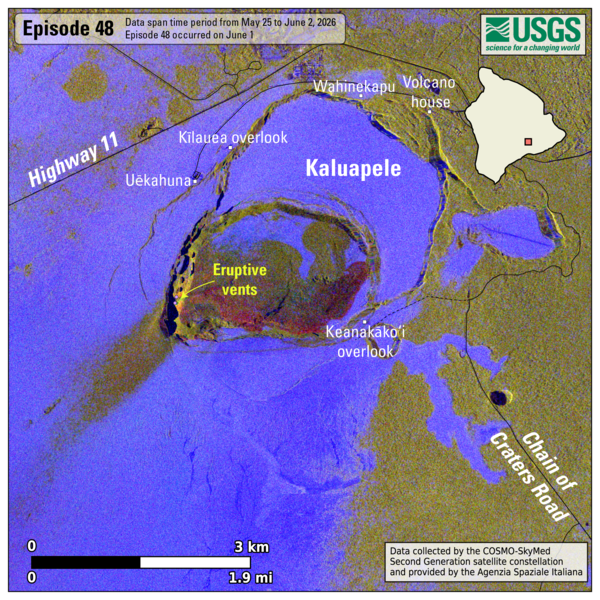
This map shows lava flow and tephra accumulation at the summit of Kīlauea volcano associated with episode 48 of the ongoing eruption in Halemaʻumaʻu that started on December 23, 2024, using data recorded by the Italian Space Agency's (ASI) COSMO-SkyMed Second Generation satellite constellation. These maps combine cross-polarized radar amplitude images taken on two different dates (on May 25 and June 2, 2026), along with interferometric coherence from the time between those dates. In the maps, unchanged barren areas are represented in blue/purple, vegetated areas appear in yellow/light green, new deposits over barren land are shown in dark green, and the recent lava flows in red. Public viewing areas within Hawaiʻi Volcanoes National Park are indicated with white squares; these can be temporarily closed for public safety.
Rain at Kīlauea summit following nine hours of lava fountaining during episode 48 on June 1, 2026, created steamy conditions within Halemaʻumaʻu, the crater floor of which was 40% covered with new lava flows during the episode. In the V1cam, a prominent whirlwind (puahiohio in ʻŌlelo Hawaiʻi, or the Hawaiian language) was visible forming at 4:47 p.m. HST and quickly dissipated. These features are commonly observed during and directly after eruptive events and form in part because of hot air rising from the ground surface. USGS video. 
Was this page helpful?