



By Hawaiian Volcano Observatory
July 9, 2025
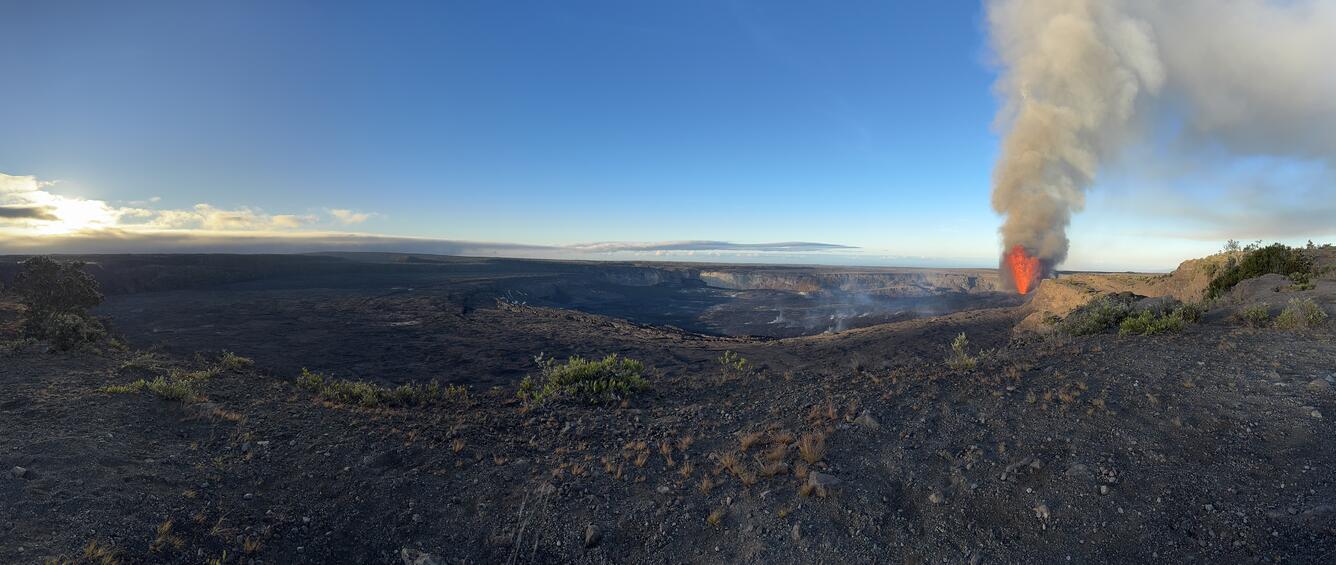
Episode 28 of the ongoing Halemaʻumaʻu eruption began at 4:10 a.m. HST on July 9, 2025, and ended abruptly just over 9 hours later, at 1:20 p.m. HST.
Media
Sources/Usage: Public Domain. View Media Details
Media
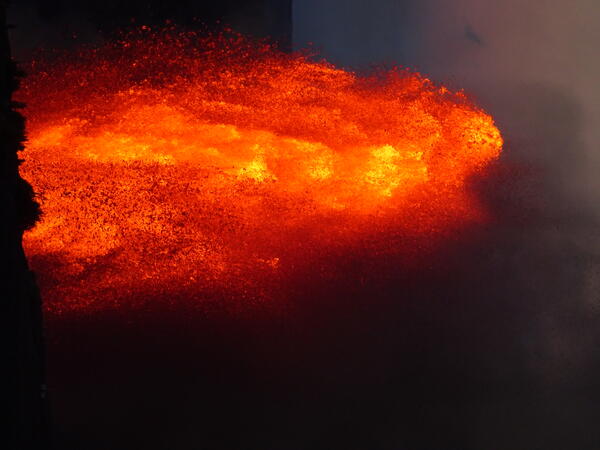
Lava fountaining associated with episode 28 of the ongoing Halemaʻumaʻu eruption began at 4:10 a.m. HST on July 9, following several days of gas pistoning cycles, some of which produced small lava overflows at the north vent on July 8. USGS photo by L. Gallant.
Sources/Usage: Public Domain. View Media Details
Media
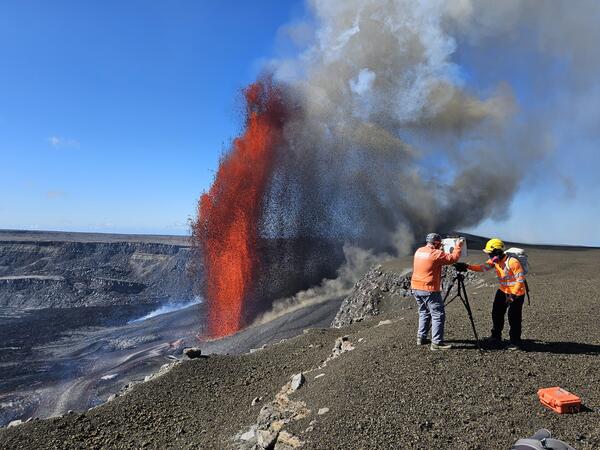
During episode 28 of lava fountaining during the ongoing Kīlauea summit eruption, USGS scientists approached the caldera rim to measure volcanic gas emissions with permission from Hawai‘i Volcanoes National Park. This lava fountain on the morning of July 9 was approximately 1000 feet tall (300 meters). Here, two scientists set up an FTIR (Fourier Transform Infrared Spectroscopy) instrument to analyze the gases emitted during the eruptive episode. Volcanic gas concentrations and compositions provide information about magma storage conditions, which aid in ongoing volcanic hazard assessments. USGS photo by K. Wall.
Sources/Usage: Public Domain. View Media Details
Media
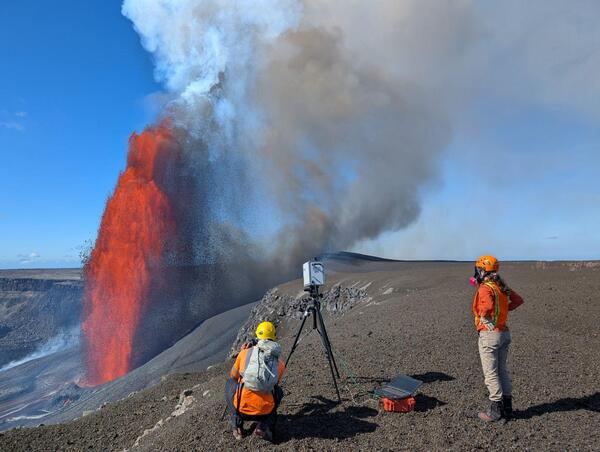
USGS scientists use an FTIR (Fourier transform infrared spectrometer) to measure the chemical composition of volcanic gas during episode 28 of the ongoing Kīlauea summit on July 9, 2025. USGS photo by M. Cappos.
Sources/Usage: Public Domain. View Media Details
Media
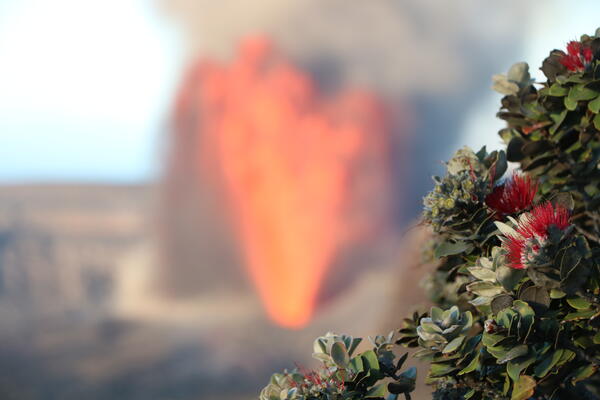
Near the Kīlauea Overlook in Hawaiʻi Volcanoes National Park, an ‘ōhi‘a lehua frames the lava fountains of episode 28 on July 9. USGS photo by K. Mulliken.
Sources/Usage: Public Domain. View Media Details
Media
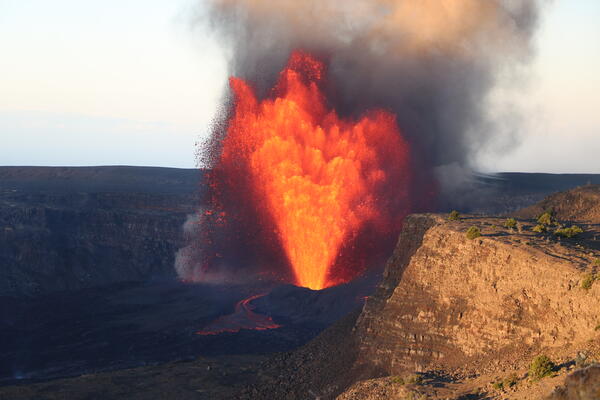
At approximately 6:30 a.m. on July 9, the sunrise illuminated the walls of Kaluapele, as the north vent remained in the shadows of the caldera walls. USGS photo by K. Mulliken.
Sources/Usage: Public Domain. View Media Details
Media
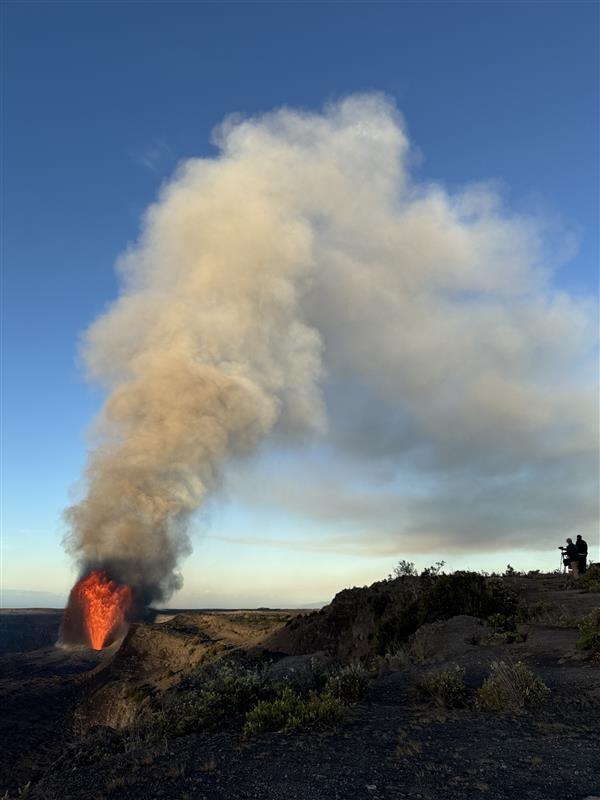
Episode 28 of the ongoing Halemaʻumaʻu eruption began just after 4 a.m. HST on July 9, 2025. This photograph was taken from the north rim of the caldera around 6:30 a.m., as Hawaiʻi Volcanoes National Park visitors gathered to view the episode. USGS photo by K. Mulliken.
Sources/Usage: Public Domain. View Media Details
Media
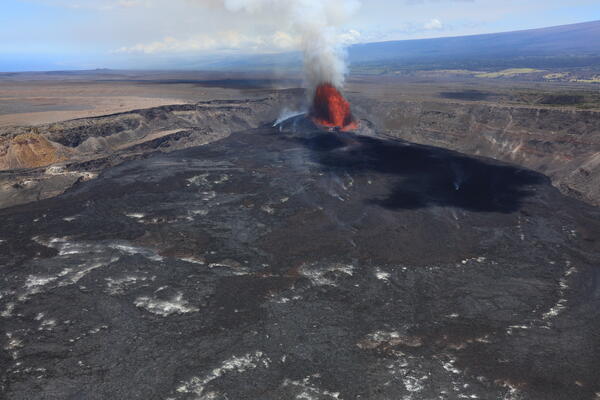
Aerial view taken during a USGS Hawaiian Volcano Observatory helicopter overflight, showing the lava fountain of episode 28 within the summit caldera (Kaluapele) of Kīlauea. These lava fountains reached a maximum of 1150 ft (350 meters) but were mostly lower than this height throughout the fountaining episode. The tephra and eruptive plume were blowing to the southwest with strong trade winds. At the time of the overflight, around 11 a.m. HST on July 9. lava flows had only advanced a little less than halfway across the crater floor. USGS photo by D. Downs.
Sources/Usage: Public Domain. View Media Details
Media
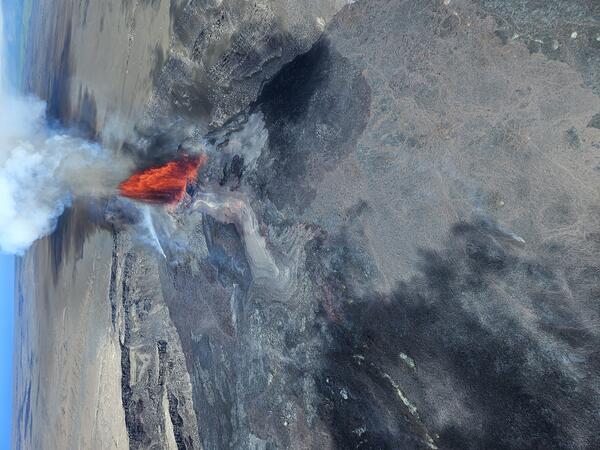
In this view from an eruption monitoring helicopter overflight on Wednesday, July 9, new lava flows can be seen traveling across the Halema‘uma‘u crater floor—these appear as fluid forms with a shiny, silvery crust over incandescent red-hot lava. Older lava flows from previous eruptive episodes have a darker or duller appearance. The lava fountain during episode 28 reached heights of approximately 1000 feet (300 meters) above the vent. The plume rising above the fountain includes particles of ash and Pele’s hair, giving a brown color to the core of the plume, as well as volcanic gases such as sulfur species that can lend a wispy blue appearance. While another team of scientists measured these gases from a site on the caldera rim (out of view of this photo), the helicopter team landed on the crater floor to find a safe location to approach and sample the fresh lava. USGS photo by K. Wall.
Sources/Usage: Public Domain. View Media Details
Media
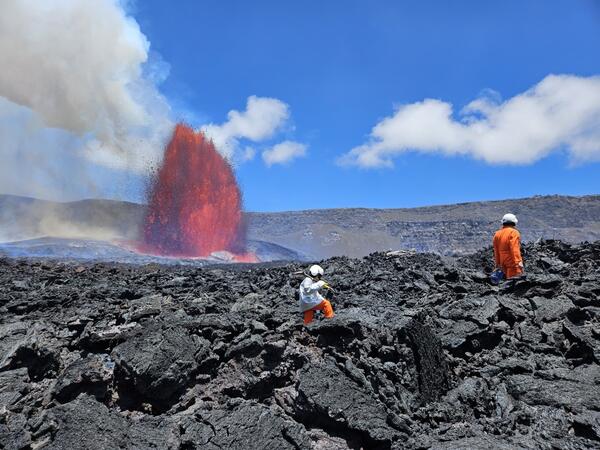
Halemaʻumaʻu crater is the home of Pele, the Native Hawaiian elemental force associated with lava, and numerous eruptions have taken place in the crater. With permission from Hawaiʻi Volcanoes National Park, USGS Hawaiian Volcano Observatory scientists landed briefly on the crater floor on Wednesday, July 9, to collect lava samples of episode 28. Here, two scientists are walking across earlier, cooled lava searching for a safe point to access the active episode 28 flows for a molten sample. Analyses of molten lava samples provides information on magma storage conditions, which aid in ongoing hazard assesssments. USGS photo by M. Zoeller.
Sources/Usage: Public Domain. View Media Details
Media
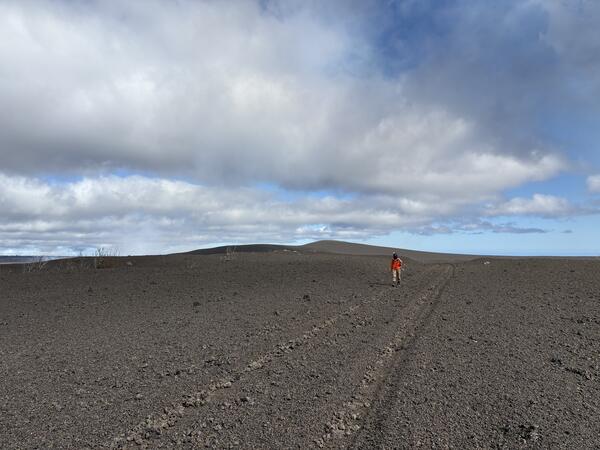
After episode 28 ended, USGS geologists inspected the tephra deposit southwest of the eruptive vents, in the closed area of Hawai‘i Volcanoes National Park. The tephra continues to accumulate and build up a hill that is more than 80 ft (~25 m) high, covering parts of Crater Rim Drive. While new measurements will be made in the following days to ascertain how much new tephra was added during episode 28, it was clear from a precursory inspection that dense, glassy tephra bombs were from episode 28 were still cooling and covering a large part of the landscape. USGS photo by D. Downs.
Sources/Usage: Public Domain. View Media Details
Media
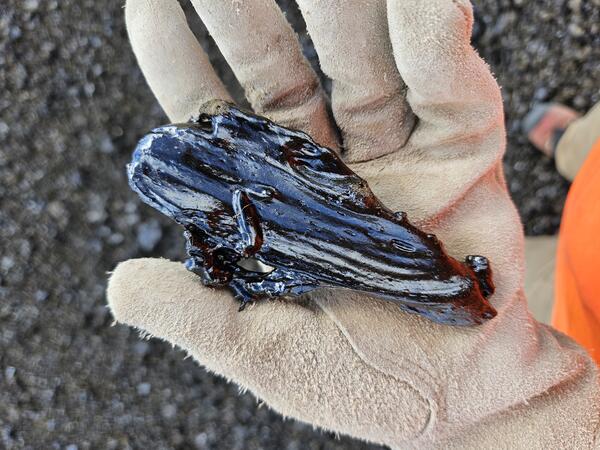
During episode 28 lava fountaining on Wednesday, July 9, clasts of fluid, molten lava were ejected to heights of approximately 1000 feet (300 meters) from the vent within Halema‘uma‘u crater and deposited onto the growing tephra hill on the western side of Kaluapele (Kīlauea summit caldera). These molten clasts were quickly quenched (cooled) by the air to create shiny, glassy “bombs” that preserve their fluid form, such as the one pictured here. Despite their solid appearance on the outside, these lava bombs are extremely delicate and light, with frothy interiors full of air bubbles, and they readily crumble into small pieces. With permission from Hawai‘i Volcanoes National Park, USGS Hawaiian Volcano Observatory scientists collected samples of these fresh lava bombs and pieces for geochemical analysis. The chemical compositions of these rocks, and the mineral crystals contained within, reveal information about the magma sources and storage conditions. USGS photo by K. Wall.
Sources/Usage: Public Domain. View Media Details