



Volcano Watch — A “window” into forecasting fountaining episodes at Kīlauea’s summit
Over the past month, the frequency of fountaining events at the summit of Kīlauea has increased to nearly one per week. This is reminiscent of the early days of the current episodic eruption that began on December 23, 2024. Nonetheless in 2026, we started to get used to longer pauses between episodes, which allowed for more time to clean up fallout if necessary and to prepare for the next episode.
Volcano Watch is a weekly article and activity update written by U.S. Geological Survey Hawaiian Volcano Observatory scientists and affiliates. Today’s article is by HVO research geophysicist Ingrid Johanson.
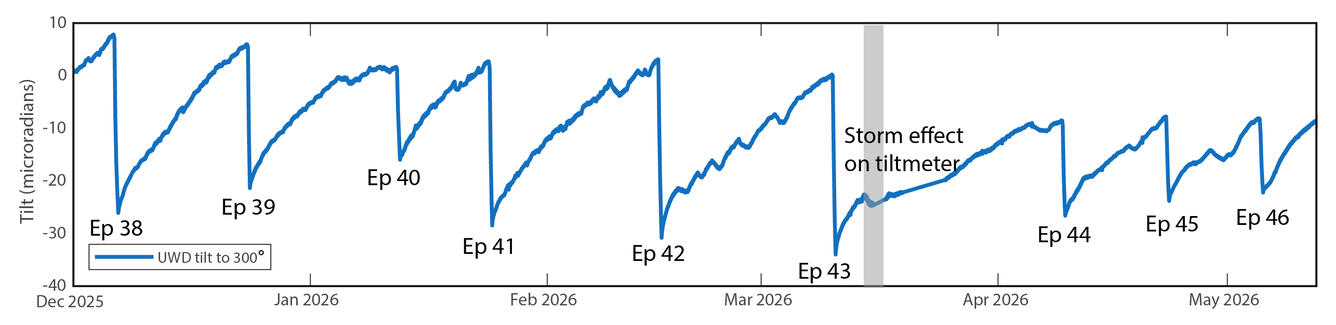
The reason for the quick repeats is that the volume of lava that is erupted has been much lower during the past three episodes, which means it does not take long for the magma storage system to recover what was erupted. This is the underlying basis for the forecast windows that the USGS Hawaiian Volcano Observatory (HVO) has been publishing since episode 5 and the change in behavior illustrates how the forecasts are made.
When lava is erupted, it removes magma from the magma chamber below and the chamber’s volume decreases. This is tracked by measuring how the ground deforms in response to the chamber shrinking or expanding; like tracking how much air is in a balloon by its change in shape. For the forecast windows, the data we use are ground tilt from a network of summit instruments. When magma exits the chamber during a fountaining episode, the magma chamber contracts and pulls the ground inwards, resulting in downwards tilt towards Kīlauea’s summit (deflationary tilt). As the magma chamber is re-inflated (by magma moving into it from deeper) the ground bulges above it and tilts away from the summit (inflationary tilt).
Since episode 5, deflationary tilt and inflationary tilt have been nearly balanced; that is, the amount of deflationary tilt during a fountaining episode is followed by nearly the same amount of inflationary tilt during the pause. This observation indicates that fountaining episodes occur once the system has regained the volume lost during the previous episode. Volume change is directly related to the pressure in the magma chamber, suggesting that there is a certain system pressure that is favorable for generating fountaining.
This regularity of the “target” point for a fountaining episode is the basis for the forecasting windows. Once enough inflationary tilt has occurred during a pause to get a good measurement of its rate, HVO can estimate when it will hit a target amount required for a fountaining episode to start. Each of the tiltmeters drifts a little bit, so the target tilt amount can vary, but is usually close to where it was when the previous episode started.
The feedback HVO has received for the forecasts has typically been positive; with partners and members of the public reporting that they appreciate having a ballpark estimate for when an eruptive episode could occur, even if that estimate gets adjusted. In particular, knowing the forecast and wind conditions allows residents in downwind areas to prepare for potential tephra fall.
The most common reason for adjusting the forecast window is to accommodate changes in the reinflation rate of the summit. Tiltmeters will sometimes record a flattening of the tilt signal (for example during precursory lava overflows) or even a reversal to deflationary tilt during an eruption pause. This is evidence that reinflation has slowed down and it will take longer to reach the target level.
The Kona low storms in mid-March also threw a wrench into forecasting. Excess groundwater can result in ground shifts in the immediate vicinity of the instrument that the tiltmeter picks up as tilt. This led to extra uncertainty in the timing of episode 44, the first episode after the storms.
The forecast window adjustments remind us that it is the behavior of the volcano and the stability of the HVO’s monitoring network that allows the forecast windows to be as accurate as they are. Our ability to provide the forecast windows will almost certainly end some day; likely because the volcano starts behaving in a new way (e.g. see this Information Statement, https://volcanoes.usgs.gov/hans-public/notice/DOI-USGS-HVO-2026-01-23T03:39:44+00:00). While there have been some brief earthquakes swarms at Kīlauea’s summit in the last couple of months, there are no clear signs yet of changes in the summit eruption. As always, things can happen quickly and HVO will look out for evidence of upcoming changes as they arise.
Volcano Activity Updates
Kīlauea has been erupting episodically within the summit caldera since December 23, 2024. Its USGS Volcano Alert level is WATCH.
Episode 46 of summit lava fountaining happened for 9 hours on May 5. Summit region inflation since the end of episode 46 indicates that another fountaining episode is possible, with precursory lava flowing from the vents beginning on May 14. Episode 47 is most likely to begin on May 14. Because an eruption is imminent, HVO has raised Kīlauea’s Alert Level from ADVISORY to WATCH and the Aviation Color Code from YELLOW to ORANGE on March 13. No unusual activity has been noted along Kīlauea’s East Rift Zone or Southwest Rift Zone.
Mauna Loa is not erupting. Its USGS Volcano Alert Level is at NORMAL.
No earthquakes were reported felt in the Hawaiian Islands during the past week.
HVO continues to closely monitor Kīlauea and Mauna Loa.
Please visit HVO’s website for past Volcano Watch articles, Kīlauea and Mauna Loa updates, volcano photos, maps, recent earthquake information, and more. Email questions to askHVO@usgs.gov.