



Volcano Watch — Beneath the boardwalk: the scientific legacy of Haʻakulamanu
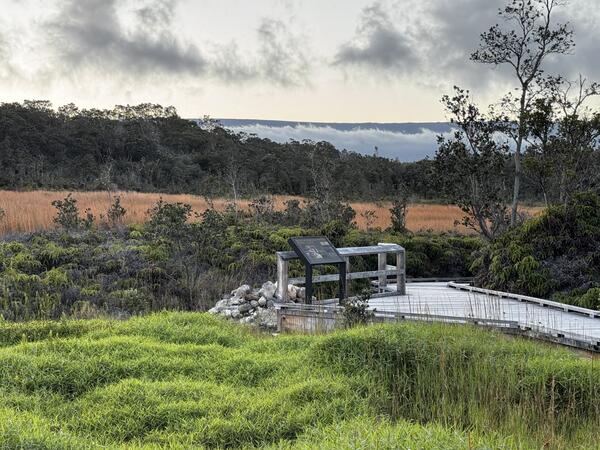
Just off the boardwalk at Haʻakulamanu (Sulphur Banks) in Hawaiʻi Volcanoes National Park, beneath an unassuming pile of rocks and rubble, lies the beginning of over 100 years of geochemical research at Kīlauea.
Volcano Watch is a weekly article and activity update written by U.S. Geological Survey Hawaiian Volcano Observatory scientists and affiliates. Today's article is written by HVO gas technician Christine Sealing.
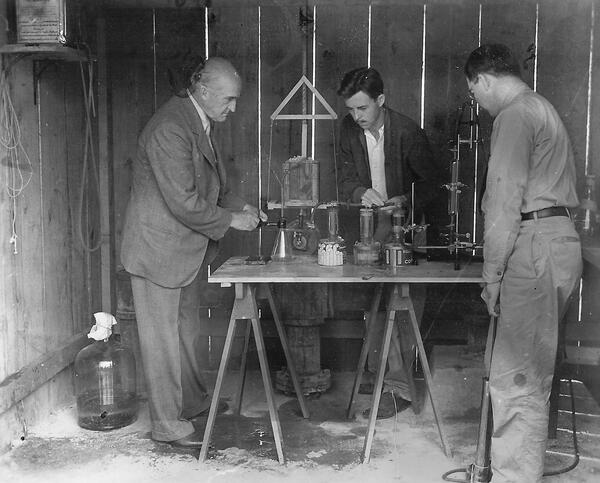
Like most scientists, the founder of the USGS Hawaiian Volcano Observatory (HVO), Dr. Thomas Jaggar, was filled with curiosity. He had been studying Kīlauea for 10 years and could not help but wonder, what if there was a way to know when a volcano was getting close to eruption?
As magma gets closer to the surface, it heats the surrounding rocks. In the early days of modern volcanology, without an understanding of how deep magma is stored at Kīlauea and how quickly it ascends, Jaggar thought that perhaps tracking temperature fluctuations below the surface might give some indication when activity at the volcano was about to change.
In May 1922, he set up an experiment to find out. The first in a series of shallow wells, approximately 12 inches (30 centimeters) in diameter, was drilled “between a large steaming crevasse and the main bank of red clay and sulphur” at Haʻakulamanu. Drilling was done by rudimentary machine, and water hauled from Volcano House was poured down the hole to lubricate a drill bit which was turned by hand each time the drill stem was raised. It was an arduous process made more dangerous by the scalding steam emanating from the hole. After being plagued by problems, the decision was made to stop drilling at 22 feet (about 7 meters).
Encouraged by the high temperatures in the first well and curious whether the chemistry of gases from the man-made wells would match the chemistry of the natural fumaroles, Jaggar had the drill rig moved 140 feet (43 meters) away and tried again. Between 1922 and 1923, three more wells were drilled at Haʻakulamanu just a few feet away (about a meter) from each other. The second well reached a depth of 50 feet (15 meters) before intersecting a large crack beneath the surface, which stopped the drilling.
The scorching steam and acid gases made work at each well a challenge. The first several feet (first few meters) of rock below the surface were soft, having been effectively cooked by heat and the corrosive gases. Soon, however, the altered material gave way to rocks which Jaggar described as “mineralized basalt lava with much iron sulphide (pyrite).” After detailing the slow progress and difficulties in his HVO Monthly Bulletin, Jaggar remarked wryly, “These results show that basaltic lava sheets are hard rocks to drill.”
Despite the challenges, the wells began yielding data almost immediately. Aside from recording the chemically altered geology as it came out of the hole, Jaggar also measured the temperature of steam at depth as drilling progressed. In each of the wells, by 10 feet (3 meters) depth the temperature had reached approximately 204 degrees Fahrenheit (96 degrees Celsius), which corresponds to the boiling point of water at the 3,900 feet (1,200 meters) elevation of Haʻakulamanu, and it remained steady to the base of the well.
A visiting colleague, Dr. Eugene T. Allen from the Carnegie Institution of Washington, confirmed that the chemistry of the wells and fumaroles were indeed a match, saying, “I had not anticipated that the drill holes like natural fumaroles would serve as vents tor escaping gases… As soon as it had been ascertained that the gases from the drill-holes responded to the same tests as those from the natural fumaroles, attention was focused entirely on the former…” Although Allen’s preliminary analyses returned mixed results, they hinted at what we now understand, that the gases at Haʻakulamanu come directly from the magma beneath Kaluapele, Kīlauea’s caldera.
Since 1922, HVO scientists have tracked gas chemistry from the wells at Haʻakulamanu. Although the original well heads have long since disintegrated, hot gases continue to seep from the place where Jaggar conducted his first experiments. With new analytical laboratories coming soon to replace the ones lost during the 2018 eruption, today’s HVO scientists are looking forward to a new era of measurements, continuing the work of the geochemists who came before us. So, the next time you walk down the boardwalk at Haʻakulamanu, give a nod to geochemistry and the little pile of rubble that started it all.
Volcano Activity Updates
Kīlauea has been erupting episodically within the summit caldera since December 23, 2024. Its USGS Volcano Alert level is ADVISORY.
Episode 56 of lava fountaining in Halema'uma'u at the summit of Kīlauea occurred for six hours on November 5, 2026. The summit region switched from deflationary to inflationary tilt at the end of fountaining and the forecast window for episode 57 fountaining is November 16-21. Summit sulfur dioxide emissions are elevated. No unusual activity has been noted along Kīlauea’s East Rift Zone or Southwest Rift Zone.
Mauna Loa is not erupting. Its USGS Volcano Alert Level is at NORMAL.
Two earthquakes were reported felt in the Hawaiian Islands during the past week: a M2.6 earthquake 7 km (4 mi) NNE of Puako at 4 km (2 mi) depth on Nov. 10 at 2:41 a.m. HST and a M2.9 earthquake 5 km (3 mi) NE of Kalaoa at 13 km (8 mi) depth on Nov. 6 at 12:08 p.m. HST.
HVO continues to closely monitor Kīlauea and Mauna Loa.
Please visit HVO’s website for past Volcano Watch articles, Kīlauea and Mauna Loa updates, volcano photos, maps, recent earthquake information, and more. Email questions to askHVO@usgs.gov.