



Volcano Watch — Episode 43, new fountain height record and tephra fallout on communities
Episode 43 at the summit of Kīlauea began at 9:17 a.m. HST on March 10, 2026, and continued for 9 hours. Both the north and south vents erupted lava fountains, with the south vent fountain reaching 1770 feet (540 meters) high — a new record for this eruption. Southwesterly winds carried tephra traveled toward visitor overlooks and nearby communities, both near and far.
Volcano Watch is a weekly article and activity update written by U.S. Geological Survey Hawaiian Volcano Observatory scientists and affiliates.
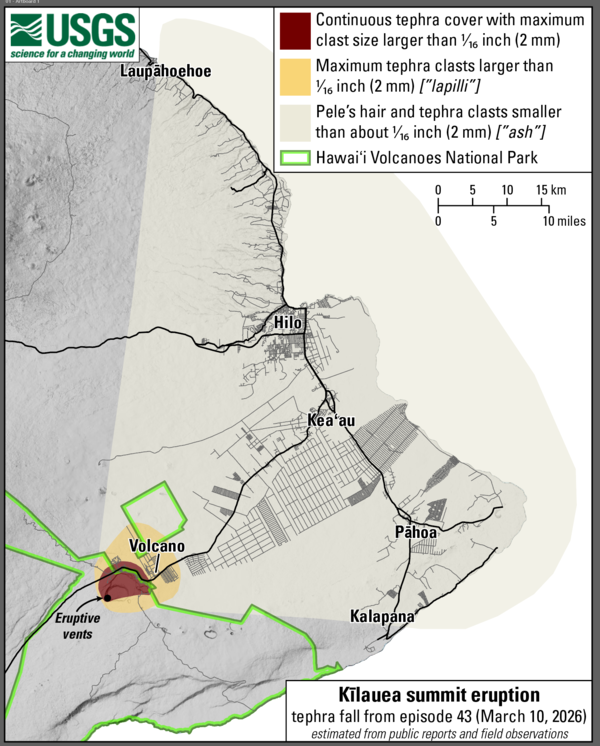
Most of the fallout accumulated at the Uēkahuna overlook and Kilauea Military Camp in Hawaiʻi Volcanoes National Park, as well as portions of Highway 11 and the Volcano Golf Course community. These areas, located northeast of the vents, experienced continuous ground coverage. For safety, part of Highway 11 and Hawaiʻi Volcanoes National Park were temporarily closed to allow for tephra cleanup.
Lighter but still widespread tephra was reported across other parts of the Volcano Golf Course community, as well as Volcano Village and Mauna Loa Estates. These areas received sparser fallout ranging up to lapilli in size (larger than 1/16th inches or 2 mm). More distant communities reported only ash (less than 1/6 inch or 2 mm in size) and Pele’s hair.
Mahalo to residents and visitors who reported fallout using the “Is Tephra Falling?” webtool to share real-time observations. These observations helped responding agencies to track the extent and timing of the fallout. The USGS Hawaiian Volcano Observatory relayed these ground observations with the National Weather Service, who used the information to issue Ashfall Advisories and Warnings early in episode 43.
More than 200 tephra fall reports were submitted in total. The first came in around 10:30 a.m. HST from areas within Hawaiʻi Volcanoes National Park and communities surrounding Kīlauea summit. By midday, reports of ash and Pele’s hair were received from Mountain View, followed by Keaʻau, Pāhoa, and Hilo around 1 p.m. Ashfall observations from communities along the Hāmākua coast began around 2 p.m. The farthest confirmed observations ranged from Kalapana in the south to Laupāhoehoe in the north, with the latter received around 3:30 p.m.
Tephra fall raises concerns for residents who rely on rooftop rainwater catchment systems, and data from
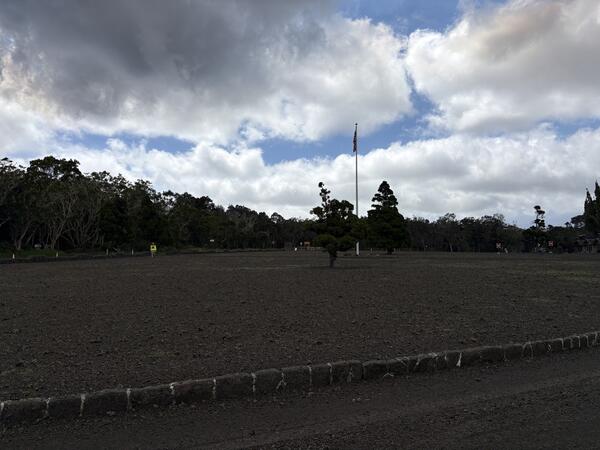
previous eruptions can provide useful guidance on what to expect. Episode 41 on January 24, 2026, similarly deposited abundant tephra on communities near the summit of Kīlauea that rely on rainwater catchment. Scientists and community volunteers collected ash, rooftop runoff, and catchment tank water samples from affected areas to understand how these tephra deposits might affect water quality.
One of the main concerns is fluoride, which can coat tephra particles and then dissolve into water. Testing found that fluoride in catchment tank water after episode 41 ranged from 0.06 to 0.3 parts per million (ppm), well below the U.S. Environmental Protection Agency limit of 4.0 ppm for public water systems. Runoff collected from roofs during the first rainfall after the tephra fell was higher: 7–10 ppm from roofs that had not been cleared of tephra, and about 1.5 ppm from a roof that had been cleaned. The lower level from the cleaned roof demonstrates how cleaning tephra can meaningfully reduce contamination.
Other potential contaminants associated with volcanic ash, such as arsenic, cadmium, chromium, copper, and lead, were too low to detect. In most cases, water affected by ash is likely to taste unpleasant or look discolored before contaminants reach levels of health concern.
The largest impact on water quality occurs during the first flush of rain after an eruption, when most contaminants are washed from the tephra. Residents using rainwater catchment systems can reduce risk by temporarily disconnecting downspouts before tephra fall, covering storage tanks, and cleaning tephra from roofs and gutters before reconnecting their systems. These precautions are effective at minimizing impacts, and continued rainfall will naturally dilute any remaining contamination. Additional guidance on protecting catchment water during ashfall is available from The University of Hawai‘i Sea Grant College Program.
Tephra is an eye, skin, and respiratory irritant. When clearing tephra, wear personal protective equipment such as a particulate mask, eye protection, gloves, and protective clothes such as long-sleeves, a hat, and covered shoes. More information on cleanup is available at Impacts & Mitigation - Personal Protection PPE.
The area affected by tephra fallout during Kīlauea summit episodes can vary depending on the lava fountaining behavior and wind conditions. As future eruptive episodes approach, monitor the weather forecast and follow guidance from Hawaii County Civil Defense Agency so you can prepare for these events if you live in an area that may experience tephra fallout.
Volcano Activity Updates
Kīlauea has been erupting episodically within the summit caldera since December 23, 2024. Its USGS Volcano Alert level is WATCH.
Episode 43 lava fountaining happened for just 9 hours on March 10. Summit region inflation since the end of episode 43 indicates that another fountaining episode is possible, with models suggesting that episode 44 could begin between March 28 and April 14. No unusual activity has been noted along Kīlauea’s East Rift Zone or Southwest Rift Zone.
Mauna Loa is not erupting. Its USGS Volcano Alert Level is at NORMAL.
Two earthquakes were reported felt in the Hawaiian Islands during the past week: a M3.1 earthquake 3 km (1 mi) ENE of Honalo at 23 km (14 mi) depth on March 10 at 9:03 p.m. HST, a M2.8 earthquake 8 km (4 mi) SE of Mākena at 1 km (0 mi) depth on March 10 at 11:05 a.m. HST, and a M2.9 earthquake 14 km (8 mi) S of Volcano at 4 km (3 mi) depth on March 6 at 8:45 p.m. HST.
HVO continues to closely monitor Kīlauea and Mauna Loa.
Please visit HVO’s website for past Volcano Watch articles, Kīlauea and Mauna Loa updates, volcano photos, maps, recent earthquake information, and more. Email questions to askHVO@usgs.gov.