



In honor of Valentine’s Day, let’s talk about a geyser in Norris Geyser Basin that came back to life in August 2025 after a 20-year hiatus -- Valentine Geyser.
Yellowstone Caldera Chronicles is a weekly column written by scientists and collaborators of the Yellowstone Volcano Observatory. This week's contribution is from Michael Poland, geophysicist with the U.S. Geological Survey and Scientist-in-Charge of the Yellowstone Volcano Observatory.
Thermal activity in Yellowstone is, in a word, dynamic—especially in Norris Geyser Basin, which might be the most variable of the park’s amazing thermal areas. New geysers and hot springs form there frequently, like the blue pool that grew gradually from late 2024 into early 2025, and the steam vent that formed north of the basin in August 2024. Geysers also start and stop, like Steamboat Geyser, which entered a period of frequent eruptions in 2018 but now seems to have gone dormant once more.
Hydrothermal activity in the basin changes tremendously over time. And that trend continued in 2025 with the reawakening of Valentine Geyser after over 20 years without an eruption.
Valentine Geyser is located just north of and below the Norris Geyser Basin museum in a small alcove in the hillside. It is adjacent to Guardian Geyser, with which it often shares eruptions, and is not far from Ledge Geyser, which is well known for its loud steam phase and tendency to douse nearby visitors with spray.
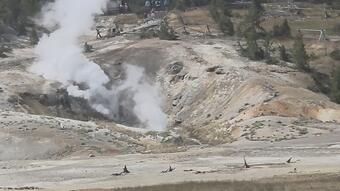
The date that Valentine Geyser formed is not known—it may have been in existence in some form as early as the 1880s or may have developed in 1902. Regardless, it received its name in the early 1900s (probably 1907, although some reports suggest it was 1909) when it was observed by C. W. Bronson, who was the winter keeper of the Norris Hotel, to erupt violently on Valentine’s Day. In 1910, a newspaper from Deer Lodge, Montana, amusingly claimed that the geyser erupted “ice cold water” that would create a “furore [sic] among geologists.” This was obviously misreported but shows that even 116 years ago there were weird rumors circulating about Yellowstone activity!
Valentine Geyser erupts from a cone that is about 6 feet (2 meters) high—probably the largest cone in Norris Geyser Basin—but it is unclear if the cone is completely made of silica sinter from past eruptions, or if it is a thin coating of sinter on bedrock. Major eruptions are relatively quiet but can send water to 75 feet (23 meters), although about half that height is more common. Each major eruption starts with water but quickly transitions to steam, and eruptions last from several to more than 20 minutes, often with a longer steam phase.
Like Steamboat Geyser, Valentine Geyser seems to go through periods of frequent eruptions separated by quiet intervals. When it is active, eruptions of Valentine Geyser can be quite regular—so much so that a 1982 trail map produced by the park even included a place for visitors to note eruption times. Prior to 2025, the most recent active phase was in the late 1980s to early 1990s, when eruptions occurred every few days. A few eruptions occurred during 1999–2004, but no major eruptions are known after that time (although it is possible some isolated eruptions took place during winter and went unobserved).
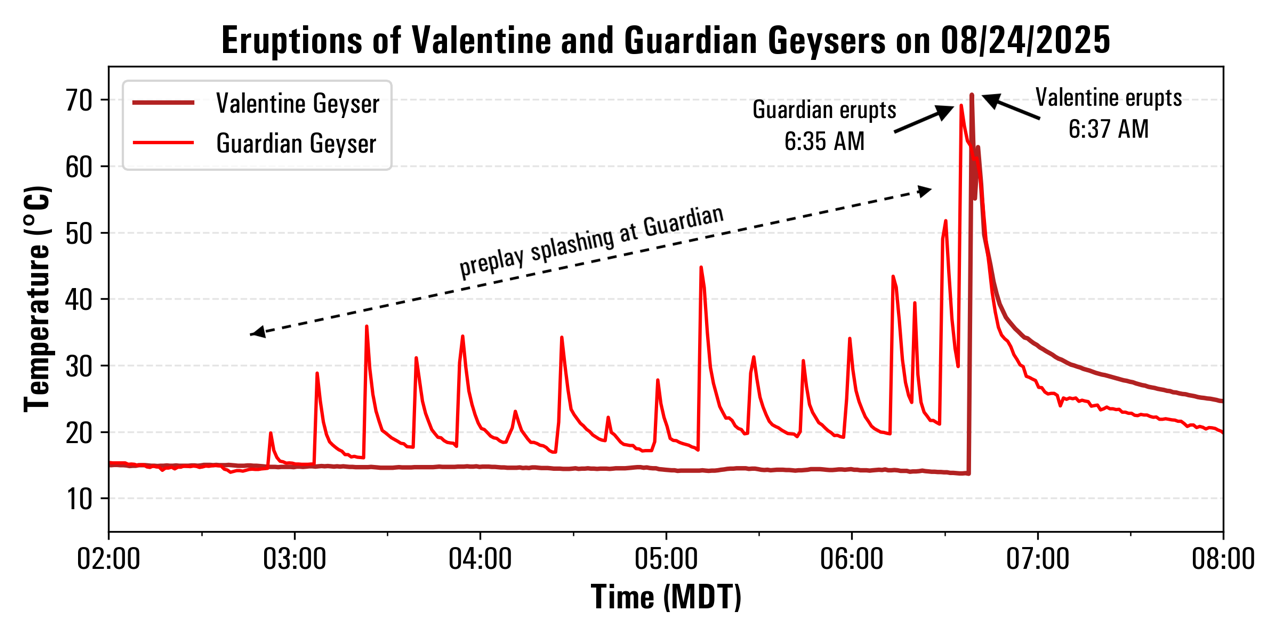
Valentine sprang to life once again on August 7, 2025—its first documented eruption in almost 21 years! From that time through at least mid-October, the geyser erupted about every 4–6 days, always preceded by splashing in nearby Guardian Geyser, and ultimately with eruptions occurring from both geysers at the same time. From mid-October onward, Norris Geyser Basin has been closed to visitors, first for infrastructure maintenance and then for the winter season. The Yellowstone National Park Geology Program established temperature loggers on both Valentine Geyser and Guardian Geyser, and these data have tracked eruptions since August. Geologists will recover the logger data collected since mid-October in spring 2026, hopefully revealing more about the geysers’ eruptive patterns.
As with most geysers, Valentine’s behavior raises more questions than it answers. Why did the geyser spring back to life? What sort of plumbing system feeds the geyser? Observations from the most recent eruptive period may help to address some of these unknowns. As for how long the renewed activity at Valentine Geyser might last…well, that’s something only time will tell.
ACKNOWLEDGEMENTS: Much of the information about the history of Valentine Geyser comes from T. Scott Bryan’s The Geysers of Yellowstone, Lee H. Whittlesey’s Yellowstone Place Names, and from archival research by M.A. Bellingham. Mara Reed contributed observations and temperature data.