



Echinus Geyser is back in action! For now…
The world’s largest acidic geyser is located in Norris Geyser Basin. Lately, it’s been putting on quite a show.
Yellowstone Caldera Chronicles is a weekly column written by scientists and collaborators of the Yellowstone Volcano Observatory. This week's contribution is from Michael Poland, geophysicist with the U.S. Geological Survey and Scientist-in-Charge of the Yellowstone Volcano Observatory.
Norris Geyser Basin is known for being the hottest and most dynamic of Yellowstone National Park’s thermal areas—and that’s saying something! It is home to Steamboat Geyser, the tallest active geyser on Earth, and it contains an interesting and chaotic mix of acidic and neutral features in terms of chemistry.

In the Back Basin of Norris Geyser Basin, about 200 meters (660 feet) away from Steamboat Geyser, is Echinus Geyser. The name comes from mineralogist Albert Charles Peale, who visited the geyser in 1878 and thought the rocks around the geyser looked like sea urchins—a type of animal known as an echinoderm.
The geyser pool is about 20 meters (66 feet) across. Paradoxically, the geyser has an acidic chemistry, and it is the largest acidic geyser in the world. That sounds a bit scary, but the acid is not concentrated. Rather, it’s a bit like orange juice or vinegar.
Acid geysers are rare because acidic water can break down the rock that makes up a geyser’s plumbing system. At Echinus Geyser, however, the composition is due to mixing between acidic gases and neutral waters, and the acidity is not sufficient to eat away at the rock. The somewhat unique water chemistry results in interesting formations and compositions, including the red color (from iron, aluminum, and arsenic) that rims the geyser pool and the silica-covered spiny rocks that give the geyser its name.
The boardwalk around Echinus Geyser contains several benches and multiple tiers of platforms. Visitors to the geyser during most of the 21st century might have wondered why there were so many viewing areas, because eruptions are not common. But in the latter half of the 20th century, the geyser was a consistent performer, and visitors could get closer to an eruption there than almost anywhere in the park!
The geyser appears to have been mostly dormant with only occasional eruptions prior to 1948. In the 1970s Echinus Geyser was erupting regularly at 40–80-minute intervals. In the 1980s and 1990s, the eruption durations could be quite extreme, sometimes lasting more than 90 minutes!
Eruptions of Echinus Geyser varied tremendously when the geyser was vigorously active. Some were small while others reached about 23 meters (75 feet). They could be vertical or inclined, occasionally soaking onlookers with warm water, and could be regular enough that the park would sometimes post predictions—the duration of an eruption could often be used to forecast the timing of the subsequent eruption. By the early 2000s, however, eruptions started to wane, and activity became much less common.
In 2010, a temperature monitoring system was established in the outflow channel of Echinus Geyser as a means of tracking any changes. Data from that system recorded 15 sporadic eruptions during October 2010–January 2011. After that time there were a few eruptions here and there until the geyser came alive in 2017.
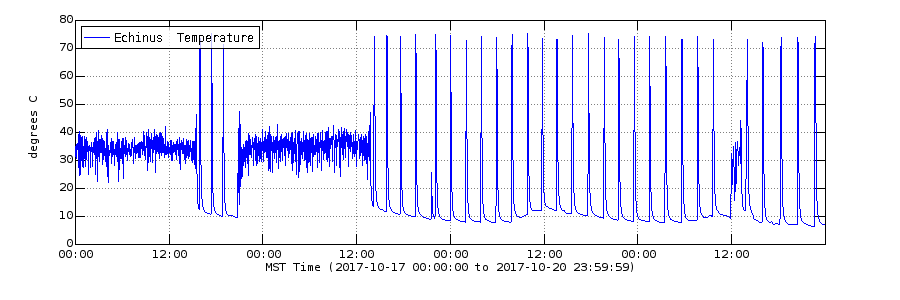
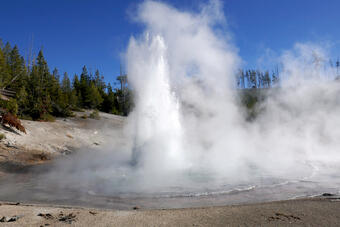
Starting in mid-September of that year, the temperature sensor recorded spikes followed by decreases happening many times throughout the day. These were associated not with eruptions but rather surges from the pool where the surface became agitated, releasing hot water down the channel, and then calming, with lower water levels that gradually returned to normal. In October, true eruptions started, indicated by higher temperature spikes as more hot water went down the channel. From October 18 to November 10, 2017, eruptions took place very consistently about every 2–3 hours. Then the activity suddenly stopped. There was one eruption in January 2018, one in January 2019, and two in December 2020. Then quiet.
Until now.
In early February 2026, repeated surges of the geyser began—as before, with the surface becoming agitated and releasing more water down the runoff channel. The first eruption since 2020 occurred on February 7, followed by additional eruptions on February 9, 12, and 15. Starting on February 16, eruptions began occurring every 2 to 5 hours. These eruptions last 2–3 minutes and reach about 6–10 meters (20–30 feet) in height. After eruption, the water level decreases significantly and doesn’t return to normal for about an hour. Overall, this pattern resembles that of late 2017.
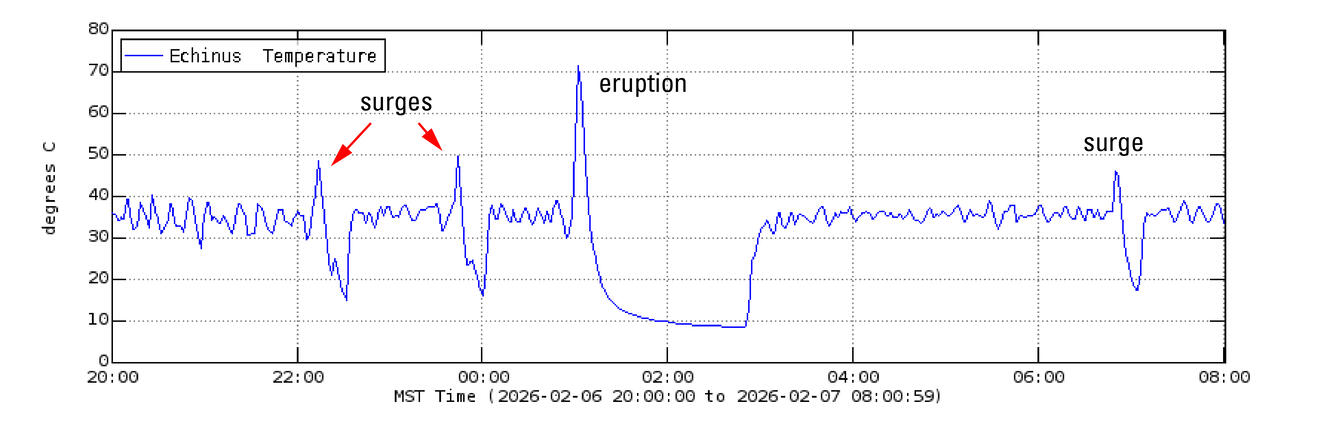
You can follow the activity of Echinus Geyser via the temperature graphs on the Yellowstone Volcano Observatory website—look for the spikes that reach about 70 °C (158 °F). Those are the eruptions! Spikes that reach 40–50 °C (104–122 °F) are the surges.
Will the eruptions continue into the summertime, allowing visitors to use the seating and viewing areas around the geyser for their intended purpose? It’s probably not too likely given the geyser’s tendency to wake up for a month or two before going back to sleep, and there were no eruptions during the last few days of February so it might already have gone quiet. But change is constant at Norris Geyser Basin, so perhaps the show will continue into the summer! Fingers crossed…
Acknowledgement: Some of the information for this article was derived from T. Scott Bryan’s The Geysers of Yellowstone, Lee H. Whittlesey’s Yellowstone Place Names, the online GeyserTimes database for Echinus Geyser, U.S. Geological Survey Professional Paper 1456, and research by M.A. Bellingham.
Related

Taking the Temperature of Norris Geyser Basin

Water Temperature Data for Echinus Geyser, Yellowstone National Park
Related
Taking the Temperature of Norris Geyser Basin