



The fascinating history of Imperial Geyser
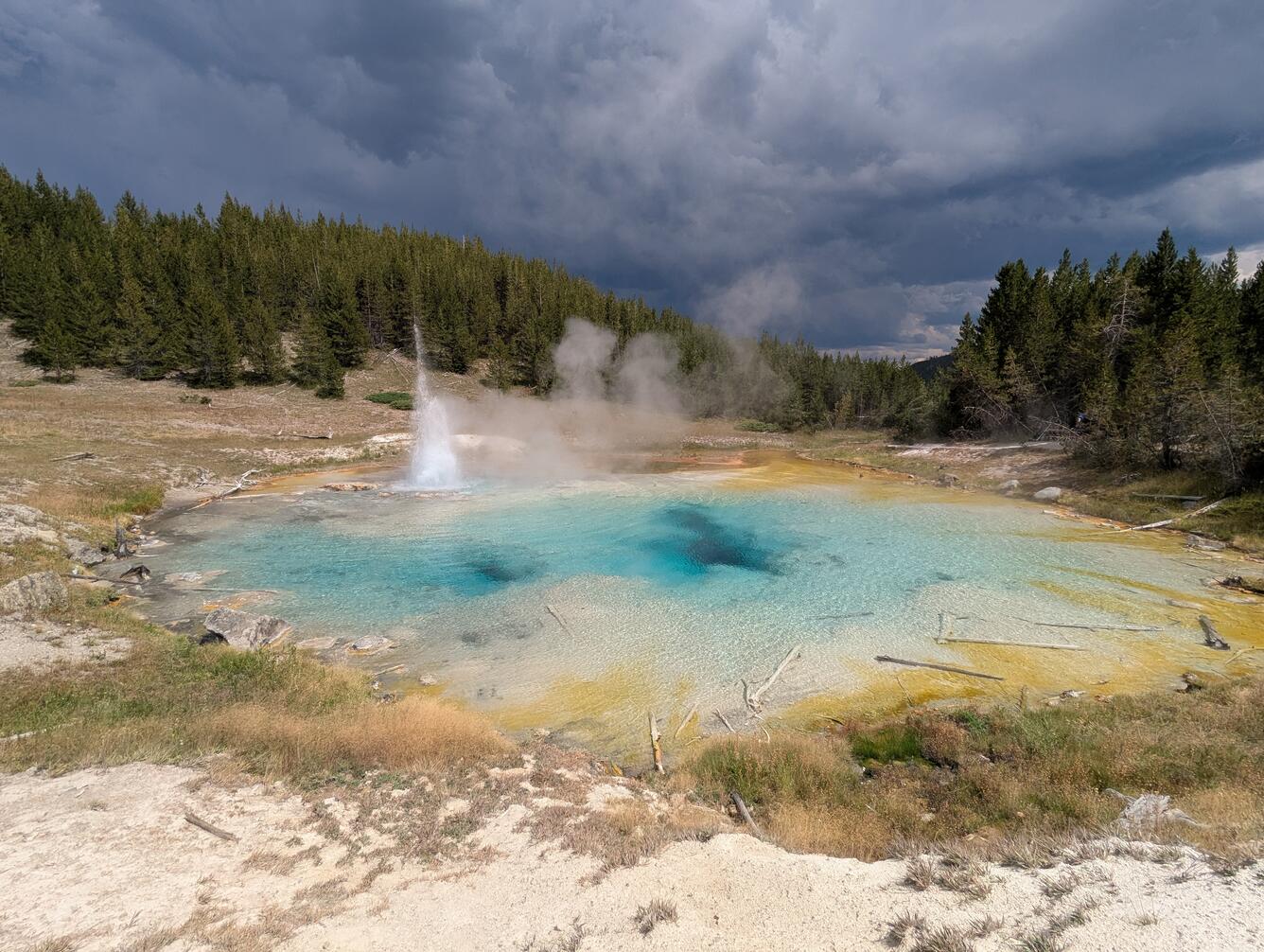
In the far southwest corner of Lower Geyser Basin is Imperial Geyser—a colorful pool that is also a perpetual spouter. The feature seems to have formed in 1927 and for a time was the most spectacular geyser in Yellowstone National Park!
Yellowstone Caldera Chronicles is a weekly column written by scientists and collaborators of the Yellowstone Volcano Observatory. This week's contribution is from Michael Poland, geophysicist with the U.S. Geological Survey and Scientist-in-Charge of the Yellowstone Volcano Observatory.
If you’re interested in a peaceful day hike in Yellowstone National Park to a remarkable pool and geyser, consider checking out Imperial Geyser. The feature is most easily accessed via the Fairy Falls trail, and the hike along that path includes great views of several thermal features, like Grand Prismatic Spring, and Fairy Falls itself, at 200 feet (60 meters) one of the tallest waterfalls in the park.
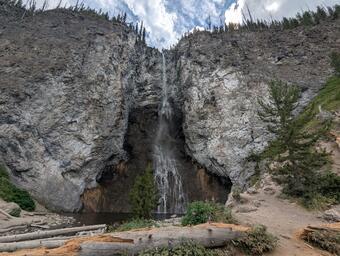
A little over half a mile (1 kilometer) west of Fairy Falls is Imperial Geyser—for a few years, said to be one of the most spectacular geysers in the entire park. The feature lies at the base of Twin Buttes, which is a thermal kame made of glacial material that has been cemented together by silica from circulating hydrothermal fluids.
No geyser was known in this area prior to 1927, although the presence of silica sinter hints at some past thermal activity. A survey of the region in the late 1800s documented a pool that might have been located in the area, and some visitors to the region reported a hot spring at that location but could not offer any clear description of its characteristics. Spray Geyser, which is about 750 feet (225 meters) to the east and adjacent to the runoff channel of Imperial Geyser, was well known in those early days, and a fire trail passed through the area, so it seems unlikely that anyone would have missed any major feature where Imperial Geyser is located today.
The first definitive report of activity at Imperial Geyser was in August 1927, when a stream of hot water was noted by geologists and rangers investigating the area. When they followed the stream to its source, they found a crater containing a hot pool from which a jet of water erupted to about 25 feet (8 meters) every few seconds.
In July 1928, the geysering intensified and could be seen as a tall column of steam from many miles away. Eruptions lasted up to several hours, sending water to almost 100 feet (30 meters), with many hours of quiet between eruptions. The amount of water discharged during single eruption periods could be immense—often about twice the discharge rate as Old Faithful Geyser eruptions. This activity continued until September 1929, when eruptions suddenly ceased. Some boiling was noted thereafter, and mud pots nearby remained agitated, leading geologists to believe that the reservoir for Imperial had become leaky due to high levels of steam pressure that eventually found other ways to vent to the surface.
What to name this new feature? That was decided via a vote of the National Editorial Association, whose members (mostly from newspapers) were visiting Old Faithful in 1929. On July 31 of that year, “Imperial Geyser” was chosen from among 17 candidate names suggested by artist and scientist William Henry Holmes (“Columbia Geyser” tied in the vote but ultimately lost).
For 38 years Imperial Geyser remained mostly dormant, although small splashing and hot-water discharge continued, and the feature developed into a pool over 100 feet (30 meters) across with a blue center and colorful orange-red margins due to bacterial growth. Then, in August 1966, a new vent formed at the edge of the Imperial Geyser pool, sending jets of water tens of feet (many meters) into the air. This perpetual spouter activity continues today, with tens of seconds of activity separated by tens of seconds of dormancy.
The colorful waters of Imperial Geyser’s pool and the presence of silica sinter indicate that the pool is not acidic, but rather neutral to alkaline, similar to nearby Grand Prismatic Spring. But the mudpots on the margin of the pool have an acidic nature. While not unprecedented, the presence of such different chemistries in close proximity is a testament to the complicated plumbing systems that allow steam and water to rise to the surface in Yellowstone’s thermal basins.
Although off the beaten path, Imperial Geyser does not disappoint! And the journey there is quintessentially Yellowstone, with open meadows, forested plateaus, glacial hills, rhyolite cliffs, rivers and streams, a waterfall, colorful hot springs, and splashing geysers.
Acknowledgement: Some of the information from this article was taken from T. Scott Bryan’s The Geysers of Yellowstone, Lee H. Whittlesey’s Yellowstone Place Names, and the Carnegie Institute of Washington report Hot Springs of Yellowstone National Park, by E.T. Allen and Arthur L. Day.