



Fire and ice: were Yellowstone’s past volcanic eruptions and glaciations related?
At least 28 rhyolitic lava flows, domes, and tuffs erupted since the formation of Yellowstone Caldera 631,000 years ago. Yellowstone’s past also includes multiple glacial periods. Are the eruptions and glaciations related?
Yellowstone Caldera Chronicles is a weekly column written by scientists and collaborators of the Yellowstone Volcano Observatory. This week's contribution is from Shaul Hurwitz, research hydrologist with the U.S. Geological Survey.
Yellowstone is a land of fire and ice. Not only does it have a history of different styles of volcanic eruptions, but it has also been covered by glaciers at various times. Is there any connection between glaciation and eruptions (cause and effect)?
To determine whether volcanism and glaciation are correlated in time, accurate (how close a measurement is to the true value) and precise (small errors in measurement, or how close repeated measurements are to each other) age determinations for volcanic eruptions and for glacial periods are required. An age determination can be precise without being accurate, and vice versa.
Using argon dating of large tuff (ash) deposits, it was determined that the Yellowstone Caldera formed 631,300 years ago, with an uncertainty (the precision) of 4,300 years. Following the formation of Yellowstone Caldera, there have been at least 28 intracaldera rhyolite eruptions, which occurred in two episodes: the Upper Basin Member erupted between approximately 580,000 and 250,000 years ago, and the Central Plateau Member erupted from approximately 160,000 years ago to 70,000 years ago. Whereas argon dating of the Central Plateau Member is considered as both accurate and precise (precision of dates for most rhyolite flows is better than 1,000 years), the accuracy of dates for Upper Basin Member rhyolite flows is significantly less (YVO scientists are currently working to improve this using argon dating of rocks from different Upper Basin Member Units).
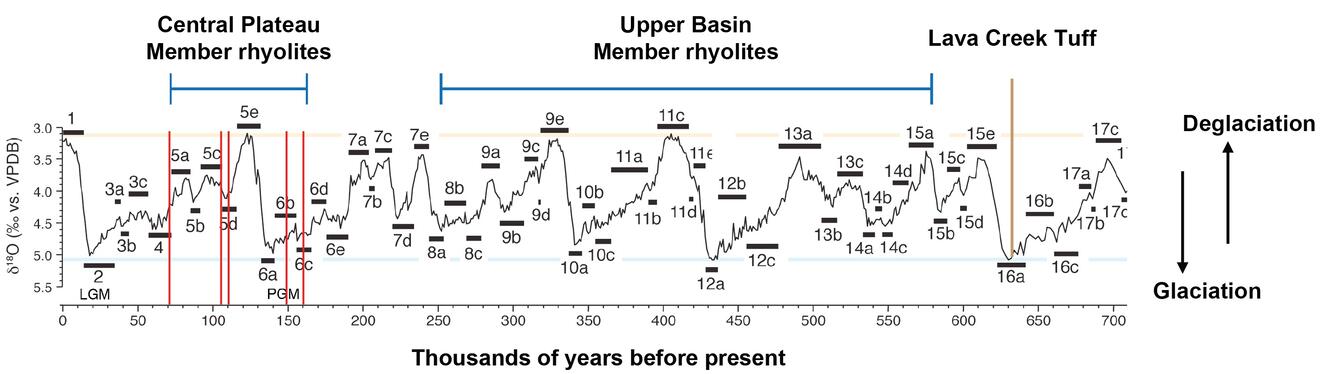
Analysis of deep-sea sediment cores and ancient ice cores has documented alternating periods of ice ages and warmer global temperatures worldwide throughout the Quaternary Period (the past 2.6 million years). Since the middle Quaternary, glacial–interglacial cycles (also known as Milankovitch cycles) have had a frequency of about 100,000 years. The oxygen isotope ratio (which is a measure of the proportion of atoms of oxygen that have different numbers of neutrons in their nucleus) of shells and other hard parts of marine organisms from the deep-sea sediment cores serves as a proxy (an indirect measure) for the average global temperature. This record helped scientists define marine isotope stages that represent alternating periods of Earth’s warm and cool climates and that correlate with the extent of ice sheets, sea-levels, and glacial and interglacial intervals.
Using cosmogenic isotope dating of boulders (glacial erratics) in moraines (piles of rock deposited by retreating glaciers), two glacial periods have been dated In the Yellowstone region. Deposits from the older of these glaciations, known in the Rocky Mountains as the Bull Lake glacial period, were dated to about 150,000–140,000 years ago and correlate with Marine Isotope Stage 6. Deposits from the more recent Pinedale glaciation period, which lasted from 22,000 to about 14,000 years ago, correlate with Marine Isotope Stage 2. There are no known glaciations in Yellowstone prior to Bull Lake, likely because any evidence is buried under thick lava and ash flows.
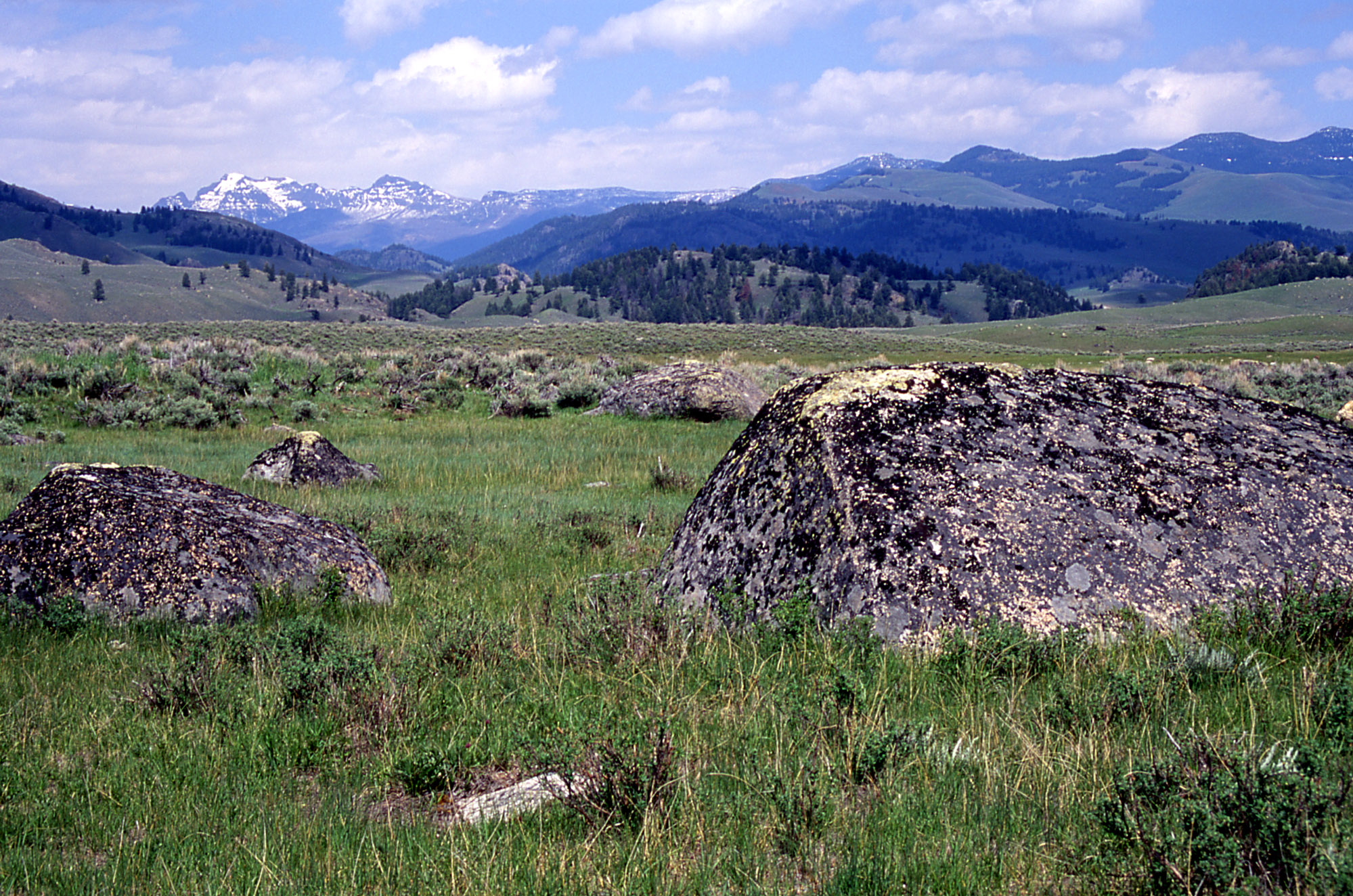
The relatively accurate and precise dates of the Central Plateau Member rhyolite flows and of glacial moraines from the Bull Lake glaciation in Yellowstone suggest that volcanism and glaciation are probably not correlated—the timing is not quite right. However, geologist Robert L. Christiansen suggested that “the West Yellowstone flow, at the north end of the Madison Plateau, is here interpreted as having been emplaced against a body of glacial ice that must have occupied much of the rhyolite plateau farther east when the flow was extruded.” This poses a conundrum, because the West Yellowstone flow was dated to 109,900 ± 2,100 years ago, which is much later than the end of Bull Lake glaciation. This discrepancy might suggest that the West Yellowstone flow could be more complex than currently understood, and that some older flows are present on the margin of the West Yellowstone flow and interacted with ice, or that a local ice sheet was present during the time of the eruption. More geologic field work is needed to resolve this mystery.
There is no correlation between the more recent Pinedale glaciation and volcanic eruptions in Yellowstone, given that no eruptions occurred during that glacial period. However, using radiometric and luminescence dating, it was demonstrated that removal of the ~1 km-thick ice cap from the Yellowstone Plateau about 14,000 years ago was followed by several large hydrothermal explosions at places like Rush Lake, Mary Bay, and Pocket Basin. With the accuracy and precision of the different dating methods, these explosions occurred within about 1,000 years following the final removal of the ice sheet. As the saying goes, however, "correlation does not imply causation"—just because two things are related in time doesn’t mean one causes the other.
There might, however, be a reason that the end of the Pinedale glaciation correlates in time with a number of large hydrothermal explosions. Removal of the ice cap reduced the overburden pressure on the hydrothermal system, and that might have led to extensive groundwater boiling, and therefore increased pressure in the subsurface that caused breaking of the rocks and explosions.
Although deglaciation in Yellowstone does not seem to trigger volcanic eruptions, the same cannot be said elsewhere on Earth. For example, studies have established correlations between the last deglaciation in Iceland (following Marine Isotope Stage 2) and an increased number of volcanic eruptions. The causation in this case might be similar to how deglaciation in Yellowstone could have motivated hydrothermal explosions. Removal of much of the ice load from Iceland could have led to enhanced decompression melting at depth—a common mechanism for the formation of magma.