



Oops, it did it again: Another small hydrothermal explosion at Biscuit Basin
Early on the morning of Saturday, June 13, 2026, a small hydrothermal explosion occurred at Biscuit Basin in Yellowstone National Park. Although smaller than the explosion that occurred in the same area in 2024, it emphasizes the dynamic and hazardous nature of hydrothermal activity in the region.
Yellowstone Caldera Chronicles is a weekly column written by scientists and collaborators of the Yellowstone Volcano Observatory. This week's contribution is from Jefferson Hungerford, Park Geologist, and Kiernan Folz-Donahue, Brandon Duktig, Liam Rogers, and Margery Price, all with the Yellowstone National Park Geology Program, as well as Michael Poland, geophysicist with the U.S. Geological Survey and Scientist-in-Charge of the Yellowstone Volcano Observatory, and Jamie Farrell, associate research professor with the University of Utah Seismograph Stations and Chief Seismologist of the Yellowstone Volcano Observatory.
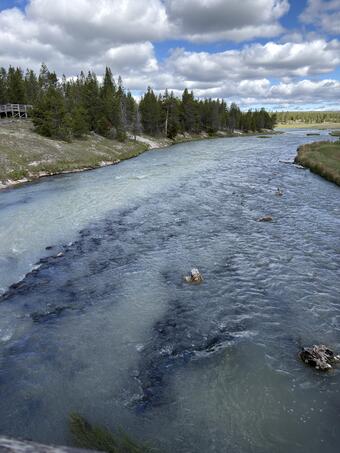
Just after 5:09 a.m. MDT on Saturday, June 13, 2026, monitoring equipment in Biscuit Basin registered anomalous activity, including seismic energy and a low-frequency acoustic signal, called infrasound, that was coming from the general direction of Black Diamond Pool, site of a well-observed hydrothermal explosion on July 23, 2024. As the sun rose higher into the sky, park interpretive staff noticed something odd: the Firehole River from Biscuit Basin downstream to Midway Geyser Basin, a distance of about 6 km (3.7 mi), was filled with a light‑grey, milky plume. Two new runoff channels from Biscuit Basin into the river were also visible from the road throughout the day.
Did Black Diamond Pool explode again? The Yellowstone National Park Geology team reviewed data from the temperature sensor that records eruptions from the pool, but those data showed only a very small heat blip, after which the temperature slowly dropped to that of the background air—nothing resembling the rapid drop that has accompanied past eruptions of Black Diamond Pool, and a sign that the pool was not the source of the morning’s anomalous event.
Fortunately, the Yellowstone Volcano Observatory installed a camera to monitor Black Diamond Pool in May 2025, and it has caught numerous eruptions of varying sizes. The camera happened to be looking in the right direction to capture the activity on the morning of June 13.
At 5:09:50 a.m. that morning, the camera recorded a dark-colored steam plume jetting out of the ground to the north of Black Diamond Pool—a time that coincides with the seismic and infrasound signals.
Yellowstone National Park geologists were on the scene the following day to assess the new activity. A few tens of meters (yards) north of Black Diamond Pool they found clear evidence that large volumes of hydrothermal water had surged into the Firehole River from three sets of newly formed vents. These vents represent pathways where water at or even slightly above boiling temperatures beneath the ground suddenly found a pathway to the surface and flashed to steam, driving a hydrothermal explosion.
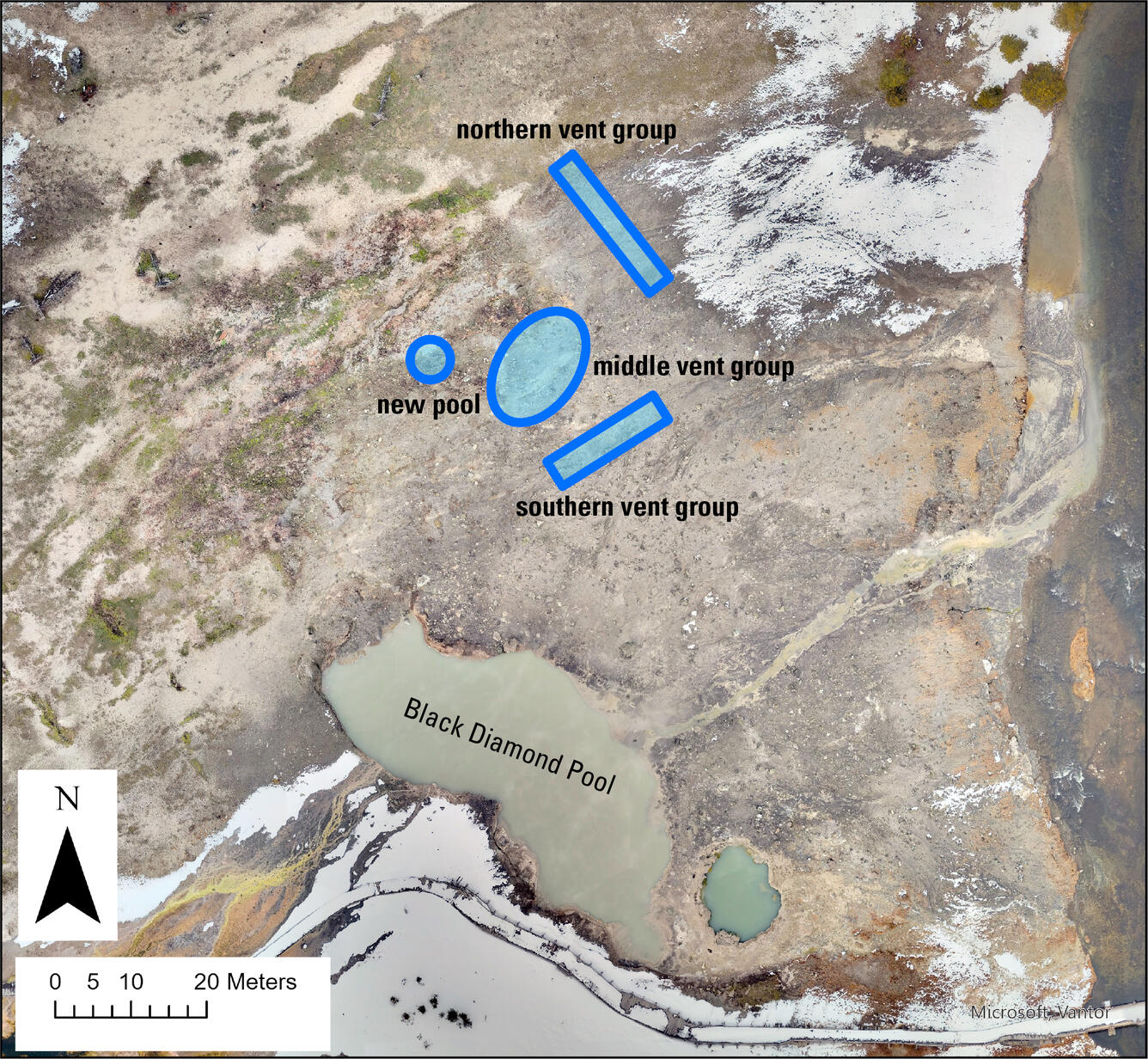
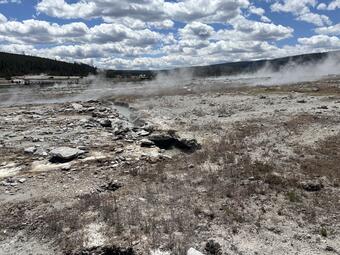
At the time of their visit, the geologists observed that the only vent still sending water to the river was the northern-most, farthest from Black Diamond Pool, including a north-northwest-trending crack that was 18.5 meters (61 feet) long and up to 1.5 meters (5 feet) wide in places. The water was 90 °C (194 °F), which is close to the boiling temperature at that elevation—93 °C (200 °F). The crack was surrounded by numerous rocks that had been ejected during the explosion, but none went particularly far—at most a few meters (yards)—so the explosive energy was relatively low, especially compared to that of July 23, 2024.
The middle vent group, consisting of five small vents, produced short‑lived water flow during the initial event. By the day after they formed, they were passively steaming but still hot, with temperatures around 85 °C (185 °F) indicating shallow subsurface boiling. More rocks were scattered about this area as well.
Farther south, and closest to Black Diamond Pool, another linear vent trending to the northeast and about 15 meters (49 feet) in length had sent significant water and sediment into the river. Although the vent likely stopped flowing within a few hours after the explosion, 89 °C (192 °F) water was still present in the fractured rubble.
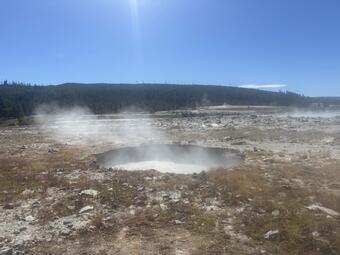
When the Yellowstone Geology Program team returned two days later, they found something remarkable. Between Sunday evening and Tuesday morning, a new pool of vigorously boiling, gray, silty water about 6.5 × 5.3 meters (21 × 17 feet) in size had formed near the middle vent group. Ground that the team had walked on just two days earlier had developed into an actively boiling pool! Notable thumping, caused by steam bubbles forming and then collapsing within the pool, startled the team. The pool was not surrounded by explosion debris, indicating that it formed via collapse. On Thursday, June 18, camera observations showed that the pool experienced intermittent episodes of spouting to a height of perhaps about 6–9 meters (20–30 feet), and geologists noted that it was roiling vigorously when not showing this geyser-like behavior.
Fortunately, no one was impacted by the June 13 explosion—Biscuit Basin has been closed since the 2024 event. But the recent explosion emphasizes the unstable and hazardous nature of some of Yellowstone’s thermal areas. Biscuit Basin, and especially the area around Black Diamond Pool, has been a site of numerous hydrothermal explosions for more than a century.
Yellowstone Volcano Observatory scientists installed temporary seismic monitoring stations in the basin to record signals related to the evolution of these newly formed vents. In addition, they will spend the next few weeks pouring over data to look for possible precursors that might have warned that an explosion was imminent. This event occurred about 100 meters (328 feet) from the new Biscuit Basin monitoring station, installed in summer 2025. If there were any seismic or infrasound precursors, there is a good chance they were recorded—no hydrothermal explosion has ever occurred this close to a monitoring station! The June 13, 2026, explosion thus offers an unprecedented opportunity to better understand this critical hazard in Yellowstone National Park and perhaps learn more about their potential warning signs.