



What’s that smell? Tracking Yellowstone’s hydrocarbon history
Hydrocarbons in Yellowstone? Yes indeed, there are oil seeps in the northeastern part of the park! These seeps are a consequence of the region’s long and complex geological history.
Yellowstone Caldera Chronicles is a weekly column written by scientists and collaborators of the Yellowstone Volcano Observatory. This week’s contribution is from Phillip Kondracki, graduate student, and Lauren Harrison, assistant professor, in the Department of Geosciences at Colorado State University.
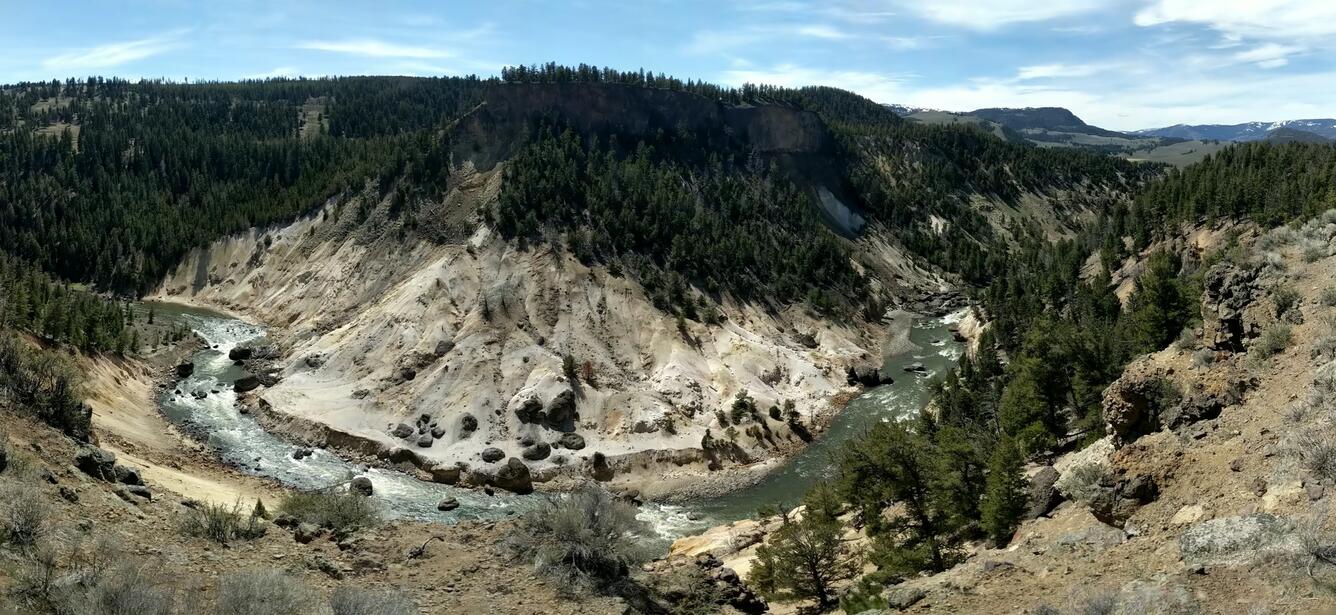
The deep narrow canyon, with the rushing green river at its bottom and the sheer towering cliffs on its further side, forms an unusual setting for this little group of springs….all the springs and visible steam vents are confined to the lower parts of the area. Especially along the lower third of the slope, sulphur lining cracks and vents may be seen in many places. Breaking into fumaroles with the pick, one finds well-crystallized masses of it, mixed with bitumen of tarry appearance and odor. On the bench above the river’s edge, sinuous trails, resembling the marks of burrowing moles, follow the lines of cracks where the same products have been deposited. No evidence regarding the origin of this tarry substance in the fumaroles is at hand. A unique occurrence in Yellowstone Park, it seems to be best explained as a distillate from organic matter buried in sediments.” – Allan and Day (1935) describing Calcite Spring hydrothermal deposits
More than just thermal water discharges from Yellowstone’s hydrothermal system—there are gasses like water (H2O), carbon dioxide (CO2), and hydrogen sulfide (H2S), minerals that precipitate from thermal waters as they cool (sinter, travertine, sulfur, orpiment, and many more), and, in some rare places, hydrocarbons. In other words, oil. The excerpt from geoscientists Eugene Allan and Arthur Day above describes Calcite Springs in the northeastern part of Yellowstone National Park, where these scientists found sulfur and bituminous hydrocarbons in the deposits around the spring. But where did this material come from and why is it only rarely observed in Yellowstone thermal waters?
Hydrocarbons are chains of carbon and hydrogen atoms bonded to one another. They form the building blocks of petroleum, natural gas, oil, and coal, and they occur naturally from the thermal maturation of buried organic matter. Hydrocarbon seeps are common in the deep seafloor where the material is consumed by specialized organisms for energy (methanogenesis). Hydrocarbon seeps occur on land as well—a famous example is the La Brea tar pits in Los Angeles, California. In that location, oil discharged at the surface created asphaltic tar pits that trapped many plants and animals (including mammoths!) that scientists now study as an important fossil record of that time. Terrestrial seeps, including Calcite Springs and the La Brea tar pits, are typically found where faults or fractures form a pathway for hydrocarbons to ascend from a subsurface reservoir to the surface. Hydrocarbon seeps can occur anywhere organic-bearing geologic units are buried.
The thermal maturation of buried organic matter into hydrocarbons depends on temperature and proceeds through three stages: diagenesis, catagenesis, and metagenesis. Diagenesis is the first and lowest-temperature and -pressure stage. As sediments with organic material are shallowly buried they are compacted, water in the pore spaces between particles is expelled, and microbial action decomposes organic matter into methane and other hydrocarbons. At this stage, organic-rich sediments (usually from large land plants) can form peat or lignite.
With continued burial of the sediments to greater depths, the pressure and temperature will increase. In a basin without volcanic activity to add extra heat, catagenesis will be achieved once the sediments are buried in several kilometers of overburden sediment and they reach temperatures of 50 to 150°C (122 to 302°F). This is the stage at which liquid petroleum, methane, and various types of coal can form. Hydrocarbons formed during catagenesis are the materials that power most of the energy needs of humans.
The last stage, metagenesis, occurs where sediments are buried so deeply that the temperature and pressures climb high enough that hydrocarbons are “cooked off”, leaving only methane and carbon residue or high-grade coal called anthracite (the most energy-dense coal possible, and one that burns with little smoke or soot). With even higher pressures and temperatures, hydrocarbons are transformed into graphite.
Just east of Yellowstone National Park is the Bighorn Basin, where there are many productive oil and gas wells. These hydrocarbons are thought to be sourced from Permian (the geologic period 299 to 252 million years ago) marine shales and other units (check out the Wyoming State Geological Survey’s Oil and Gas interactive map at https://portal.wsgs.wyo.gov/arcgis/apps/webappviewer/index.html?id=d42f571b87fa4234b03d66ca7ae311a4). Permian organic-bearing marine shales likely exist in the subsurface underneath northeastern Yellowstone National Park as well and may be a source of the hydrocarbons that discharge at Calcite Springs. There are probably also some additions of hydrocarbons from buried Eocene (the geological epoch 56 to 33 million years ago) lake sediments to the hydrocarbons discharging at Calcite Springs.
You may wonder if there are hydrocarbon seeps in other hydrothermal areas around Yellowstone National Park. Although some recent studies have found trace amounts of hydrocarbons in Yellowstone Lake, Lower Geyser Basin, and Norris Geyser Basin, there are no known surface discharges of oil like at Calcite Springs. This makes sense, as other hydrothermal areas within the Park are located within the caldera, where an active magmatic system is sustained, the heat flux is elevated, and volcanic activity has taken place for roughly the last 2.1 million years. All this heat and magmatism would likely have pushed any buried organic material in the subsurface into the third stage of hydrocarbon maturation, metagenesis, where it is transformed into graphite or was broken down into CO2 and CH4 that then discharged at the surface as volcanic degassing. The carbon cycle in action!
Sources:
Allen, E.T., Day, A.L. (1935) The Hot Springs of the Yellowstone National Park: Carnegie Institute of Washington Publication 466, 525 p.
Clifton, C.G.,Walters, C.C., Simoneit, B.R.T. (1990) Hydrothermal petroleums from the Yellowstone National Park, Wyoming, U.S.A. Applied Geochemistry 5, p. 169–191. https://doi.org/10.1016/0883-2927(90)90047-9