



How many eruptions has Yellowstone had?
When trying to understand the behavior of a volcanic system like Yellowstone and the likelihood it will have another eruption, it is important to determine how many eruptions occurred in the past and when they occurred. Some of Yellowstone’s past eruptions may be hiding, which makes this question difficult to answer.
Yellowstone Caldera Chronicles is a weekly column written by scientists and collaborators of the Yellowstone Volcano Observatory. This week's contribution is from Mark Stelten and Nicole Thomas, geologists with the U.S. Geological Survey. Mark Stelten is the deputy Scientist-in-Charge of the Yellowstone Volcano Observatory.
When geologists study volcanic hazards or try to anticipate what a volcano may do in the future, one of their primary tools is to examine the volcano’s past behavior. By studying the past, geologists can learn about the types of eruptions a volcano tends to produce, where it tends to erupt from, and how frequently it erupts. Geologists piece together this history by combining boots-on-the-ground geologic mapping with advanced analytical techniques such as geochemistry, geochronology, and paleomagnetics to determine the number of unique eruptions that have occurred and their characteristics.
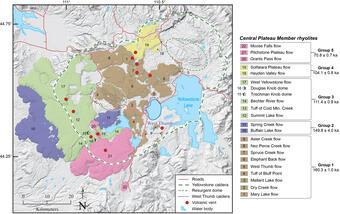
So, how many times has Yellowstone erupted in the past? This seemingly simple question can be frustratingly difficult to answer. We know that Yellowstone has produced three large, caldera-forming eruptions in the past 2.1 million years, with the most recent occurring 631,000 years ago and forming Yellowstone caldera. We also know that Yellowstone erupted numerous rhyolite lava flows and domes within the calderas produced by these large eruptions, but the number of rhyolite lava flows and domes remains uncertain. For example, based on current geologic mapping and geochronology, geologists estimate that "at least 28 eruptions" have occurred within Yellowstone caldera since its formation 631,000 years ago. This number is treated as a minimum because geologists know there may be more eruptions that have yet to be recognized.
One difficulty geologists face is that evidence of older eruptions is often partially or fully concealed by deposits from more recent eruptions, leaving only fragments of clues on the surface about these past events. This incomplete knowledge of Yellowstone’s eruptive history leads to uncertainty in key parameters, such as the frequency of eruptions at Yellowstone and the volume of magma that erupted in the past.
Improvements in analytical technologies, like argon dating, are helping to refine our understanding of Yellowstone’s geological history. For example, the lava flow exposed in Hayden Valley was originally thought to be associated with an eruption that occurred 102,000 years ago, but newer data suggest that this lava may be older (closer to 160,000 years old) and could represent a newly recognized lava flow. USGS scientists sampled this lava flow in 2025 to determine its age using argon dating; hopefully, results will be available in a few months.
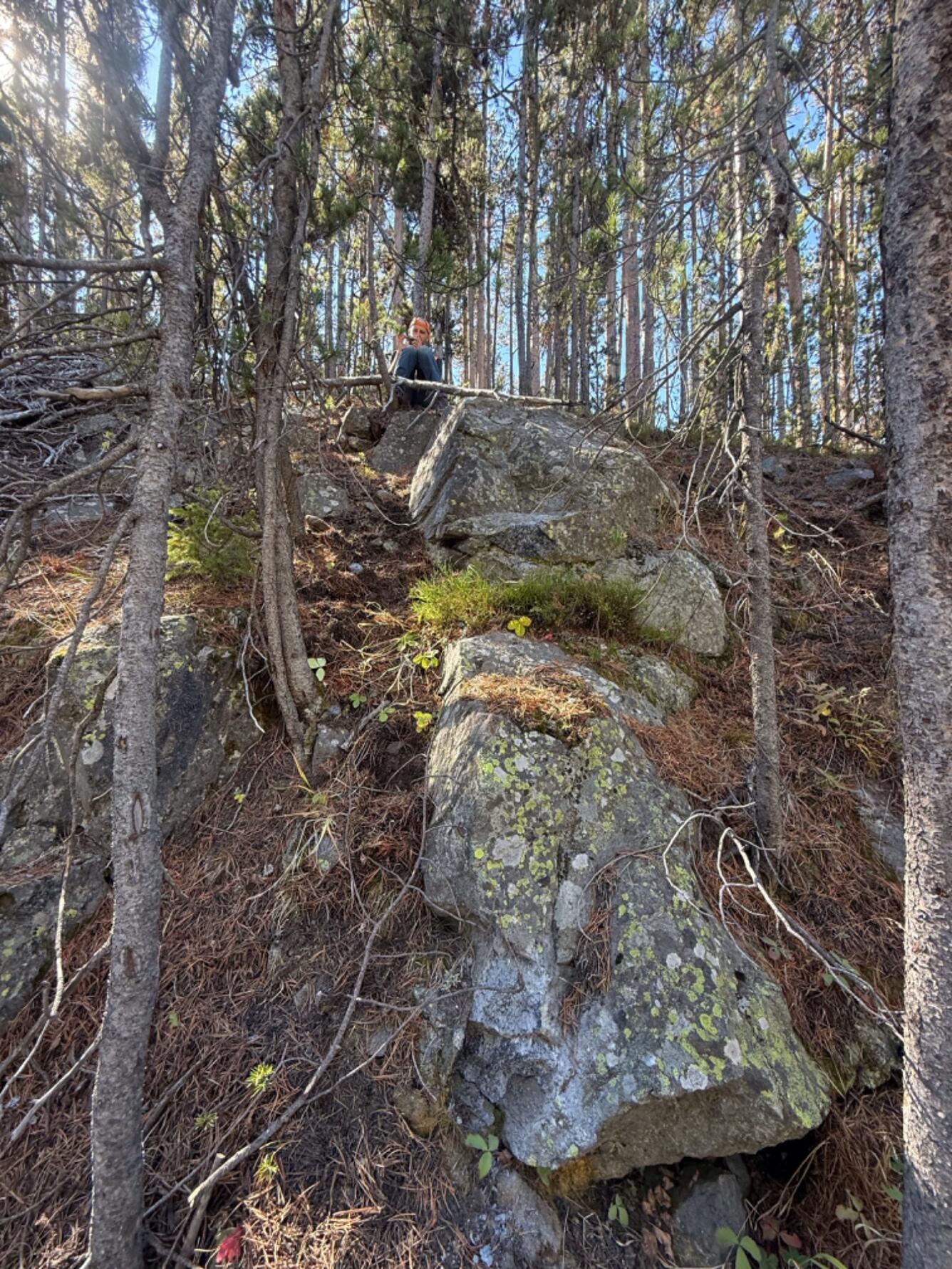
Similarly, during field work in 2025 USGS scientists who were planning to sample the Nez Perce Creek flow along the Gibbon River identified what may be a small portion of an older lava flow peeking out beneath. This potential new eruption will be analyzed using geochemistry and argon dating to determine its eruption age and composition, which will in turn determine if this a newly identified eruption or part of an already identified eruption.
Researchers from Montana State University have also used geologic mapping and argon dating to identify potential new eruptions that occurred just before Yellowstone caldera formed. These deposits are located just northwest of the caldera, in the vicinity of Madison Junction.
These new discoveries help geologists construct a more robust eruptive history for the Yellowstone volcanic system and bring us closer to being able to answer the question of how many times it has erupted in the past. Although we may never know the full history of Yellowstone’s eruptions, each new piece of the puzzle helps to build a clearer picture of how Yellowstone and its world-famous magmatic system behave. Perhaps next year we will be saying that "at least 30" eruptions have occurred within Yellowstone caldera since its formation 631,000 years ago.