



Yellowstone, Redstone, Greenstone, Blueschist—what makes rocks so colorful?
Rocks have a variety of colors that result from the minerals and chemical elements they contain and from their internal structure. Some names of rocks and stones reflect their color. That’s why Yellowstone is called Yellowstone!
Yellowstone Caldera Chronicles is a weekly column written by scientists and collaborators of the Yellowstone Volcano Observatory. This week's contribution is from Shaul Hurwitz, research hydrologist with the U.S. Geological Survey.
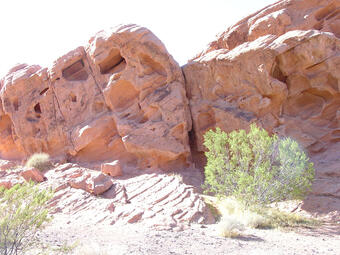
Yellowstone National Park was named after the Yellowstone River, the major river running through the park. The river got its name from the indigenous Minnetaree (Hidatsa), who were referring to yellow sandstones along the banks of the Yellowstone River in eastern Montana, several hundred miles downstream and northeast of the park. They called it Mi tse a-da-zi which literally translates as “Rock Yellow River.” In 1797, explorer David Thompson adapted the French translation of the Minnetaree name into English—“Yellow stone”—and subsequent use formalized the name as “Yellowstone”. This is contrary to popular belief, that Yellowstone was named for the yellow altered rocks in the Grand Canyon of Yellowstone.
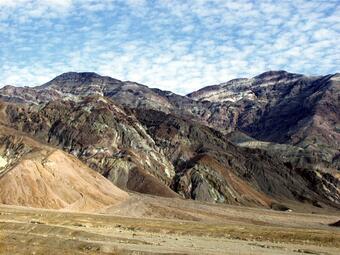
How do rocks like the yellow sandstones along the banks of the Yellowstone River or those in the Grand Canyon of Yellowstone get their color? Generally, the color comes from the specific minerals and chemical elements the rocks contain. When sunlight hits a rock, the atoms and trace metals in some of its minerals absorb certain wavelengths of the light and reflect others. These reflected wavelengths determine the color that you see. The visible spectrum is the small segment of the electromagnetic spectrum that the human eye can see, ranging from roughly 380 to 750 nanometers in wavelength. Some colors such as magenta, purple, or pink result from a mixture of multiple wavelengths.
Mineral color is determined by the internal structure, impurities in the structure, and the specific chemical elements in their structure. These properties affect the way light is reflected to the viewer. For example, pure diamond is a mineral that consists only of carbon in its structure and formed at high pressure deep in the Earth. However, low concentrations of nitrogen, sulfur, and boron that interact with the carbon atoms during the diamond's creation will give the diamonds shades of yellow, green and blue.
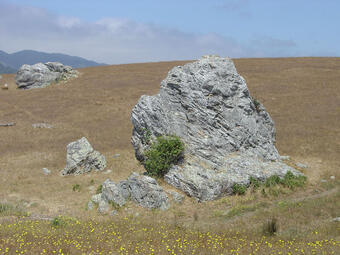
Let’s examine a few of the rocks with colors in their name and understand the origin of the names. Redstone (or Red Sandstone) predominantly refers to red sedimentary rocks that contain finely disseminated iron oxides, such as the mineral hematite, which gives a distinct rusty-red color. For example, many of the sandstones in the Grand Canyon, in Arizona, or Canyonlands National Park, in Utah, are reddish in color. Greenstone is a metamorphic rock derived primarily from rocks like basalt or gabbro and that takes a dull green color from minerals such as chlorite, actinolite, and epidote. Greenschist has the same green minerals as greenstone, but it has a layered texture (schist), whereas greenstone is a non-layered metamorphic rock. Blueschist is a metamorphic rock that is formed under high pressures (corresponding to depths of 15 to 30 kilometers [9.3 to 18.6 miles]) and relatively low temperatures (200 to 500 °C [392 to 932 °F]). Blueschist is characterized by a blue tint from minerals like glaucophane.
What makes the sandstones in the Yellowstone River appear yellow? Sandstone typically consists of minerals like quartz and feldspar, but small amounts of iron oxide give sandstone a characteristic color. The variations in iron oxide type and content affect the tone of the yellow hue, with higher concentrations resulting in richer, golden tones. Some iron oxides, when hydrated (combined with hydrogen and oxygen atoms), can form bright yellow colors such as yellow ochre that comes from the mineral limonite.
The next time you're on hike, a horse ride, or a drive, pay attention to the color of the rocks surrounding you. These colors provide information on the minerals that form the rocks and on the conditions in which they were formed. They are also usually very pretty!
Additional reading and viewing