Yellowstone National Park is rightly famous for spectacular geysers. It also has hot springs that create thumps you can hear and feel!
Yellowstone Caldera Chronicles is a weekly column written by scientists and collaborators of the Yellowstone Volcano Observatory. This week's contribution is from Michael Poland, geophysicist with the U.S. Geological Survey and Scientist-in-Charge of the Yellowstone Volcano Observatory.
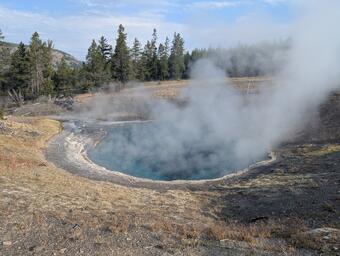
Black Sand Pool, in Yellowstone National Park’s Upper Geyser Basin (near Old Faithful), is a hidden gem. Although it is not far from a road and is very accessible via an easy trail, few people visit the hot spring. Those that make the short walk and stay a few minutes are rewarded with a special treat—every several minutes the pool starts to thump, and it is strong enough to feel and hear! It’s as if a giant in an underground cavern is striking the cavern’s ceiling with a hammer.
Another famous “thumper” is Doublet Pool on Geyser Hill, also in Upper Geyser Basin. The thumping at Doublet Pool varies over time, lasting up to a few minutes with intervening quiet times that have varied between 13 and 35 minutes in recent years. The thumping is so strong that you can see the water in the spring “jump.”
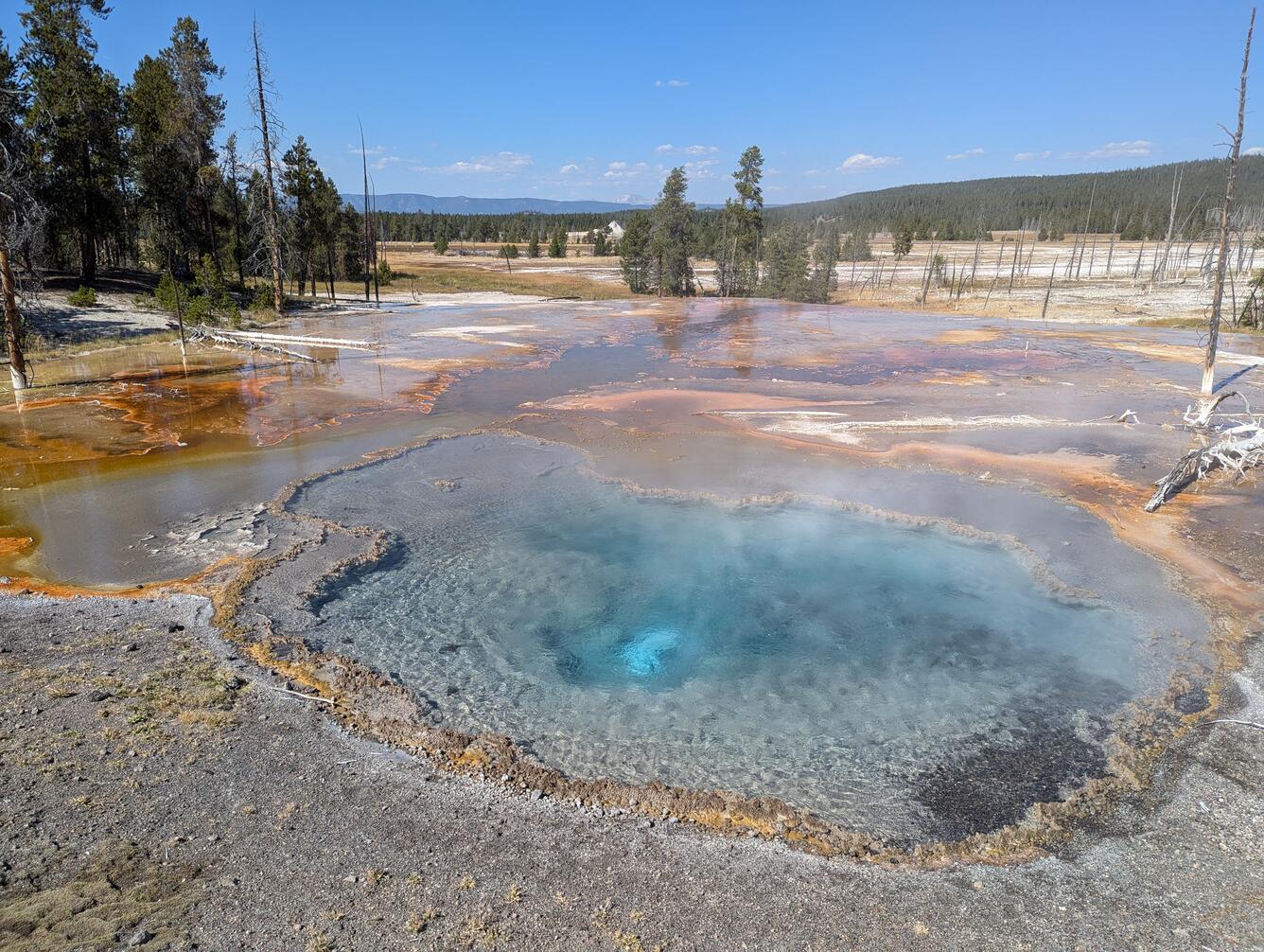
One of best places in Yellowstone National Park to see this process in action is Firehole Spring, which is along Firehole Lake Drive in Lower Geyser Basin. This small one-way side road off the main highway is often closed due to bear management and also poor road conditions (the road lies on very hot ground and so the asphalt tends to melt), but when it is open, Firehole Spring is along the north side of the road just before Great Fountain Geyser. The spring’s water is very clear, providing a view of bubbles that rise from the vent at the bottom of the pool. The bubbles often collapse as they rise, creating an audible “thump” as they implode.
Many other hot springs in Yellowstone also thump—for example, pools in Norris Geyser Basin. But what causes this activity?

The collapse of the bubbles is due to the variable temperature and pressure conditions within the hot springs. As bubbles rise within a thermal pool, their volumes increase and internal pressures decrease. At the same time, the cooler temperatures near the tops of the pools cause the steam in the bubbles to condense back into liquid water, and this, combined with the decreasing internal pressure, causes the bubbles to implode. If the bubbles are large enough, the thump can be felt. The components for thumping are not that common, which explains why only a few hot springs in Yellowstone demonstrate that behavior.
Scientists investigated the thumping at Doublet Pool by deploying seismometers around the area to record how the thumping changes with time. They found a number of interesting correlations. For example, when strong winds blew, the time between thumping was longer than on calm days. This is because the wind cooled the pool by removing heat from the surface. There were also changes that corresponded to activity at nearby features. In September 2018, Ear Spring, a short distance from Double Pool, erupted for the first time in decades. At that time, the interval between thumping periods at Doublet Pool was only about 13 minutes—a very short time period that may have been due to an overall increase in thermal input to Geyser Hill.
That the rate of thumping seems to change due to heat input indicates that monitoring the thumping interval could be a useful way to track hydrothermal activity in a region. For instance, if interval between thumping at Doublet Pool suddenly starts to decrease, it might be a sign of deeper variations in heat input that could impact other thermal features in the region, perhaps even leading to the formation of new thermal features as occurred in 2023.
If you have a chance to visit Yellowstone National Park, be sure to check out one of the thumping springs—Doublet Pool, Black Sand Pool, and Firehole Spring are easily accessible. You can literally hear and feel the changes that are happening in one of the most spectacular hydrothermal systems on Earth!