



Alabama Cooperative Fish and Wildlife Research Unit
The Alabama Cooperative Fish and Wildlife Research Unit, est.1936, is a partnership among Alabama Department of Conservation and Natural Resources, Auburn University, the U.S. Geological Survey, the U.S. Fish and Wildlife Service, and the Wildlife Management Institute.
The Alabama Cooperative Wildlife Research Unit was established on the Auburn University campus in 1936. Among the first ten Units, it was established to conduct wildlife research and promote the education of wildlife professionals for the southeastern region, Alabama, Georgia, northern Florida and eastern Mississippi. The Alabama Cooperative Fisheries Unit was established at Auburn in 1966 with a similar role. The Units were combined in 1984 to form the Alabama Cooperative Fish and Wildlife Research Unit.
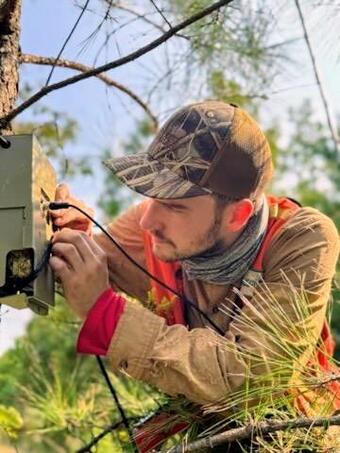
The Alabama Unit has identified four areas in which to concentrate its research efforts: 1) determining the effects of forest management practices on wildlife populations, 2) investigating the ecology and management of riverine systems, 3) investigating the status, life history, habitat requirements, and population dynamics of species of conservation concern, and 4) investigating the ecology and management of fish and wildlife on landscape scales. The Alabama Cooperative Fish and Wildlife Research Unit staff teach graduate level course in applied fisheries and wildlife science. Coursework offered by unit scientists focus on quantitative ecology and management science.
Detection of 7 Faxonius crayfishes and associated physicochemical factors in Northeast Oklahoma Detection of 7 Faxonius crayfishes and associated physicochemical factors in Northeast Oklahoma
Presence/Absence of Buffalofishes at select sites in the lower Red River catchment of Texas, Oklahoma, and Arkansas, 2021-2023 Presence/Absence of Buffalofishes at select sites in the lower Red River catchment of Texas, Oklahoma, and Arkansas, 2021-2023
Catch-and-release delayed hooking mortality estimates for riverine fishes, a meta-analysis and review dataset Catch-and-release delayed hooking mortality estimates for riverine fishes, a meta-analysis and review dataset
Multi-source geospatial dataset supporting random forest land cover classification in Alabama Wildlife Management Areas from 2008 to 2024 Multi-source geospatial dataset supporting random forest land cover classification in Alabama Wildlife Management Areas from 2008 to 2024
Occupancy surveys near Marbled Murrelet (Brachyramphus marmoratus) nest sites and random locations between 2018 and 2022 along the central Oregon coast, USA Occupancy surveys near Marbled Murrelet (Brachyramphus marmoratus) nest sites and random locations between 2018 and 2022 along the central Oregon coast, USA
Movement and tag evaluation of two prairie fishes in Oklahoma, USA, October-June (2018-2020) Movement and tag evaluation of two prairie fishes in Oklahoma, USA, October-June (2018-2020)
Prioritization of areas for open pine ecosystem restoration in the Southeastern United States: All Species Prioritization of areas for open pine ecosystem restoration in the Southeastern United States: All Species
Survey protocols drive heterogeneity in occupancy estimates that cannot be standardized using post hoc analyses Survey protocols drive heterogeneity in occupancy estimates that cannot be standardized using post hoc analyses
Spatial behavior of socially isolated wild pigs (Sus scrofa) following sounder removal via trapping Spatial behavior of socially isolated wild pigs (Sus scrofa) following sounder removal via trapping
Spatially concentrating logging could mitigate climate-magnified fragmentation risks to a globally endangered bird Spatially concentrating logging could mitigate climate-magnified fragmentation risks to a globally endangered bird
Comparing surgery time and short-term incision healing for Largemouth Bass using smooth- and barbed-absorbable sutures Comparing surgery time and short-term incision healing for Largemouth Bass using smooth- and barbed-absorbable sutures
Overwinter and prespawning movements by a vulnerable freshwater pelagophilic minnow Overwinter and prespawning movements by a vulnerable freshwater pelagophilic minnow
Thinking beyond the closure assumption: Designing surveys for estimating biological truth with occupancy models Thinking beyond the closure assumption: Designing surveys for estimating biological truth with occupancy models
Designing count-based studies in a world of hierarchical models Designing count-based studies in a world of hierarchical models
Passive acoustic monitoring and convolutional neural networks facilitate high-resolution and broadscale monitoring of a threatened species Passive acoustic monitoring and convolutional neural networks facilitate high-resolution and broadscale monitoring of a threatened species
Code for Meta-analysis and review of catch-and-release fish mortality estimates Code for Meta-analysis and review of catch-and-release fish mortality estimates
LandCurate Alabama Shiny App LandCurate Alabama Shiny App
Playback and recording device base code Playback and recording device base code
Code for A Landsat based alternative for adaptive habitat management on protected lands Code for A Landsat based alternative for adaptive habitat management on protected lands
Code for manuscript: Post hoc statistical analyses cannot standardize occupancy estimates across variable survey protocols Code for manuscript: Post hoc statistical analyses cannot standardize occupancy estimates across variable survey protocols
Analysis of occupancy surveys near Marbled Murrelet (Brachyramphus marmoratus) nest sites and random locations between 2018 and 2022 along the central Oregon coast, USA Analysis of occupancy surveys near Marbled Murrelet (Brachyramphus marmoratus) nest sites and random locations between 2018 and 2022 along the central Oregon coast, USA
The Alabama Cooperative Fish and Wildlife Research Unit, est.1936, is a partnership among Alabama Department of Conservation and Natural Resources, Auburn University, the U.S. Geological Survey, the U.S. Fish and Wildlife Service, and the Wildlife Management Institute.
The Alabama Cooperative Wildlife Research Unit was established on the Auburn University campus in 1936. Among the first ten Units, it was established to conduct wildlife research and promote the education of wildlife professionals for the southeastern region, Alabama, Georgia, northern Florida and eastern Mississippi. The Alabama Cooperative Fisheries Unit was established at Auburn in 1966 with a similar role. The Units were combined in 1984 to form the Alabama Cooperative Fish and Wildlife Research Unit.
The Alabama Unit has identified four areas in which to concentrate its research efforts: 1) determining the effects of forest management practices on wildlife populations, 2) investigating the ecology and management of riverine systems, 3) investigating the status, life history, habitat requirements, and population dynamics of species of conservation concern, and 4) investigating the ecology and management of fish and wildlife on landscape scales. The Alabama Cooperative Fish and Wildlife Research Unit staff teach graduate level course in applied fisheries and wildlife science. Coursework offered by unit scientists focus on quantitative ecology and management science.