Forams in Flux: Study Reveals Sharp Decline in Two Key Gulf Plankton Species
A new USGS study documents an unprecedented decline in two planktic foraminifera species from 2017-2020 in the northern Gulf.
In the world’s oceans, tiny single-celled organisms have been recording big clues about past ocean conditions going back millions of years.
Foraminifera—or “forams” —are tiny organisms that build complex shells made of calcium carbonate. Most forams are marine, with some species living in seafloor sediments (benthic forams) and others floating in the water column as part of the plankton (planktic forams).
Marine forams are sensitive to shifts in ocean temperature, salinity, and chemistry. When ocean conditions change, certain species increase or decrease in abundance, depending on the conditions they thrive in. Their shells also record environmental conditions. For example, the ratio of magnesium to calcium within foram shells is directly related to ocean temperature. By studying how the relative abundances of species vary and analyzing the geochemistry of their shells, scientists use forams to reconstruct past ocean conditions.
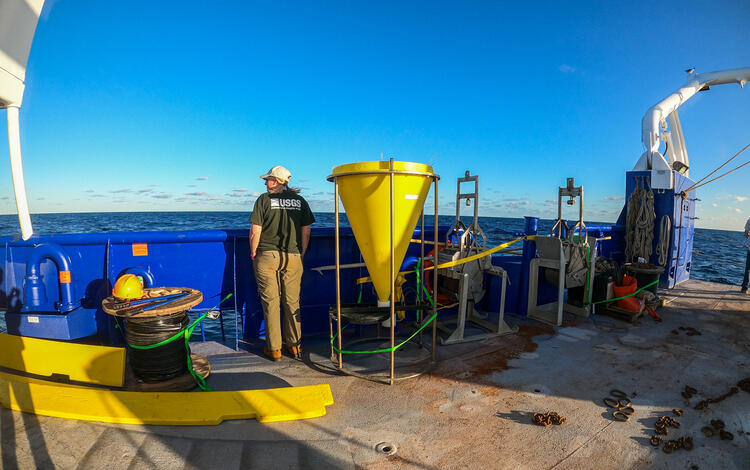
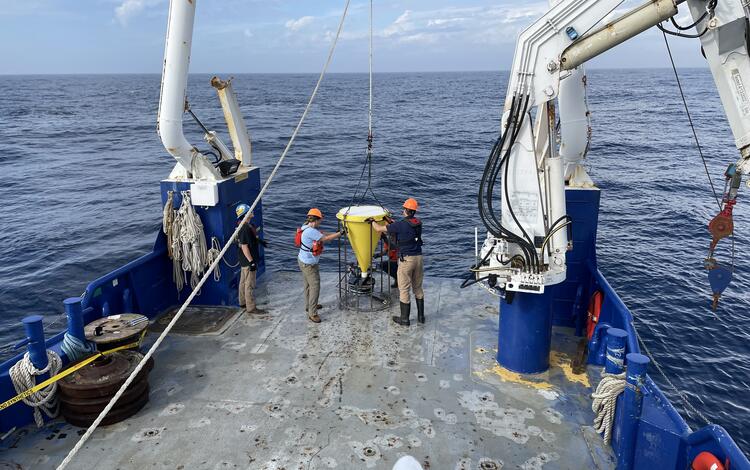
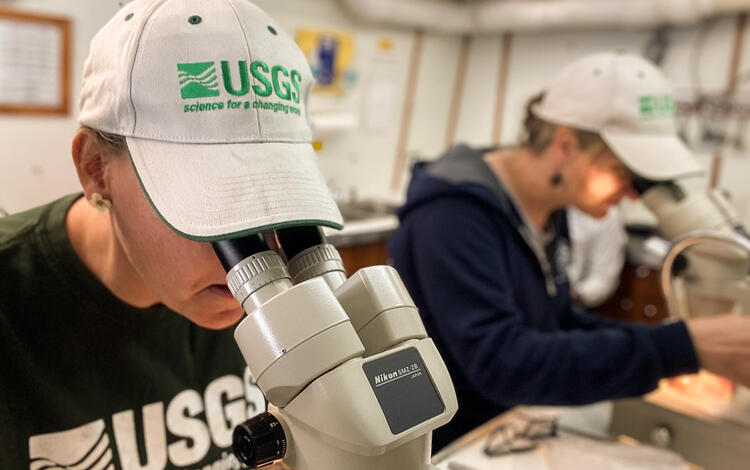
In 2008, USGS scientists initiated what has become the longest-running observational record of the flux and composition of planktic foraminifera species in the northern Gulf. Scientists have since conducted more than two dozen research cruises to recover samples from deployed sediment traps that catch forams as they sink to the seafloor. This long-term dataset allows scientists to understand which species are present, how their abundance changes with the seasons, and how they respond to changing ocean conditions—essential information for improving our ability to use forams to understand past climates in the region.
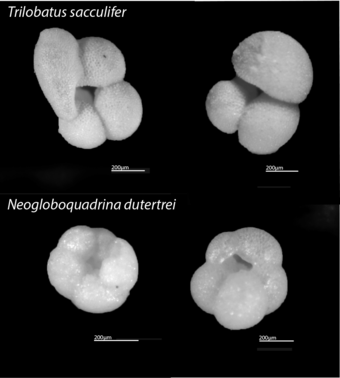
Two species of planktic foraminifera—Trilobatus sacculifer and Neogloboquadrina dutertrei—have, on average, each made up more than 10% of the planktic foraminifera in the Gulf over the last 10,000 years. However, in a new study published in the Journal of Foraminifera Research, USGS researchers and partners found that the relative abundance of T. sacculifer and N. dutertrei declined dramatically from 2017–2020. From 2008 to 2016, the abundance of these two species aligned with the historical average, comprising 9-10% of the total foraminiferal assemblage. Then, in 2017, they all but disappeared, dropping to less than 1% of the total.
The cause of this sharp decline is currently unclear and is surprising in part because these two foram species have different seasonalities and habitat preferences. Trilobatus sacculifer is a warm-water species that inhabits the upper levels of the water column, increases in abundance as salinity decreases, and its seasonal blooms occur during warmer months. In contrast, N. dutertrei lives deeper in the water column, increases in abundance as nutrient availability increases, and blooms during winter. In short, the two species require different environmental conditions to thrive.
Researchers did not find any obvious abrupt shift in temperature or salinity in the Gulf in 2017, but it’s possible that the observed changes in these small plankton may signal that ecological shifts are underway, such as changes in nutrient availability, ocean circulation, or stratification of the water column. USGS scientists are currently analyzing samples collected from 2022 to 2025 to see if this dramatic decline persisted beyond 2020.
Read the paper: Julie N. Richey, Caitlin E. Reynolds, Emily B. Osborne, Maoli Vizcaíno, Eric J. Tappa; Synthesizing a Twelve-Year Sediment Trap Time Series of Planktic Foraminiferal Flux in the Gulf of America (Mexico). Journal of Foraminiferal Research 2026;; 56 (3): 105–124. doi: https://doi.org/10.61551/gsjfr.56.3.105