



Cyanobacteria bloom at Lake Washington Park, NY
Learn about the Northeast Region Harmful Algal Blooms Capability Team.
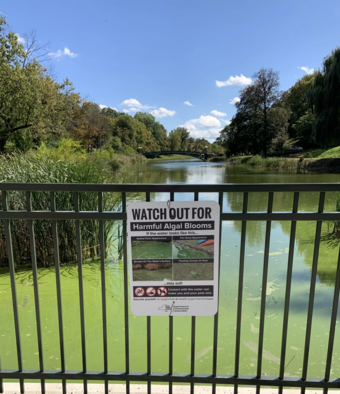
Harmful algal blooms (HABs) are increasingly a global concern because they pose a threat to human and aquatic ecosystem health and can cause significant economic damage. Freshwater and marine HABs can occur anytime water use is impaired due to excessive accumulations of algae.
HAB occurrence is affected by a complex set of physical, chemical, biological, hydrological, and meteorological conditions making it difficult to isolate specific causative environmental factors. Potential impairments include reduction in water quality, excessive biomass fouling recreational areas or clogging drinking-water intakes, algal production of toxins potent enough to poison both aquatic and terrestrial organisms, and algal production of taste-and-odor compounds that cause unpalatable drinking water and fish.
Many unanswered questions remain about occurrence, environmental triggers for toxicity, and the ability to predict the timing, duration, and toxicity of HABs.
The U.S. Geological Survey has both the expertise and capability in the Northeast Region (NER) to respond to HAB events, as well as design and execute studies across a range of scales (from site specific to regional in scope) to better understand aquatic ecosystems currently experiencing, or at risk of, HABs.
Event responses and focused studies that draw on expertise and material within the Region, can be coordinated as to produce scientifically defensible and nationally comparable datasets for both real-time management decisions as well as enhanced understanding of the causal factors related to HAB development, duration, and decline.
Goals
The NER HAB Science Capability Team will advance Northeast Region capabilities in HAB data collection, reporting, interpretation, and communication with the greater goal of better serving not only the USGS, but also local, state, and federal partners by providing information to support management decisions. The Team will be a resource to assist the Region and its Science Centers to coordinate HAB event response and develop and maintain HAB science programs.
Specific areas for technical collaboration include
- Event response in both freshwater and marine systems for science-based decision making
- Collection of comparable HAB datasets with the larger goal of national consistency
- Measuring and reporting the public health, ecological and economic impacts of HAB events
- Consistent messaging and communication with local and state agencies
- Mapping local and regional vulnerabilities to HABs by analyzing baseline conditions and trends with respect to HAB occurrence
- Understanding causal factors leading to the development, duration, and decline of HABs, that can ultimately inform predictive models
Major Objectives
Major objectives for the NER HAB Science Capability Team include
- Identifying regional HAB expertise, data collection and analytical capabilities across USGS Mission Areas in the NER and nationally
- Developing core event response guidance on data collection needs and capabilities for both freshwater and marine HABs
- Assisting NER Science Centers in developing and maintaining HAB programs that result in regionally and nationally consistent datasets
- Developing training products for USGS scientists collecting, interpreting and publishing HAB data
- Adopting and maintaining clear and consistent messaging for communications with local, state, and federal agencies, as well as the public in the NER
- Keeping NER technical staff aware of HAB-science developments, as well as in situ and remote sensing and analytical technologies
- Assisting the Mission Areas by providing technical reviews of new sensor technology and analytical methods and publications
By building the NER HAB Science Capability Team, experience can be gained by USGS scientists working across Mission Area boundaries to be able to respond, analyze, and interpret HAB events at local and regional scales. Because of the complex set of factors that may influence HAB occurrence, interdisciplinary approaches are required to understanding HAB development, duration, and decline. Experience and knowledge gained in the NER can then be scaled to the national level, resulting in a more consistent, coordinated agency approach to conducting HAB science throughout the nation.
Learn about the Northeast Region Harmful Algal Blooms Capability Team.
Harmful algal blooms (HABs) are increasingly a global concern because they pose a threat to human and aquatic ecosystem health and can cause significant economic damage. Freshwater and marine HABs can occur anytime water use is impaired due to excessive accumulations of algae.
HAB occurrence is affected by a complex set of physical, chemical, biological, hydrological, and meteorological conditions making it difficult to isolate specific causative environmental factors. Potential impairments include reduction in water quality, excessive biomass fouling recreational areas or clogging drinking-water intakes, algal production of toxins potent enough to poison both aquatic and terrestrial organisms, and algal production of taste-and-odor compounds that cause unpalatable drinking water and fish.
Many unanswered questions remain about occurrence, environmental triggers for toxicity, and the ability to predict the timing, duration, and toxicity of HABs.
The U.S. Geological Survey has both the expertise and capability in the Northeast Region (NER) to respond to HAB events, as well as design and execute studies across a range of scales (from site specific to regional in scope) to better understand aquatic ecosystems currently experiencing, or at risk of, HABs.
Event responses and focused studies that draw on expertise and material within the Region, can be coordinated as to produce scientifically defensible and nationally comparable datasets for both real-time management decisions as well as enhanced understanding of the causal factors related to HAB development, duration, and decline.
Goals
The NER HAB Science Capability Team will advance Northeast Region capabilities in HAB data collection, reporting, interpretation, and communication with the greater goal of better serving not only the USGS, but also local, state, and federal partners by providing information to support management decisions. The Team will be a resource to assist the Region and its Science Centers to coordinate HAB event response and develop and maintain HAB science programs.
Specific areas for technical collaboration include
- Event response in both freshwater and marine systems for science-based decision making
- Collection of comparable HAB datasets with the larger goal of national consistency
- Measuring and reporting the public health, ecological and economic impacts of HAB events
- Consistent messaging and communication with local and state agencies
- Mapping local and regional vulnerabilities to HABs by analyzing baseline conditions and trends with respect to HAB occurrence
- Understanding causal factors leading to the development, duration, and decline of HABs, that can ultimately inform predictive models
Major Objectives
Major objectives for the NER HAB Science Capability Team include
- Identifying regional HAB expertise, data collection and analytical capabilities across USGS Mission Areas in the NER and nationally
- Developing core event response guidance on data collection needs and capabilities for both freshwater and marine HABs
- Assisting NER Science Centers in developing and maintaining HAB programs that result in regionally and nationally consistent datasets
- Developing training products for USGS scientists collecting, interpreting and publishing HAB data
- Adopting and maintaining clear and consistent messaging for communications with local, state, and federal agencies, as well as the public in the NER
- Keeping NER technical staff aware of HAB-science developments, as well as in situ and remote sensing and analytical technologies
- Assisting the Mission Areas by providing technical reviews of new sensor technology and analytical methods and publications
By building the NER HAB Science Capability Team, experience can be gained by USGS scientists working across Mission Area boundaries to be able to respond, analyze, and interpret HAB events at local and regional scales. Because of the complex set of factors that may influence HAB occurrence, interdisciplinary approaches are required to understanding HAB development, duration, and decline. Experience and knowledge gained in the NER can then be scaled to the national level, resulting in a more consistent, coordinated agency approach to conducting HAB science throughout the nation.