Snow-density measurement near Dunckley Pass, Colorado
Snow-density measurement near Dunckley Pass, ColoradoSnow-density measurement in snowpack-sampling pit near Dunckley Pass, Colorado


Official websites use .gov
A .gov website belongs to an official government organization in the United States.

Secure .gov websites use HTTPS
A lock () or https:// means you’ve safely connected to the .gov website. Share sensitive information only on official, secure websites.

In practical terms, density is the mass of a substance for a specific volume. The density of water is roughly 1 gram per milliliter but, this changes with temperature or if there are substances dissolved in it. Ice is less dense than liquid water which is why your ice cubes float in your glass. As you might expect, water density is an important water measurement.
• Water Science School HOME • Water Properties topics •
If you're still in school, you've probably heard this statement in your science class: "Density is the mass per unit volume of a substance". On Earth, you can assume mass is the same as weight, if that makes it easier.
If you're not still in school, then you probably forgot you ever even heard it. The definition of density, makes a lot more sense with a little bit of explanation. As long as an object is made up of molecules, and thus has size or mass, it has a density. Density is just the weight for a chosen amount (volume) of the material. A common unit of measurement for water's density is gram per milliliter (1 g/ml) or 1 gram per cubic centimeter (1 g/cm3).
Actually, the exact density of water is not really 1 g/ml, but rather a bit less (very, very little less), at 0.9998395 g/ml at 4.0° Celsius (39.2° Fahrenheit). The rounded value of 1 g/ml is what you'll most often see, though.
| Temperature (°F/°C) | Density (grams/cm3 | Weight (pounds/ft3 |
|---|---|---|
| 32°F/0°C | 0.99987 | 62.416 |
| 39.2°F/4.0°C | 1.00000 | 62.424 |
| 40°F/4.4°C | 0.99999 | 62.423 |
| 50°F/10°C | 0.99975 | 62.408 |
| 60°F/15.6°C | 0.99907 | 62.366 |
| 70°F/21°C | 0.99802 | 62.300 |
| 80°F/26.7°C | 0.99669 | 62.217 |
| 90°F/32.2°C | 0.99510 | 62.118 |
| 100°F/37.8°C | 0.99318 | 61.998 |
| 120°F/48.9°C | 0.98870 | 61.719 |
| 140°F/60°C | 0.98338 | 61.386 |
| 160°F/71.1°C | 0.97729 | 61.006 |
| 180°F/82.2°C | 0.97056 | 60.586 |
| 200°F/93.3°C | 0.96333 | 60.135 |
| 212°F/100°C | 0.95865 | 59.843 |
Source: U.S. Department of the Interior, Bureau of Reclaimation, 1977, Ground Water Manual, from
The Water Encyclopedia, Third Edition, Hydrologic Data and Internet Resources, Edited by Pedro Fierro, Jr.
and Evan K. Nyler, 2007
If you look at this picture you can see that some of the iceberg is below the water level. This is not a surprise, but actually almost all of the volume of an iceberg is below the water line, not above it. This is because ice is less dense than liquid water, which causes it to float. In most substances solids are more dense. If this were the case for water, ice would sink and we would not be able to ice skate or ice fish, without SCUBA equipment! Upon freezing, the density of ice decreases by about 9 percent.

One way to visualize how water can have different densities is to look at the frozen form of water. Ice has a very different structure than liquid water in that the molecules align themselves in a regular lattice rather than more randomly as in the liquid form. The lattice arrangement allows water molecules to be more spread out than in a liquid, and, thus, ice is less dense than water. iced teaThe density of ice is about 90 percent that of water, but that can vary because ice can contain air. That means that about 10 percent of an ice cube (or iceberg) will be above the water line.
This property of water is critical for all life on earth. Since water at about 39°F (4°C) is denser than water at 32°F (0°C), in lakes and other water bodies the denser water sinks below less-dense water. If water was most dense at the freezing point, then in winter the very cold water at the surface of lakes would sink, the lake could freeze from the bottom up. And, with water being such a good insulator (due to its heat capacity), some frozen lakes might not totally thaw in summer.
The real-world explanation of water density is more complicated, as the density of water also varies with the amount of material that is dissolved in it. Water in nature contains minerals, gasses, salts, and even pesticides and bacteria, some of which are dissolved. As more material is dissolved in a gallon of water that gallon will weigh more and be more dense—ocean water, which contains dissolved salt, is denser than pure water.
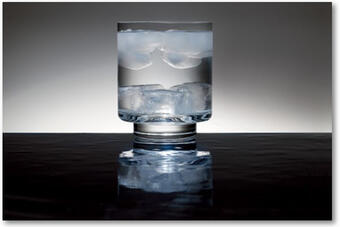
We already said ice floats on water because it is less dense, but ice of a special kind can be denser than normal water. "Heavy ice" is 10.6 percent denser than normal water because the ice is made from "heavy water". Heavy water, D2O instead of H2O, is water in which both hydrogen atoms have been replaced with deuterium, the isotope of hydrogen containing one proton and one neutron. Heavy water is indeed heavier than normal water (which contains a tiny amount of heavy water molecules naturally), and heavy-water ice will sink in normal water.

The instrument to measure the density of a liquid is called a hydrometer. It is one of the simplest of scientific-measuring devices, and you can even make your own out of a plastic straws. More often, though, it is made of glass and looks a lot like a thermometer. It consists of a cylindrical stem and a weighted bulb at the bottom to make it float upright. The hydrometer is gently lowered into the liquid to be measured until the hydrometer floats freely. There are etched or marked lines on the device so the user can see how high or low the hydrometer is floating. In less dense liquids the hydrometer will float lower, while in more dense liquids it will float higher. The hydrometer is measuring the relative density, also called specific gravity, of the liquid. Relative density is the ration of the density of one substance to the density of another reference substance, for liquids the reference substance is typically water at its maximum density (at 39.2 °F or 4 °C).
Hydrometers have many uses, not the least being to measure the salinity of water for science classes in schools. They are also used in the dairy industry to get estimates of the fat content of milk, as milk with higher fat content will be less dense than lower-fat milk. Hydrometers are often used by people who make beer and wine at home, as it offers an indication of how much sugar is in the liquid, and lets the brewer know how far along the fermentation process has gone.

Do you think you know a lot about water properties?
Take our interactive water-properties true/false quiz and test your water knowledge.
Below are other science topics associated with water density.


Below are multimedia items associated with water density.

Snow-density measurement in snowpack-sampling pit near Dunckley Pass, Colorado
Snow-density measurement in snowpack-sampling pit near Dunckley Pass, Colorado
In practical terms, density is the mass of a substance for a specific volume. The density of water is roughly 1 gram per milliliter but, this changes with temperature or if there are substances dissolved in it. Ice is less dense than liquid water which is why your ice cubes float in your glass. As you might expect, water density is an important water measurement.
• Water Science School HOME • Water Properties topics •
If you're still in school, you've probably heard this statement in your science class: "Density is the mass per unit volume of a substance". On Earth, you can assume mass is the same as weight, if that makes it easier.
If you're not still in school, then you probably forgot you ever even heard it. The definition of density, makes a lot more sense with a little bit of explanation. As long as an object is made up of molecules, and thus has size or mass, it has a density. Density is just the weight for a chosen amount (volume) of the material. A common unit of measurement for water's density is gram per milliliter (1 g/ml) or 1 gram per cubic centimeter (1 g/cm3).
Actually, the exact density of water is not really 1 g/ml, but rather a bit less (very, very little less), at 0.9998395 g/ml at 4.0° Celsius (39.2° Fahrenheit). The rounded value of 1 g/ml is what you'll most often see, though.
| Temperature (°F/°C) | Density (grams/cm3 | Weight (pounds/ft3 |
|---|---|---|
| 32°F/0°C | 0.99987 | 62.416 |
| 39.2°F/4.0°C | 1.00000 | 62.424 |
| 40°F/4.4°C | 0.99999 | 62.423 |
| 50°F/10°C | 0.99975 | 62.408 |
| 60°F/15.6°C | 0.99907 | 62.366 |
| 70°F/21°C | 0.99802 | 62.300 |
| 80°F/26.7°C | 0.99669 | 62.217 |
| 90°F/32.2°C | 0.99510 | 62.118 |
| 100°F/37.8°C | 0.99318 | 61.998 |
| 120°F/48.9°C | 0.98870 | 61.719 |
| 140°F/60°C | 0.98338 | 61.386 |
| 160°F/71.1°C | 0.97729 | 61.006 |
| 180°F/82.2°C | 0.97056 | 60.586 |
| 200°F/93.3°C | 0.96333 | 60.135 |
| 212°F/100°C | 0.95865 | 59.843 |
Source: U.S. Department of the Interior, Bureau of Reclaimation, 1977, Ground Water Manual, from
The Water Encyclopedia, Third Edition, Hydrologic Data and Internet Resources, Edited by Pedro Fierro, Jr.
and Evan K. Nyler, 2007
If you look at this picture you can see that some of the iceberg is below the water level. This is not a surprise, but actually almost all of the volume of an iceberg is below the water line, not above it. This is because ice is less dense than liquid water, which causes it to float. In most substances solids are more dense. If this were the case for water, ice would sink and we would not be able to ice skate or ice fish, without SCUBA equipment! Upon freezing, the density of ice decreases by about 9 percent.
One way to visualize how water can have different densities is to look at the frozen form of water. Ice has a very different structure than liquid water in that the molecules align themselves in a regular lattice rather than more randomly as in the liquid form. The lattice arrangement allows water molecules to be more spread out than in a liquid, and, thus, ice is less dense than water. iced teaThe density of ice is about 90 percent that of water, but that can vary because ice can contain air. That means that about 10 percent of an ice cube (or iceberg) will be above the water line.
This property of water is critical for all life on earth. Since water at about 39°F (4°C) is denser than water at 32°F (0°C), in lakes and other water bodies the denser water sinks below less-dense water. If water was most dense at the freezing point, then in winter the very cold water at the surface of lakes would sink, the lake could freeze from the bottom up. And, with water being such a good insulator (due to its heat capacity), some frozen lakes might not totally thaw in summer.
The real-world explanation of water density is more complicated, as the density of water also varies with the amount of material that is dissolved in it. Water in nature contains minerals, gasses, salts, and even pesticides and bacteria, some of which are dissolved. As more material is dissolved in a gallon of water that gallon will weigh more and be more dense—ocean water, which contains dissolved salt, is denser than pure water.
We already said ice floats on water because it is less dense, but ice of a special kind can be denser than normal water. "Heavy ice" is 10.6 percent denser than normal water because the ice is made from "heavy water". Heavy water, D2O instead of H2O, is water in which both hydrogen atoms have been replaced with deuterium, the isotope of hydrogen containing one proton and one neutron. Heavy water is indeed heavier than normal water (which contains a tiny amount of heavy water molecules naturally), and heavy-water ice will sink in normal water.
The instrument to measure the density of a liquid is called a hydrometer. It is one of the simplest of scientific-measuring devices, and you can even make your own out of a plastic straws. More often, though, it is made of glass and looks a lot like a thermometer. It consists of a cylindrical stem and a weighted bulb at the bottom to make it float upright. The hydrometer is gently lowered into the liquid to be measured until the hydrometer floats freely. There are etched or marked lines on the device so the user can see how high or low the hydrometer is floating. In less dense liquids the hydrometer will float lower, while in more dense liquids it will float higher. The hydrometer is measuring the relative density, also called specific gravity, of the liquid. Relative density is the ration of the density of one substance to the density of another reference substance, for liquids the reference substance is typically water at its maximum density (at 39.2 °F or 4 °C).
Hydrometers have many uses, not the least being to measure the salinity of water for science classes in schools. They are also used in the dairy industry to get estimates of the fat content of milk, as milk with higher fat content will be less dense than lower-fat milk. Hydrometers are often used by people who make beer and wine at home, as it offers an indication of how much sugar is in the liquid, and lets the brewer know how far along the fermentation process has gone.
Do you think you know a lot about water properties?
Take our interactive water-properties true/false quiz and test your water knowledge.
Below are other science topics associated with water density.
Below are multimedia items associated with water density.
Snow-density measurement in snowpack-sampling pit near Dunckley Pass, Colorado
Snow-density measurement in snowpack-sampling pit near Dunckley Pass, Colorado