



The Alaska Forage Fish Database is a consolidation of survey catch data and predator diets from multiple partners including USGS Alaska Science Center, NOAA National Marine Fisheries Service Alaska Fisheries Science Center, USFWS Alaska Maritime National Wildlife Refuge, Alaska Department of Fish and Game, and others. The spatial coverage of the database encompasses the coastal and offshore regions of Alaska, including the Gulf of Alaska, Bering Sea, Aleutian Islands, Chukchi Sea, and southern Beaufort Sea.
Return to Ecosystems >> Marine Ecosystems >> Seabirds and Forage Fish Ecology
The Alaska Forage Fish Database (AFFD) is hosted by the USGS Alaska Science Center to support the science information needed by managers at the Bureau of Ocean Energy Management to inform oil spill risk assessments and spatial planning for energy development in Alaska Outer Continental Shelf Region. The AFFD contains information on forage fish and invertebrates sampled from trawls (surface, midwater, and bottom trawls), nearshore sampling techniques (i.e. beach seines, purse seines, jigs, gill nets, cast nets), ichthyoplankton surveys, groundfish stomach contents, and seabird diets. With contributions from many organizations and individuals, the database contains spatial and catch information on over 40 prey species from more than 461,000 sampling events at 105,000 unique sites in Alaska’s marine ecosystems.
The AFFD is a powerful tool for examining abundance and distribution of forage fish across marine ecosystems of the North Pacific and the Arctic. AFFD data are available at the links below. Additional information can be found in the tabs at the top of this page.
Data
AFFD [Data Download] [Metadata]
Species list
- Smelts (Family: Osmeridae) including Pacific capelin (Mallotus catevarius), eulachon (Thaleichthys pacificus), and other smelts
- Pacific herring (Clupea pallasii)
- Pacific and Arctic sand lance (Ammodytes personatus and A. hexapterus, respectively)
- Lanternfishes (Family: Myctophidae)
- Juvenile walleye pollock (Gadus chalcogrammus) and Pacific cod (G. macrocephalus)
- Krill (Order: Euphausiacea)
- Squid (superorder: Decapodiformes)
Suggested Citation
Turner, L.C., Arimitsu, M.L., Piatt, J.F., Eckert, G.L., and Cunningham, C.J., 2024, Alaska Forage Fish Database (AFFD): U.S. Geological Survey data release, https://doi.org/10.5066/P9WZQJ8N
AFFD Sampling Effort Maps
This map is showing data contributors and primary sampling methods for Alaska Forage Fish Database (AFFD). Spatial coverage of the six primary sampling methods:
- surface trawls (light blue)
- midwater trawls (dark red)
- bottom trawls (small-mesh in dark blue, large-mesh in yellow)
- nearshore sampling (purple)
- locations of groundfish stomach content collection (orange)
- seabird colonies (green circle with black point)
All individual sampling events are included as points, except for seabird colony data which highlight colony locations. Data contributor logos are displayed on the top right of each panel.

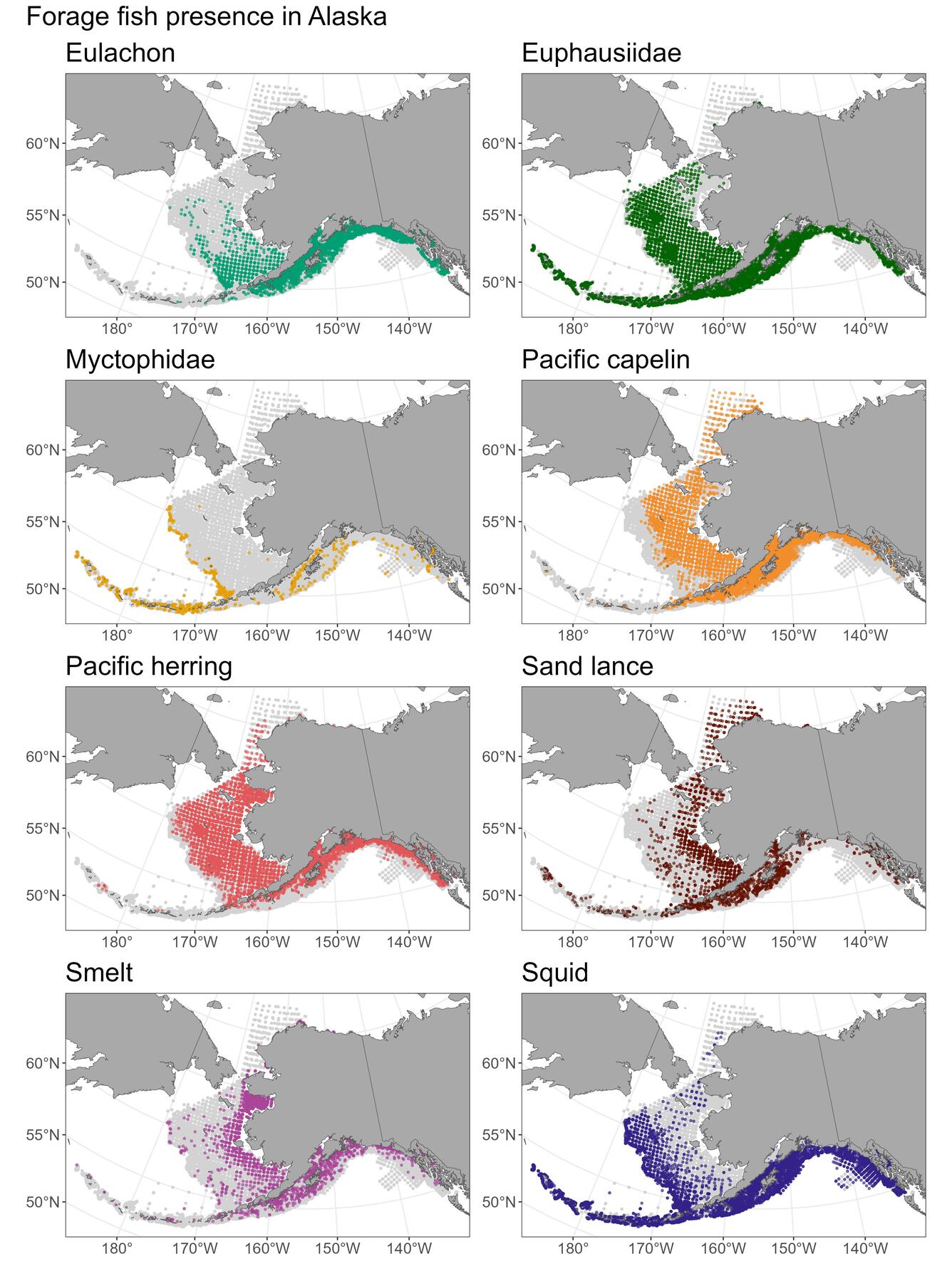
Map of locations within the Alaska Forage Fish Database where forage species were encountered (color). Grey points represent sites where sampling occurred, but the specific forage species was not encountered.
Data contributions
We thank the many organizations and individuals that contributed forage fish data for this effort, including Kerim Aydin, Andrew Dimond, Ed Farley, Ned Layman, Darcie Neff, Katharine Miller, Olav Ormseth, Johanna Page, Steve Porter, Mike Sigler, Duane Stevenson, (NOAA NMFS Alaska Fisheries Science Center), Heather Renner, Nora Rojek, Brie Drummond (USFWS Alaska Maritime National Wildlife Refuge), Scott Hatch, Shannon Whelan (Institute for Seabird Research and Conservation), Kally Spalinger (Alaska Department of Fish and Game), Chris Guo (National Estuarine Research Reserve, Kachemak Bay), Andrew Seitz, Anne Beaudreau (University of Alaska Fairbanks and University of Washington), Vanessa von Biela (USGS Alaska Science Center), and Martin Robards (Wildlife Conservation Society, Arctic Beringia Program) for working with us on forage fish datasets and technical support. We also thank Sean Burril, Catherine Coon, Heather Crowley, Rick Raymond, and Tim White (BOEM) for their support. Funding was provided by USGS-BOEM Outer Continental Shelf program, USGS Alaska Science Center, BOEM Alaska, Exxon Valdez Oil Spill Trustee Council, and the University of Alaska Fairbanks.
The Alaska Forage Fish Database is a consolidation of survey catch data and predator diets from multiple partners including USGS Alaska Science Center, NOAA National Marine Fisheries Service Alaska Fisheries Science Center, USFWS Alaska Maritime National Wildlife Refuge, Alaska Department of Fish and Game, and others. The spatial coverage of the database encompasses the coastal and offshore regions of Alaska, including the Gulf of Alaska, Bering Sea, Aleutian Islands, Chukchi Sea, and southern Beaufort Sea.
Return to Ecosystems >> Marine Ecosystems >> Seabirds and Forage Fish Ecology
The Alaska Forage Fish Database (AFFD) is hosted by the USGS Alaska Science Center to support the science information needed by managers at the Bureau of Ocean Energy Management to inform oil spill risk assessments and spatial planning for energy development in Alaska Outer Continental Shelf Region. The AFFD contains information on forage fish and invertebrates sampled from trawls (surface, midwater, and bottom trawls), nearshore sampling techniques (i.e. beach seines, purse seines, jigs, gill nets, cast nets), ichthyoplankton surveys, groundfish stomach contents, and seabird diets. With contributions from many organizations and individuals, the database contains spatial and catch information on over 40 prey species from more than 461,000 sampling events at 105,000 unique sites in Alaska’s marine ecosystems.
The AFFD is a powerful tool for examining abundance and distribution of forage fish across marine ecosystems of the North Pacific and the Arctic. AFFD data are available at the links below. Additional information can be found in the tabs at the top of this page.
Data
AFFD [Data Download] [Metadata]
Species list
- Smelts (Family: Osmeridae) including Pacific capelin (Mallotus catevarius), eulachon (Thaleichthys pacificus), and other smelts
- Pacific herring (Clupea pallasii)
- Pacific and Arctic sand lance (Ammodytes personatus and A. hexapterus, respectively)
- Lanternfishes (Family: Myctophidae)
- Juvenile walleye pollock (Gadus chalcogrammus) and Pacific cod (G. macrocephalus)
- Krill (Order: Euphausiacea)
- Squid (superorder: Decapodiformes)
Suggested Citation
Turner, L.C., Arimitsu, M.L., Piatt, J.F., Eckert, G.L., and Cunningham, C.J., 2024, Alaska Forage Fish Database (AFFD): U.S. Geological Survey data release, https://doi.org/10.5066/P9WZQJ8N
AFFD Sampling Effort Maps
This map is showing data contributors and primary sampling methods for Alaska Forage Fish Database (AFFD). Spatial coverage of the six primary sampling methods:
- surface trawls (light blue)
- midwater trawls (dark red)
- bottom trawls (small-mesh in dark blue, large-mesh in yellow)
- nearshore sampling (purple)
- locations of groundfish stomach content collection (orange)
- seabird colonies (green circle with black point)
All individual sampling events are included as points, except for seabird colony data which highlight colony locations. Data contributor logos are displayed on the top right of each panel.
Map of locations within the Alaska Forage Fish Database where forage species were encountered (color). Grey points represent sites where sampling occurred, but the specific forage species was not encountered.
Data contributions
We thank the many organizations and individuals that contributed forage fish data for this effort, including Kerim Aydin, Andrew Dimond, Ed Farley, Ned Layman, Darcie Neff, Katharine Miller, Olav Ormseth, Johanna Page, Steve Porter, Mike Sigler, Duane Stevenson, (NOAA NMFS Alaska Fisheries Science Center), Heather Renner, Nora Rojek, Brie Drummond (USFWS Alaska Maritime National Wildlife Refuge), Scott Hatch, Shannon Whelan (Institute for Seabird Research and Conservation), Kally Spalinger (Alaska Department of Fish and Game), Chris Guo (National Estuarine Research Reserve, Kachemak Bay), Andrew Seitz, Anne Beaudreau (University of Alaska Fairbanks and University of Washington), Vanessa von Biela (USGS Alaska Science Center), and Martin Robards (Wildlife Conservation Society, Arctic Beringia Program) for working with us on forage fish datasets and technical support. We also thank Sean Burril, Catherine Coon, Heather Crowley, Rick Raymond, and Tim White (BOEM) for their support. Funding was provided by USGS-BOEM Outer Continental Shelf program, USGS Alaska Science Center, BOEM Alaska, Exxon Valdez Oil Spill Trustee Council, and the University of Alaska Fairbanks.