



A Bald Eagle on Juneau Beach in Juneau, Alaska
Alaska provides breeding habitat for more than 140 regularly occurring species of landbirds, half of which breed predominantly north of the U.S.–Canada border. The road-based North American Breeding Bird Survey (BBS) provides some data on population trends in Alaska, but most northern species are inadequately monitored by that continental program because of a paucity of roads.
Boreal Partners in Flight developed the Alaska Landbird Monitoring Survey (ALMS) to monitor breeding populations of landbirds in the vast off-road areas of Alaska and to complement data collected from the roadside BBS.
The primary objective of ALMS is to monitor population trends of northern populations of landbirds using replicated point-count surveys in off-road areas. This approach complements data collected by the roadside BBS.
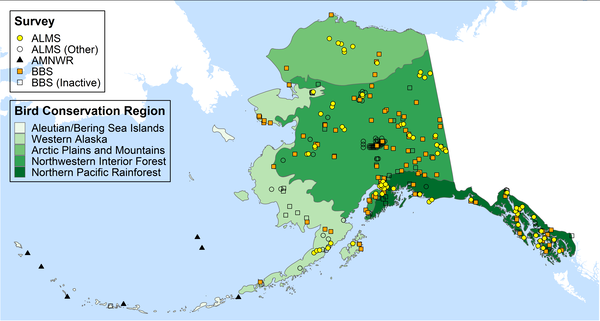
In addition to trend monitoring, similar surveys conducted for inventories or other purposes can be incorporated into analyses of distribution, habitat use, and population size (see Figure 1). Most ALMS samples consist of a mini-grid of 12–25 points arranged within a randomly shifted 10 km × 10 km grid across continental Alaska.
- Surveys for population trends are conducted biennially, with half of the samples surveyed in alternating years.
- Samples are stratified by accessibility and cost, and the initial stratum includes areas accessible by foot, vehicle, boat, or fixed-winged aircraft.
- The initial allocation of samples is concentrated in the Northwestern Interior Forest and Northern Pacific Rainforest Bird Conservation Regions, where landbird populations are most diverse and abundant.
- Additional samples have been allocated to Arctic and Western Alaska, with surveys in the remote Aleutian and Bering Sea islands conducted by Alaska Maritime National Wildlife Refuge biologists as logistics allow.
The updated ALMS protocol (Handel et al. 2021) specifies 10-minute point counts replicated once per breeding season, with bird detections recorded in time and distance intervals to estimate detection probability.
- Associated habitat data are collected during the first summer of point counts, with subsequent habitat surveys repeated every 10 years or following a major disturbance.
- Long-term monitoring will enable analysis of change in bird populations in relation to fire, disease and insect damage, resource development, climate change, and other landscape-level disturbances.
ALMS has received broad support from nine state, federal, and non-governmental agencies, which signed a Memorandum of Understanding in 2005 supporting the program.
For more information on participating in ALMS or adding sampling sites, please refer to the additional information on this site or contact the Program Coordinator.
Sources/Usage: Public Domain. View Media Details

Media
Sources/Usage: Public Domain. View Media Details
Map with survey locations related to Bird Conservation Regions in AK
Figure 1. Locations of blocks and routes surveyed as part of the Alaska Landbird Monitoring Survey (ALMS), North American Breeding Bird Survey (BBS), and the Alaska Maritime National Wildlife Refuge (AMNWR) monitoring program in relation to Bird Conservation Regions (US NABCI 2000) within Alaska.
- Solid markers are blocks and routes regularly surveyed for long-term bird population trends.
- Open markers show blocks and routes that have been surveyed irregularly or dropped (Other, Inactive).
Click on map for larger image


Media

Sources/Usage: Some content may have restrictions. View Media Details
Additional information on ALMS
- Alaska Landbird Monitoring Survey: Alaska Regional Protocol Framework for Monitoring Landbirds Using Point Counts (PDF 3414 KB)
- Revised protocol (Handel et al. 2021) for ALMS program on National Wildlife Refuges and other public lands.
- Revised protocol (Handel et al. 2021) for ALMS program on National Wildlife Refuges and other public lands.
- ALMS forms and reference materials (October 19, 2020; species' codes updated June 1, 2022)
- Data forms and reference sheets for collecting ALMS data in the field.
- Packing list of equipment and supplies needed when conducting ALMS surveys.
- A fillable form for completing a safety plan before heading to the field to conduct ALMS surveys.
- Supporting agencies—A memorandum of understanding supporting ALMS was signed in 2005 by nine federal, state, and non-governmental agencies.
- Original (2004) protocol for setting up and conducting surveys (PDF 828.26 KB)
- Original instructions (Handel and Cady 2004) for conducting ALMS surveys. See Handel et al. (2021) above for revised protocol.
Media

Sources/Usage: Some content may have restrictions. View Media Details
Program Coordinator:
Rachel M Richardson
Alaska Science Center
U.S. Geological Survey
Anchorage, AK 99508
rrichardson@usgs.gov
907-786-7194
Below are other science projects associated with this project.

Boreal Partners in Flight
Welcome to the Alaska Landbird Resource Information System, the official web site for Boreal Partners in Flight! Thanks for taking the time to learn more about the Boreal Partners in Flight program and our efforts to understand and conserve northern populations of landbirds.
Below are multimedia items associated with this project.
Filter Total Items: 47

A Bald Eagle on Juneau Beach in Juneau, Alaska
A Bald Eagle on Juneau Beach in Juneau, Alaska

Bald Eagle on a broken tree on shore of Juneau Beach, Juneau, Alaska
Bald Eagle on a broken tree on shore of Juneau Beach, Juneau, AlaskaBald Eagle on a broken tree on shore of Juneau Beach, Juneau, Alaska.
Bald Eagle on a broken tree on shore of Juneau Beach, Juneau, Alaska
Bald Eagle on a broken tree on shore of Juneau Beach, Juneau, AlaskaBald Eagle on a broken tree on shore of Juneau Beach, Juneau, Alaska.

Townsend's Warbler in Anchorage, Alaska
Townsend's Warbler held in the hand of a scientist in Anchorage, Alaska. Townsend's Warbler is a landbird.
Townsend's Warbler held in the hand of a scientist in Anchorage, Alaska. Townsend's Warbler is a landbird.

Scientist holding a Grey-cheeked Thrush
Scientist holding a Grey-cheeked Thrush
Scientist holding a Grey-cheeked Thrush

Alaska provides breeding habitat for more than 140 regularly occurring species of landbirds, half of which breed predominantly north of the U.S.–Canada border. The road-based North American Breeding Bird Survey (BBS) provides some data on population trends in Alaska, but most northern species are inadequately monitored by that continental program because of a paucity of roads.
Boreal Partners in Flight developed the Alaska Landbird Monitoring Survey (ALMS) to monitor breeding populations of landbirds in the vast off-road areas of Alaska and to complement data collected from the roadside BBS.
The primary objective of ALMS is to monitor population trends of northern populations of landbirds using replicated point-count surveys in off-road areas. This approach complements data collected by the roadside BBS.
In addition to trend monitoring, similar surveys conducted for inventories or other purposes can be incorporated into analyses of distribution, habitat use, and population size (see Figure 1). Most ALMS samples consist of a mini-grid of 12–25 points arranged within a randomly shifted 10 km × 10 km grid across continental Alaska.
- Surveys for population trends are conducted biennially, with half of the samples surveyed in alternating years.
- Samples are stratified by accessibility and cost, and the initial stratum includes areas accessible by foot, vehicle, boat, or fixed-winged aircraft.
- The initial allocation of samples is concentrated in the Northwestern Interior Forest and Northern Pacific Rainforest Bird Conservation Regions, where landbird populations are most diverse and abundant.
- Additional samples have been allocated to Arctic and Western Alaska, with surveys in the remote Aleutian and Bering Sea islands conducted by Alaska Maritime National Wildlife Refuge biologists as logistics allow.
The updated ALMS protocol (Handel et al. 2021) specifies 10-minute point counts replicated once per breeding season, with bird detections recorded in time and distance intervals to estimate detection probability.
- Associated habitat data are collected during the first summer of point counts, with subsequent habitat surveys repeated every 10 years or following a major disturbance.
- Long-term monitoring will enable analysis of change in bird populations in relation to fire, disease and insect damage, resource development, climate change, and other landscape-level disturbances.
ALMS has received broad support from nine state, federal, and non-governmental agencies, which signed a Memorandum of Understanding in 2005 supporting the program.
For more information on participating in ALMS or adding sampling sites, please refer to the additional information on this site or contact the Program Coordinator.
Sources/Usage: Public Domain. View Media Details
Media
Sources/Usage: Public Domain. View Media Details
Map with survey locations related to Bird Conservation Regions in AK
Figure 1. Locations of blocks and routes surveyed as part of the Alaska Landbird Monitoring Survey (ALMS), North American Breeding Bird Survey (BBS), and the Alaska Maritime National Wildlife Refuge (AMNWR) monitoring program in relation to Bird Conservation Regions (US NABCI 2000) within Alaska.
- Solid markers are blocks and routes regularly surveyed for long-term bird population trends.
- Open markers show blocks and routes that have been surveyed irregularly or dropped (Other, Inactive).
Click on map for larger image
Media
Sources/Usage: Some content may have restrictions. View Media Details
Additional information on ALMS
- Alaska Landbird Monitoring Survey: Alaska Regional Protocol Framework for Monitoring Landbirds Using Point Counts (PDF 3414 KB)
- Revised protocol (Handel et al. 2021) for ALMS program on National Wildlife Refuges and other public lands.
- Revised protocol (Handel et al. 2021) for ALMS program on National Wildlife Refuges and other public lands.
- ALMS forms and reference materials (October 19, 2020; species' codes updated June 1, 2022)
- Data forms and reference sheets for collecting ALMS data in the field.
- Packing list of equipment and supplies needed when conducting ALMS surveys.
- A fillable form for completing a safety plan before heading to the field to conduct ALMS surveys.
- Supporting agencies—A memorandum of understanding supporting ALMS was signed in 2005 by nine federal, state, and non-governmental agencies.
- Original (2004) protocol for setting up and conducting surveys (PDF 828.26 KB)
- Original instructions (Handel and Cady 2004) for conducting ALMS surveys. See Handel et al. (2021) above for revised protocol.
Media
Sources/Usage: Some content may have restrictions. View Media Details
Program Coordinator:
Rachel M Richardson
Alaska Science Center
U.S. Geological Survey
Anchorage, AK 99508
rrichardson@usgs.gov
907-786-7194
Below are other science projects associated with this project.
Boreal Partners in Flight
Welcome to the Alaska Landbird Resource Information System, the official web site for Boreal Partners in Flight! Thanks for taking the time to learn more about the Boreal Partners in Flight program and our efforts to understand and conserve northern populations of landbirds.
Below are multimedia items associated with this project.
Filter Total Items: 47
A Bald Eagle on Juneau Beach in Juneau, Alaska
A Bald Eagle on Juneau Beach in Juneau, Alaska
A Bald Eagle on Juneau Beach in Juneau, Alaska
Bald Eagle on a broken tree on shore of Juneau Beach, Juneau, Alaska
Bald Eagle on a broken tree on shore of Juneau Beach, Juneau, AlaskaBald Eagle on a broken tree on shore of Juneau Beach, Juneau, Alaska.
Bald Eagle on a broken tree on shore of Juneau Beach, Juneau, Alaska
Bald Eagle on a broken tree on shore of Juneau Beach, Juneau, AlaskaBald Eagle on a broken tree on shore of Juneau Beach, Juneau, Alaska.
Townsend's Warbler in Anchorage, Alaska
Townsend's Warbler held in the hand of a scientist in Anchorage, Alaska. Townsend's Warbler is a landbird.
Townsend's Warbler held in the hand of a scientist in Anchorage, Alaska. Townsend's Warbler is a landbird.
Scientist holding a Grey-cheeked Thrush
Scientist holding a Grey-cheeked Thrush
Scientist holding a Grey-cheeked Thrush