



A Common Murre carries a Pacific sand lance, one of the most common prey items for murres, near its colony at Gull Island, Alaska.
Alaska's coastal and offshore waters provide foraging habitat for an estimated 100 million birds comprising more than 90 different species; from loons and seaducks that nest inland, to petrels and puffins that breed on islands off shore. All these birds depend on the sea to provide a wide variety of food types— from clams, crabs and urchins nearshore— to krill, forage fish, and squid offshore. The availability of nesting habitat and suitable prey are important natural factors that regulate the distribution and abundance of marine birds. But seabird populations are also affected by human activities that have direct impacts (pollution, bycatch in fishing gear) and indirect effects (global warming alters food availability) on birds.
Return to Ecosystems >> Marine Ecosystems
The Department of Interior (DOI) is mandated by the Migratory Bird Treaty Act and the Endangered Species Act to conserve and protect all seabirds in U.S. waters up to 200 miles offshore.
Media

Sources/Usage: Public Domain. View Media Details
Additionally, the DOI is mandated to manage subsistence resources, including birds, under the Federal Subsistence Management Program.
The DOI, through the NPS, has shared responsibility for Humpback Whales and other marine mammals mandated by the Marine Mammal Protection Act (1972) and the Endangered Species Act (1973), and specific regulatory and conservation authority within Alaska's Glacier Bay National Park and Monument, one of a few marine sanctuaries managed by DOI.
Within DOI, the USGS has a responsibility to assist those DOI agencies with marine jurisdictions (NPS, USFWS, BOEM) by gathering and interpreting data on seabirds and other marine waterfowl, humpback whales and other marine mammals, and relevant components of their marine environments (such as forage fish, zooplankton, oceanography, toxins, etc.) that influence the status and trends of these protected marine animals.
Seabirds also serve as practical indicators of change in the marine environment— natural or human induced— because they can be readily monitored at colonies and at sea. For all these reasons, marine bird research is a vital part of the DOI mission in Alaska and the North Pacific.
We study population biology and feeding ecology of a variety of seabird species, including threatened and endangered species. We use a multidisciplinary approach that incorporates study of marine habitats and food webs so that we can better understand why seabird populations fluctuate over time. This website highlights some of the research conducted by the Seabird, Forage Fish and Marine Ecology Project at the Alaska Science Center.
Tidewater Glacier Influence on Marine Ecosystems
Tidewater Glacier Influence on Marine Ecosystems
Cook Inlet Seabird and Forage Fish Study
Cook Inlet Seabird and Forage Fish Study
Detecting Long-term Changes in Forage Fish Populations in Prince William Sound, Alaska
Detecting Long-term Changes in Forage Fish Populations in Prince William Sound, Alaska
Harmful algal bloom toxins in Alaska seabirds
Harmful algal bloom toxins in Alaska seabirds
North Pacific Pelagic Seabird Database
North Pacific Pelagic Seabird Database
Pacific Marine Heatwave
Pacific Marine Heatwave
Seabird Die-offs in Alaska
Seabird Die-offs in Alaska
USGS Research Vessel Alaskan Gyre
USGS Research Vessel Alaskan Gyre
Below are multimedia items associated with this project.
Filter Total Items: 117

A Common Murre carries a Pacific sand lance
A Common Murre carries a Pacific sand lance, one of the most common prey items for murres, near its colony at Gull Island, Alaska.

Common Murres on the water near their colony at Gull Island, Alaska
Common Murres on the water near their colony at Gull Island, AlaskaCommon Murres on the water near their colony at Gull Island, Alaska.
Common Murres on the water near their colony at Gull Island, Alaska
Common Murres on the water near their colony at Gull Island, AlaskaCommon Murres on the water near their colony at Gull Island, Alaska.

Common Murre next to egg at breeding colony on Gull Island, Alaska
Common Murre next to egg at breeding colony on Gull Island, AlaskaCommon Murre next to egg at breeding colony on Gull Island, in Kachemak Bay, Alaska.
Common Murre next to egg at breeding colony on Gull Island, Alaska
Common Murre next to egg at breeding colony on Gull Island, AlaskaCommon Murre next to egg at breeding colony on Gull Island, in Kachemak Bay, Alaska.

Close up of Common Murre sitting on egg
Close up of Common Murre sitting on egg at breeding colony on Gull Island in Kachemak Bay, Alaska.
Close up of Common Murre sitting on egg at breeding colony on Gull Island in Kachemak Bay, Alaska.

Close up of Common Murre sitting on egg at breeding colony on Gull Island
Close up of Common Murre sitting on egg at breeding colony on Gull IslandClose up of Common Murre sitting on egg at breeding colony on Gull Island in Kachemak Bay, Alaska. There are two other murres in the back ground.
Close up of Common Murre sitting on egg at breeding colony on Gull Island
Close up of Common Murre sitting on egg at breeding colony on Gull IslandClose up of Common Murre sitting on egg at breeding colony on Gull Island in Kachemak Bay, Alaska. There are two other murres in the back ground.

Skinny Common Murre with keel protruding
Skinny Common Murre with keel protruding. Lower Cook Inlet, Alaska
Skinny Common Murre with keel protruding. Lower Cook Inlet, Alaska

Skinny Common Murre flying with keel protruding
Skinny Common Murre with keel protruding. Lower Cook Inlet, Alaska
Skinny Common Murre with keel protruding. Lower Cook Inlet, Alaska

A Peregrine Falcon flies off with a Black-legged Kittiwake
A Peregrine Falcon flies off with a Black-legged KittiwakeA Peregrine Falcon flies off with a Black-legged Kittiwake from its colony at Gull Island, Alaska.
A Peregrine Falcon flies off with a Black-legged Kittiwake
A Peregrine Falcon flies off with a Black-legged KittiwakeA Peregrine Falcon flies off with a Black-legged Kittiwake from its colony at Gull Island, Alaska.

Skinny Common Murre (in foreground) with keel protruding
Skinny Common Murre (in foreground) with keel protrudingSkinny Common Murre (in foreground) with keel protruding in lower Cook Inlet, Alaska.
Skinny Common Murre (in foreground) with keel protruding
Skinny Common Murre (in foreground) with keel protrudingSkinny Common Murre (in foreground) with keel protruding in lower Cook Inlet, Alaska.
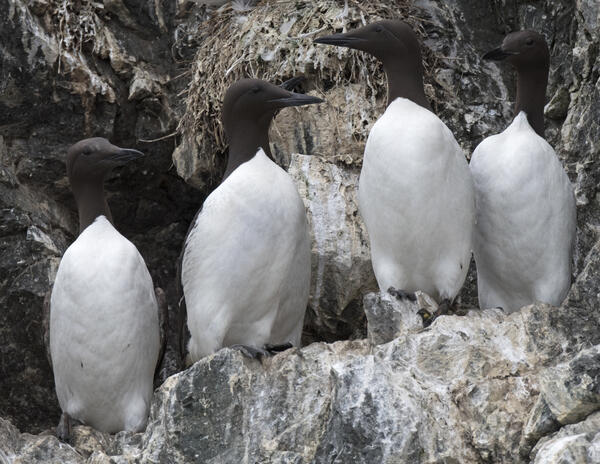
Skinny Common Murre with keel protruding (second from the left)
Skinny Common Murre with keel protruding (second from the left)Skinny Common Murre with keel protruding (second from the left) contrasted by normal murres. Lower Cook Inlet, Alaska.
Skinny Common Murre with keel protruding (second from the left)
Skinny Common Murre with keel protruding (second from the left)Skinny Common Murre with keel protruding (second from the left) contrasted by normal murres. Lower Cook Inlet, Alaska.

A Black-legged Kittiwake harasses a melanistic Common Murre
A Black-legged Kittiwake harasses a melanistic Common MurreA Black-legged Kittiwake harasses a melanistic (all black) Common Murre, forcing it off its breeding site in Kachemak Bay, Alaska, 2018. See related paper published in the Marine Ornithology: Journal of Seabird Research and Conservation at: http://www.marineornithology.org/PDF/50_2/50_2_225-22
A Black-legged Kittiwake harasses a melanistic Common Murre
A Black-legged Kittiwake harasses a melanistic Common MurreA Black-legged Kittiwake harasses a melanistic (all black) Common Murre, forcing it off its breeding site in Kachemak Bay, Alaska, 2018. See related paper published in the Marine Ornithology: Journal of Seabird Research and Conservation at: http://www.marineornithology.org/PDF/50_2/50_2_225-22

Glaucous-winged Gulls grab eggs abandoned by breeding Common Murres
Glaucous-winged Gulls grab eggs abandoned by breeding Common MurresGlaucous-winged Gulls capitalize upon a disturbance at the Gull Island colony in 2018 to grab eggs abandoned by breeding Common Murres. One lone Common Murre continues incubation despite the rest of the colony flushing.
Glaucous-winged Gulls grab eggs abandoned by breeding Common Murres
Glaucous-winged Gulls grab eggs abandoned by breeding Common MurresGlaucous-winged Gulls capitalize upon a disturbance at the Gull Island colony in 2018 to grab eggs abandoned by breeding Common Murres. One lone Common Murre continues incubation despite the rest of the colony flushing.

Melanistic Common Murre flies near its colony
A melanistic (all dark) Common Murre flies above its colony on Gull Island in Kachemak Bay, Alaska, 2018. See related paper published in the Marine Ornithology: Journal of Seabird Research and Conservation at: http://www.marineornithology.org/PDF/50_2/50_2_225-227.pdf.
A melanistic (all dark) Common Murre flies above its colony on Gull Island in Kachemak Bay, Alaska, 2018. See related paper published in the Marine Ornithology: Journal of Seabird Research and Conservation at: http://www.marineornithology.org/PDF/50_2/50_2_225-227.pdf.

Common Murre flying in lower Cook Inlet, Alaska
Common Murre flying in lower Cook Inlet, Alaska.
Common Murre flying in lower Cook Inlet, Alaska.

Juvenile Bald Eagle flies away with Black-legged Kittiwake chick
Juvenile Bald Eagle flies away with Black-legged Kittiwake chickA juvenile Bald Eagle flies away with a young Black-legged Kittiwake chick taken from its nest at Gull Island, Alaska.
Juvenile Bald Eagle flies away with Black-legged Kittiwake chick
Juvenile Bald Eagle flies away with Black-legged Kittiwake chickA juvenile Bald Eagle flies away with a young Black-legged Kittiwake chick taken from its nest at Gull Island, Alaska.

Black-legged Kittiwakes and Common Murres flush from a Bald Eagle
Black-legged Kittiwakes and Common Murres flush from a Bald EagleBlack-legged Kittiwakes and Common Murres flush from a Bald Eagle at their breeding colony at Gull Island, Alaska.
Black-legged Kittiwakes and Common Murres flush from a Bald Eagle
Black-legged Kittiwakes and Common Murres flush from a Bald EagleBlack-legged Kittiwakes and Common Murres flush from a Bald Eagle at their breeding colony at Gull Island, Alaska.

Common Murres with visibly protruding keels
Common Murres with visibly protruding keels flush from Gull Island, Kachemak Bay, Alaska.
Common Murres with visibly protruding keels flush from Gull Island, Kachemak Bay, Alaska.

Common Murres in their colony in Cook Inlet, Alaska
Common Murres in their colony in Cook Inlet, AlaskaCommon Murres in their colony in Cook Inlet, Alaska
Common Murres in their colony in Cook Inlet, Alaska
Common Murres in their colony in Cook Inlet, AlaskaCommon Murres in their colony in Cook Inlet, Alaska

Four Common Murres at breeding colony on Gull Island in Kachemak Bay, Alaska
Four Common Murres at breeding colony on Gull Island in Kachemak Bay, AlaskaFour Common Murres sitting on rocks at breeding colony on Gull Island in Kachemak Bay, Alaska. One is sitting on an egg.
Four Common Murres at breeding colony on Gull Island in Kachemak Bay, Alaska
Four Common Murres at breeding colony on Gull Island in Kachemak Bay, AlaskaFour Common Murres sitting on rocks at breeding colony on Gull Island in Kachemak Bay, Alaska. One is sitting on an egg.

Common Murres at breeding colony - four murres have bills open
Common Murres at breeding colony - four murres have bills openCommon Murres at their breeding colony on Gull Island, Kachemak Bay, Alaska. Four murres have bills open. One sitting on egg.
Common Murres at breeding colony - four murres have bills open
Common Murres at breeding colony - four murres have bills openCommon Murres at their breeding colony on Gull Island, Kachemak Bay, Alaska. Four murres have bills open. One sitting on egg.

Common Murres at breeding colony - one murre looking at camera
Common Murres at breeding colony - one murre looking at cameraCommon Murres at their breeding colony on Gull Island, Kachemak Bay, Alaska. One murre looking at camera.
Common Murres at breeding colony - one murre looking at camera
Common Murres at breeding colony - one murre looking at cameraCommon Murres at their breeding colony on Gull Island, Kachemak Bay, Alaska. One murre looking at camera.
Alaska's coastal and offshore waters provide foraging habitat for an estimated 100 million birds comprising more than 90 different species; from loons and seaducks that nest inland, to petrels and puffins that breed on islands off shore. All these birds depend on the sea to provide a wide variety of food types— from clams, crabs and urchins nearshore— to krill, forage fish, and squid offshore. The availability of nesting habitat and suitable prey are important natural factors that regulate the distribution and abundance of marine birds. But seabird populations are also affected by human activities that have direct impacts (pollution, bycatch in fishing gear) and indirect effects (global warming alters food availability) on birds.
Return to Ecosystems >> Marine Ecosystems
The Department of Interior (DOI) is mandated by the Migratory Bird Treaty Act and the Endangered Species Act to conserve and protect all seabirds in U.S. waters up to 200 miles offshore.
Media
Sources/Usage: Public Domain. View Media Details
Additionally, the DOI is mandated to manage subsistence resources, including birds, under the Federal Subsistence Management Program.
The DOI, through the NPS, has shared responsibility for Humpback Whales and other marine mammals mandated by the Marine Mammal Protection Act (1972) and the Endangered Species Act (1973), and specific regulatory and conservation authority within Alaska's Glacier Bay National Park and Monument, one of a few marine sanctuaries managed by DOI.
Within DOI, the USGS has a responsibility to assist those DOI agencies with marine jurisdictions (NPS, USFWS, BOEM) by gathering and interpreting data on seabirds and other marine waterfowl, humpback whales and other marine mammals, and relevant components of their marine environments (such as forage fish, zooplankton, oceanography, toxins, etc.) that influence the status and trends of these protected marine animals.
Seabirds also serve as practical indicators of change in the marine environment— natural or human induced— because they can be readily monitored at colonies and at sea. For all these reasons, marine bird research is a vital part of the DOI mission in Alaska and the North Pacific.
We study population biology and feeding ecology of a variety of seabird species, including threatened and endangered species. We use a multidisciplinary approach that incorporates study of marine habitats and food webs so that we can better understand why seabird populations fluctuate over time. This website highlights some of the research conducted by the Seabird, Forage Fish and Marine Ecology Project at the Alaska Science Center.
Tidewater Glacier Influence on Marine Ecosystems
Tidewater Glacier Influence on Marine Ecosystems
Cook Inlet Seabird and Forage Fish Study
Cook Inlet Seabird and Forage Fish Study
Detecting Long-term Changes in Forage Fish Populations in Prince William Sound, Alaska
Detecting Long-term Changes in Forage Fish Populations in Prince William Sound, Alaska
Harmful algal bloom toxins in Alaska seabirds
Harmful algal bloom toxins in Alaska seabirds
North Pacific Pelagic Seabird Database
North Pacific Pelagic Seabird Database
Pacific Marine Heatwave
Pacific Marine Heatwave
Seabird Die-offs in Alaska
Seabird Die-offs in Alaska
USGS Research Vessel Alaskan Gyre
USGS Research Vessel Alaskan Gyre
Below are multimedia items associated with this project.
Filter Total Items: 117
A Common Murre carries a Pacific sand lance
A Common Murre carries a Pacific sand lance, one of the most common prey items for murres, near its colony at Gull Island, Alaska.
A Common Murre carries a Pacific sand lance, one of the most common prey items for murres, near its colony at Gull Island, Alaska.
Common Murres on the water near their colony at Gull Island, Alaska
Common Murres on the water near their colony at Gull Island, AlaskaCommon Murres on the water near their colony at Gull Island, Alaska.
Common Murres on the water near their colony at Gull Island, Alaska
Common Murres on the water near their colony at Gull Island, AlaskaCommon Murres on the water near their colony at Gull Island, Alaska.
Common Murre next to egg at breeding colony on Gull Island, Alaska
Common Murre next to egg at breeding colony on Gull Island, AlaskaCommon Murre next to egg at breeding colony on Gull Island, in Kachemak Bay, Alaska.
Common Murre next to egg at breeding colony on Gull Island, Alaska
Common Murre next to egg at breeding colony on Gull Island, AlaskaCommon Murre next to egg at breeding colony on Gull Island, in Kachemak Bay, Alaska.
Close up of Common Murre sitting on egg
Close up of Common Murre sitting on egg at breeding colony on Gull Island in Kachemak Bay, Alaska.
Close up of Common Murre sitting on egg at breeding colony on Gull Island in Kachemak Bay, Alaska.
Close up of Common Murre sitting on egg at breeding colony on Gull Island
Close up of Common Murre sitting on egg at breeding colony on Gull IslandClose up of Common Murre sitting on egg at breeding colony on Gull Island in Kachemak Bay, Alaska. There are two other murres in the back ground.
Close up of Common Murre sitting on egg at breeding colony on Gull Island
Close up of Common Murre sitting on egg at breeding colony on Gull IslandClose up of Common Murre sitting on egg at breeding colony on Gull Island in Kachemak Bay, Alaska. There are two other murres in the back ground.
Skinny Common Murre with keel protruding
Skinny Common Murre with keel protruding. Lower Cook Inlet, Alaska
Skinny Common Murre with keel protruding. Lower Cook Inlet, Alaska
Skinny Common Murre flying with keel protruding
Skinny Common Murre with keel protruding. Lower Cook Inlet, Alaska
Skinny Common Murre with keel protruding. Lower Cook Inlet, Alaska
A Peregrine Falcon flies off with a Black-legged Kittiwake
A Peregrine Falcon flies off with a Black-legged KittiwakeA Peregrine Falcon flies off with a Black-legged Kittiwake from its colony at Gull Island, Alaska.
A Peregrine Falcon flies off with a Black-legged Kittiwake
A Peregrine Falcon flies off with a Black-legged KittiwakeA Peregrine Falcon flies off with a Black-legged Kittiwake from its colony at Gull Island, Alaska.
Skinny Common Murre (in foreground) with keel protruding
Skinny Common Murre (in foreground) with keel protrudingSkinny Common Murre (in foreground) with keel protruding in lower Cook Inlet, Alaska.
Skinny Common Murre (in foreground) with keel protruding
Skinny Common Murre (in foreground) with keel protrudingSkinny Common Murre (in foreground) with keel protruding in lower Cook Inlet, Alaska.
Skinny Common Murre with keel protruding (second from the left)
Skinny Common Murre with keel protruding (second from the left)Skinny Common Murre with keel protruding (second from the left) contrasted by normal murres. Lower Cook Inlet, Alaska.
Skinny Common Murre with keel protruding (second from the left)
Skinny Common Murre with keel protruding (second from the left)Skinny Common Murre with keel protruding (second from the left) contrasted by normal murres. Lower Cook Inlet, Alaska.
A Black-legged Kittiwake harasses a melanistic Common Murre
A Black-legged Kittiwake harasses a melanistic Common MurreA Black-legged Kittiwake harasses a melanistic (all black) Common Murre, forcing it off its breeding site in Kachemak Bay, Alaska, 2018. See related paper published in the Marine Ornithology: Journal of Seabird Research and Conservation at: http://www.marineornithology.org/PDF/50_2/50_2_225-22
A Black-legged Kittiwake harasses a melanistic Common Murre
A Black-legged Kittiwake harasses a melanistic Common MurreA Black-legged Kittiwake harasses a melanistic (all black) Common Murre, forcing it off its breeding site in Kachemak Bay, Alaska, 2018. See related paper published in the Marine Ornithology: Journal of Seabird Research and Conservation at: http://www.marineornithology.org/PDF/50_2/50_2_225-22
Glaucous-winged Gulls grab eggs abandoned by breeding Common Murres
Glaucous-winged Gulls grab eggs abandoned by breeding Common MurresGlaucous-winged Gulls capitalize upon a disturbance at the Gull Island colony in 2018 to grab eggs abandoned by breeding Common Murres. One lone Common Murre continues incubation despite the rest of the colony flushing.
Glaucous-winged Gulls grab eggs abandoned by breeding Common Murres
Glaucous-winged Gulls grab eggs abandoned by breeding Common MurresGlaucous-winged Gulls capitalize upon a disturbance at the Gull Island colony in 2018 to grab eggs abandoned by breeding Common Murres. One lone Common Murre continues incubation despite the rest of the colony flushing.
Melanistic Common Murre flies near its colony
A melanistic (all dark) Common Murre flies above its colony on Gull Island in Kachemak Bay, Alaska, 2018. See related paper published in the Marine Ornithology: Journal of Seabird Research and Conservation at: http://www.marineornithology.org/PDF/50_2/50_2_225-227.pdf.
A melanistic (all dark) Common Murre flies above its colony on Gull Island in Kachemak Bay, Alaska, 2018. See related paper published in the Marine Ornithology: Journal of Seabird Research and Conservation at: http://www.marineornithology.org/PDF/50_2/50_2_225-227.pdf.
Common Murre flying in lower Cook Inlet, Alaska
Common Murre flying in lower Cook Inlet, Alaska.
Common Murre flying in lower Cook Inlet, Alaska.
Juvenile Bald Eagle flies away with Black-legged Kittiwake chick
Juvenile Bald Eagle flies away with Black-legged Kittiwake chickA juvenile Bald Eagle flies away with a young Black-legged Kittiwake chick taken from its nest at Gull Island, Alaska.
Juvenile Bald Eagle flies away with Black-legged Kittiwake chick
Juvenile Bald Eagle flies away with Black-legged Kittiwake chickA juvenile Bald Eagle flies away with a young Black-legged Kittiwake chick taken from its nest at Gull Island, Alaska.
Black-legged Kittiwakes and Common Murres flush from a Bald Eagle
Black-legged Kittiwakes and Common Murres flush from a Bald EagleBlack-legged Kittiwakes and Common Murres flush from a Bald Eagle at their breeding colony at Gull Island, Alaska.
Black-legged Kittiwakes and Common Murres flush from a Bald Eagle
Black-legged Kittiwakes and Common Murres flush from a Bald EagleBlack-legged Kittiwakes and Common Murres flush from a Bald Eagle at their breeding colony at Gull Island, Alaska.
Common Murres with visibly protruding keels
Common Murres with visibly protruding keels flush from Gull Island, Kachemak Bay, Alaska.
Common Murres with visibly protruding keels flush from Gull Island, Kachemak Bay, Alaska.
Common Murres in their colony in Cook Inlet, Alaska
Common Murres in their colony in Cook Inlet, AlaskaCommon Murres in their colony in Cook Inlet, Alaska
Common Murres in their colony in Cook Inlet, Alaska
Common Murres in their colony in Cook Inlet, AlaskaCommon Murres in their colony in Cook Inlet, Alaska
Four Common Murres at breeding colony on Gull Island in Kachemak Bay, Alaska
Four Common Murres at breeding colony on Gull Island in Kachemak Bay, AlaskaFour Common Murres sitting on rocks at breeding colony on Gull Island in Kachemak Bay, Alaska. One is sitting on an egg.
Four Common Murres at breeding colony on Gull Island in Kachemak Bay, Alaska
Four Common Murres at breeding colony on Gull Island in Kachemak Bay, AlaskaFour Common Murres sitting on rocks at breeding colony on Gull Island in Kachemak Bay, Alaska. One is sitting on an egg.
Common Murres at breeding colony - four murres have bills open
Common Murres at breeding colony - four murres have bills openCommon Murres at their breeding colony on Gull Island, Kachemak Bay, Alaska. Four murres have bills open. One sitting on egg.
Common Murres at breeding colony - four murres have bills open
Common Murres at breeding colony - four murres have bills openCommon Murres at their breeding colony on Gull Island, Kachemak Bay, Alaska. Four murres have bills open. One sitting on egg.
Common Murres at breeding colony - one murre looking at camera
Common Murres at breeding colony - one murre looking at cameraCommon Murres at their breeding colony on Gull Island, Kachemak Bay, Alaska. One murre looking at camera.
Common Murres at breeding colony - one murre looking at camera
Common Murres at breeding colony - one murre looking at cameraCommon Murres at their breeding colony on Gull Island, Kachemak Bay, Alaska. One murre looking at camera.