



USGS Astrogeology Science Center: Where dreams take flight
Since the 1960s, the hallways of the USGS Astrogeology Science Center have served as a bridge between the dusty trails of Earth and the silent craters of the cosmos. It is a place where “ground truth” meets celestial ambition—a sanctuary for those who believe that to understand the heavens, one must learn the language of the stones beneath our feet.
Now that torch is passed once more in our multi-generational reach toward the horizon.
The Blueprint.
The lineage began with Shoemaker, our founder, who looked at the Moon not as a distant light, but as a field site. He had a dream to bring geology to the stars and build a powerhouse of planetary science, and so he did. In 1963, he established a hub for planetary science that became a dedicated branch of the U.S. Geological Survey (USGS), the Astrogeology Science Center (ASC), whose cartographers would apply terrestrial mapping techniques to celestial bodies. Still a critical part of modern space exploration today, ASC is still involved in mapping Mars, studying the icy moons of Jupiter, and preparing for the Artemis missions to the Moon.
Because of his deep understanding of lunar geology, Shoemaker taught the astronauts how to explore the lunar surface. Every astronaut who went to the Moon trained in Flagstaff—including Neil Armstrong—the first human to walk on the Moon.
After his death in 1997, some of Shoemaker’s ashes were carried to the Moon on NASA’s Lunar Prospector probe, which intentionally impacted the lunar surface on 31 July 1999, the highest reward bestowed on a geologist whose dream lie there. To date, no one else has been gifted a burial on a ‘body’ in the Solar System.
We do not report here all our founder’s dreams and successes, instead we choose to highlight that without this grand opening many dreams would not have come to fruition at USGS ASC.
The Vision.
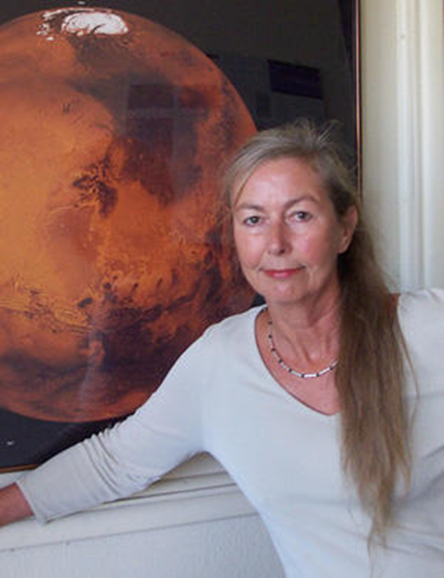
Not all employees’ dreams include being an astronaut. Beside Shoemaker stood pioneers like Baerbel Lucchitta, who transformed grainy satellite imagery into the first intricate tapestries of Martian and lunar geography, proving that a steady hand and a sharp eye could map worlds we had yet to touch.
Lucchitta authored a map covering the north side of the Moon, the first geologic maps of Europa and, with Eugene Shoemaker and others, of Ganymede, and was the coordinator of the Galilean Satellites Geologic Mapping Program. Lucchitta’s professional milestones are as vast as the landscapes that she mapped.
As a pioneer in planetary cartography and astronaut training, Lucchitta became a beacon of possibility for women in science, technology, engineering, and mathematics (STEM) during a time when the field was mostly male dominated.
She received the Meritorious Service Award from the Department of the Interior for her USGS work, had a glacier in Antarctica (Lucchitta Glacier) named after her, and an asteroid named 4569 Baerbel for her contributions to planetary geology.
The Proof.

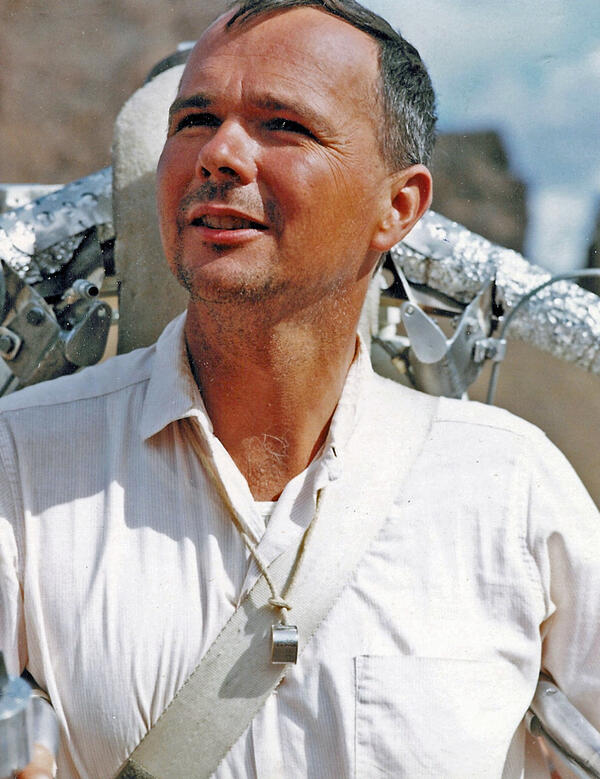
In 1964 when Schmitt worked at ASC, he was mentored by Shoemaker. He eventually became the first (and so far only) geologist to walk on the Moon during Apollo 17 in December 1972. While a medical condition kept Shoemaker's own boots off the lunar surface, his vision found its vessel in Schmitt—who carried the USGS banner to Taurus-Littrow Valley during Apollo 17. Schmitt wasn’t just an astronaut; he was a field geologist trained by Shoemaker, working the ultimate “out of office assignment,” proving that the rigor of Earth science was the key to unlocking the secrets of the Solar System.
The Future.
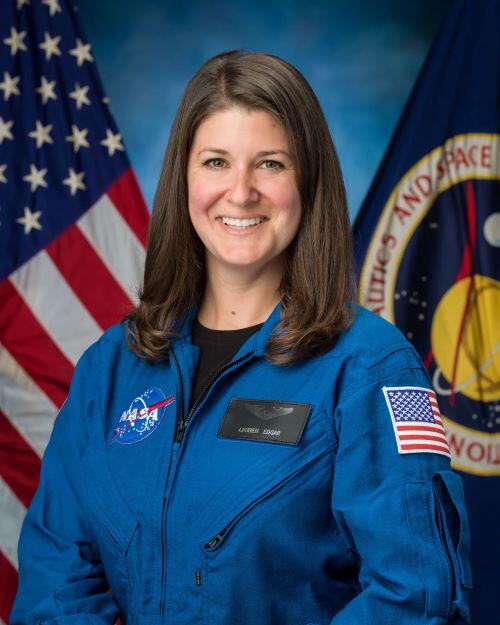
Lauren Edgar: Now that torch is passed once more, that legacy of dreaming in stone reaches its ultimate realization. With the selection of Dr. Lauren Edgar to be trained as an astronaut, the USGS legacy moves into its next great act. Edgar represents the modern synthesis of everything that came before: She carries Shoemaker’s vision and Schmitt’s trailblazing spirit. Both Lucchitta and Edgar built their careers at USGS, were responsible for teaching astronauts how to be field geologists, and their research focused on understanding the geological history of the Moon and Mars. Edgar served as the deputy principal investigator for the Artemis III Geology team, helping to set scientific goals for the upcoming return to the lunar surface.
“Lauren reminds us that we can achieve our life-long dreams through persistence and dedication.” – Chris Okubo, Acting Center Director
At the USGS, the dream hasn’t come true just once—it’s a recurring reality—proving that the best way to study the stars is to start with the stones. Our story is about more than maps and measurements; it is one of a persistent, multi-generational reach toward the horizon. From the moment Shoemaker looked through a telescope and saw a geologic frontier, a cycle was set in motion that refused to be bound by Earth’s gravity.