



39 Years of Stream Conditions Show Widespread Biological Changes Across the Chesapeake Bay Watershed
USGS scientists predicted stream biological conditions across the Chesapeake Bay watershed from 1985 through 2023, revealing widespread changes but only a ~1% increase in stream length classified as improved. These predicted improvements fell short of the Chesapeake Bay Program’s goal of improving the health of 10% of streams by 2025.
Issue
The Chesapeake Bay Program’s Stream Health Workgroup set a goal to “Improve health and function of 10 percent of stream miles above the 2008 baseline for the Chesapeake Bay watershed” by 2025. Throughout this period, numerous stream management activities were implemented to help achieve this goal; however, increasing development and other landscape changes in the watershed can offset biological improvements. Therefore, decision makers need to understand how overall stream health has changed in recent decades and how landscape factors affect in-stream conditions. This understanding can be developed by applying extensive biological monitoring data in predictive models that estimate stream conditions throughout the watershed and over multiple decades.
USGS Study
USGS scientists developed random forest machine-learning models using benthic macroinvertebrate observations together with landscape, land-cover, and climate data to predict annual biological conditions for more than 360,000 small streams from 1985 through 2023. These predictions addressed major gaps in long-term monitoring and were used to evaluate long-term trends in stream health, helping to assess progress towards Chesapeake Bay Program restoration goals.
Major Findings
This study provided a long-term, watershed-wide assessment of stream health.
- Stream-health improvements fell short of watershed goals. By 2021, improvements in the Index of Biological Integrity – a composite metric of biological condition – were predicted for only ~1% of total stream length, well below Chesapeake Bay Program’s goal of improving 10% of streams.
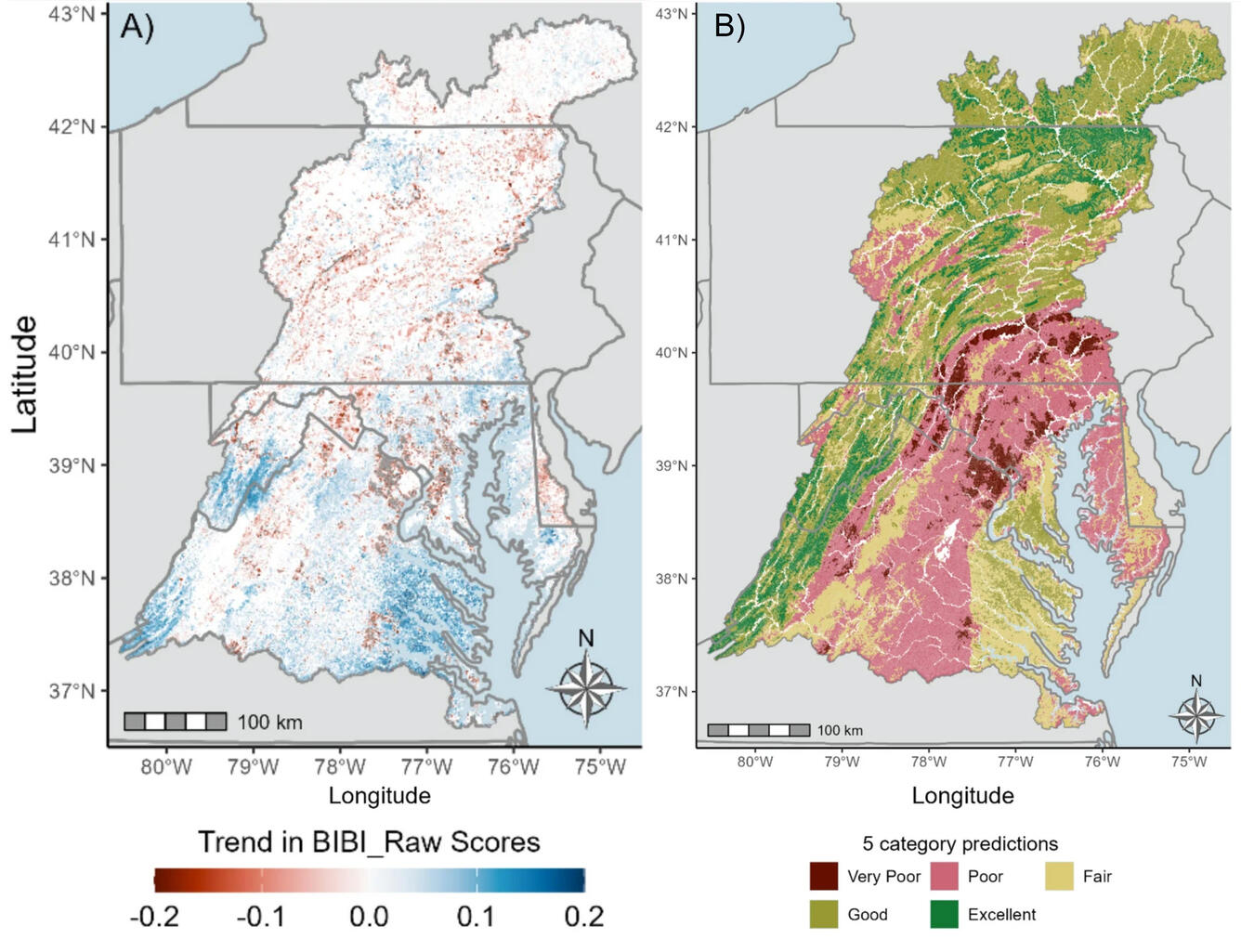
- Stream-health trends differed across regions and biological indicators. Some indicators – such as the Index of Biological Integrity – improved in many southern streams but declined in northern streams (Figure 1A), while other indicators decreased across most of the watershed outside of the Southeastern Plains bioregion.
- Streams near metropolitan regions – such as Washington, D.C. and Baltimore – consistently exhibited poor biological condition and declining trends across all biological metrics, highlighting the strong influence of urbanization on stream health (Figure 1A and 1B).
Management Implications
This study provides decision makers with valuable insights to assess progress towards meeting stream-health goals and plan future management activities. Although stream-health improvements fell short of the Chesapeake Bay Program’s goal, the net improvement predicted for watershed-wide biological conditions is notable given the increase in developed land across the watershed in recent decades. By combining long-term monitoring data with machine learning, the models can identify areas of high- and low-quality streams, providing information that can help target future management efforts.
This study is part of a larger USGS-led effort to assess watershed-wide patterns and trends in other key stream-health indicators, including fish, physical habitat, salinity, sediment and stream temperature. Scientists leading this effort are collaborating with partners throughout the watershed to synthesize these results into a web-based platform that will provide a multi-indicator assessment to support future management decisions.
For More Information
The full study is published online with open access: https://doi.org/10.1007/s10750-026-06323-8.
All R scripts and packages and model predictions are available at https://doi.org/10.5066/P1FNLURX.
USGS scientists predicted stream biological conditions across the Chesapeake Bay watershed from 1985 through 2023, revealing widespread changes but only a ~1% increase in stream length classified as improved. These predicted improvements fell short of the Chesapeake Bay Program’s goal of improving the health of 10% of streams by 2025.
Issue
The Chesapeake Bay Program’s Stream Health Workgroup set a goal to “Improve health and function of 10 percent of stream miles above the 2008 baseline for the Chesapeake Bay watershed” by 2025. Throughout this period, numerous stream management activities were implemented to help achieve this goal; however, increasing development and other landscape changes in the watershed can offset biological improvements. Therefore, decision makers need to understand how overall stream health has changed in recent decades and how landscape factors affect in-stream conditions. This understanding can be developed by applying extensive biological monitoring data in predictive models that estimate stream conditions throughout the watershed and over multiple decades.
USGS Study
USGS scientists developed random forest machine-learning models using benthic macroinvertebrate observations together with landscape, land-cover, and climate data to predict annual biological conditions for more than 360,000 small streams from 1985 through 2023. These predictions addressed major gaps in long-term monitoring and were used to evaluate long-term trends in stream health, helping to assess progress towards Chesapeake Bay Program restoration goals.
Major Findings
This study provided a long-term, watershed-wide assessment of stream health.
- Stream-health improvements fell short of watershed goals. By 2021, improvements in the Index of Biological Integrity – a composite metric of biological condition – were predicted for only ~1% of total stream length, well below Chesapeake Bay Program’s goal of improving 10% of streams.
- Stream-health trends differed across regions and biological indicators. Some indicators – such as the Index of Biological Integrity – improved in many southern streams but declined in northern streams (Figure 1A), while other indicators decreased across most of the watershed outside of the Southeastern Plains bioregion.
- Streams near metropolitan regions – such as Washington, D.C. and Baltimore – consistently exhibited poor biological condition and declining trends across all biological metrics, highlighting the strong influence of urbanization on stream health (Figure 1A and 1B).
Management Implications
This study provides decision makers with valuable insights to assess progress towards meeting stream-health goals and plan future management activities. Although stream-health improvements fell short of the Chesapeake Bay Program’s goal, the net improvement predicted for watershed-wide biological conditions is notable given the increase in developed land across the watershed in recent decades. By combining long-term monitoring data with machine learning, the models can identify areas of high- and low-quality streams, providing information that can help target future management efforts.
This study is part of a larger USGS-led effort to assess watershed-wide patterns and trends in other key stream-health indicators, including fish, physical habitat, salinity, sediment and stream temperature. Scientists leading this effort are collaborating with partners throughout the watershed to synthesize these results into a web-based platform that will provide a multi-indicator assessment to support future management decisions.
For More Information
The full study is published online with open access: https://doi.org/10.1007/s10750-026-06323-8.
All R scripts and packages and model predictions are available at https://doi.org/10.5066/P1FNLURX.