



Black Carp Biology, Assessment, and Control
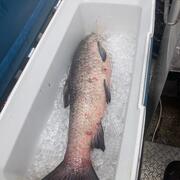
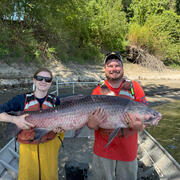
Black Carp (Mylopharyngodon piceus) is the largest of the four non-indigenous carp species, reaching sizes well in excess of 100 pounds. Scientists at the Columbia Environmental Research Center, in cooperation with federal and state partners, are studying the biology, ecology, and behavior of black carp and developing tools to monitor, assess, and control this non-indigenous species.

The Issue: Black carp are an invasive molluscivore in North America, originally transported to aquaculture facilities for their application as a biological control of snails in the 1980s. Since their introduction to the United States, escapes into the wild have been documented, and reproducing populations are now present in the Mississippi River basin. The greatest concern for black carp population expansion is the impact on native mussel and snail fauna, of which many species are already listed as threatened or endangered.
Addressing the Issue:

Much of the understanding of the black carp life history, including their habitats and diet, comes from fish caught and reported by commercial fishers and biologists to USGS and partners. These sources provide valuable data on the growth, development, diet, and methods by which black carp may be collected. However, these opportunistic results lack a systematic sample design and may not be sufficient to document spread of this species.
CERC scientists are working to collect baseline data on the biology, ecology, and status of black carp to effectively target the species and control their spread. This effort includes additional work to document captures and to monitor distribution. Information on the distribution of black carp is available at USGS Nonindigenous Aquatic Species Database.
CERC scientists have studied:
- Morphological methods for identification of large juvenile and adult black carp, and discrimination from grass carp.
- Diet composition of black carp.
- Ingested toxicity of antimycin A, a non-selective piscicide, to black carp and grass carp.
- Development of a delivery method for a black carp species-specific toxic bait.
- The methods and habitats of prior commercial captures to help design systematic, targeted collection and control efforts.
- How black carp became established in the Mississippi River basin: identifying sources and year classes contributing to recruitment.
- Evaluated aging methods for precision of age estimation using a suite of standard calcified structures.
Current projects are underway to:
- Measure habitat use and movement patterns through active relocation of telemetry tagged fish.
- Optimize commercial capture techniques to increase efficiency.
- Assess reproductive development of wild black carp for the timing and size at age of maturation.
- Quantify behavioral responses of black carp, grass carp, silver carp, and bighead carp to electrofishing waveforms to maximize capture responses.
- Support decision-making and application of relevant science for the U.S. Fish and Wildlife Service and partners to improve assessment and control of black carp.

Next Steps:
- Continue to research habitat use and movement of black carp using active relocation and passive receiver arrays.
- Predict the potential habitats and range of black carp beyond the currently studied areas.
- Optimize timing and methods for collection and detection of all life stages of black carp or their DNA.
- Continue to coordinate with state and federal partners to identify the mollusk-specific diet of wild black carp and identify tools for assessing potential ecological effects or control.
- Identify and test potential baits or attractants to increase capture efficiency of black carp.
Additional Resources:
Invasive Black Carp Established in Parts of the Mississippi River Basin
Return to Invasive Species Ecology
Return to Fisheries and Invasive Species
Invasive Carps Photos:


Black Carp (Mylopharyngodon piceus) is the largest of the four non-indigenous carp species, reaching sizes well in excess of 100 pounds. Scientists at the Columbia Environmental Research Center, in cooperation with federal and state partners, are studying the biology, ecology, and behavior of black carp and developing tools to monitor, assess, and control this non-indigenous species.
The Issue: Black carp are an invasive molluscivore in North America, originally transported to aquaculture facilities for their application as a biological control of snails in the 1980s. Since their introduction to the United States, escapes into the wild have been documented, and reproducing populations are now present in the Mississippi River basin. The greatest concern for black carp population expansion is the impact on native mussel and snail fauna, of which many species are already listed as threatened or endangered.
Addressing the Issue:
Much of the understanding of the black carp life history, including their habitats and diet, comes from fish caught and reported by commercial fishers and biologists to USGS and partners. These sources provide valuable data on the growth, development, diet, and methods by which black carp may be collected. However, these opportunistic results lack a systematic sample design and may not be sufficient to document spread of this species.
CERC scientists are working to collect baseline data on the biology, ecology, and status of black carp to effectively target the species and control their spread. This effort includes additional work to document captures and to monitor distribution. Information on the distribution of black carp is available at USGS Nonindigenous Aquatic Species Database.
CERC scientists have studied:
- Morphological methods for identification of large juvenile and adult black carp, and discrimination from grass carp.
- Diet composition of black carp.
- Ingested toxicity of antimycin A, a non-selective piscicide, to black carp and grass carp.
- Development of a delivery method for a black carp species-specific toxic bait.
- The methods and habitats of prior commercial captures to help design systematic, targeted collection and control efforts.
- How black carp became established in the Mississippi River basin: identifying sources and year classes contributing to recruitment.
- Evaluated aging methods for precision of age estimation using a suite of standard calcified structures.
Current projects are underway to:
- Measure habitat use and movement patterns through active relocation of telemetry tagged fish.
- Optimize commercial capture techniques to increase efficiency.
- Assess reproductive development of wild black carp for the timing and size at age of maturation.
- Quantify behavioral responses of black carp, grass carp, silver carp, and bighead carp to electrofishing waveforms to maximize capture responses.
- Support decision-making and application of relevant science for the U.S. Fish and Wildlife Service and partners to improve assessment and control of black carp.
Next Steps:
- Continue to research habitat use and movement of black carp using active relocation and passive receiver arrays.
- Predict the potential habitats and range of black carp beyond the currently studied areas.
- Optimize timing and methods for collection and detection of all life stages of black carp or their DNA.
- Continue to coordinate with state and federal partners to identify the mollusk-specific diet of wild black carp and identify tools for assessing potential ecological effects or control.
- Identify and test potential baits or attractants to increase capture efficiency of black carp.
Additional Resources:
Invasive Black Carp Established in Parts of the Mississippi River Basin
Return to Invasive Species Ecology
Return to Fisheries and Invasive Species
Invasive Carps Photos: