



New tools for a growing threat: Co-developed science informs the fight against invasive grasses in the sagebrush biome
In a new study, FORT scientists worked with resource managers to co-develop a strategic framework for invasive grass management across the sagebrush biome. The framework, implemented through computer simulation models, can help resource managers explore the efficacy of invasive grass management strategies and develop informed, economic conservation plans.
Managing invasive grasses: a costly, complicated issue
Invasive annual grasses are taking over the sagebrush biome, increasing wildfire risk and destroying native ecosystems. Controlling invasive annual grasses is difficult, and requires understanding the effectiveness of management actions, the logistical and budgetary constraints of treating invasive grasses, and the uncertainty in treatment dynamics across geographic scales.
Resource managers need tools that can forecast the cumulative costs and potential outcomes of invasive annual grass management actions over space and time. To support this need, scientists worked with resource managers to develop relevant simulation models of invasive annual grass management actions across scales.
Co-developing an invasive plant management framework
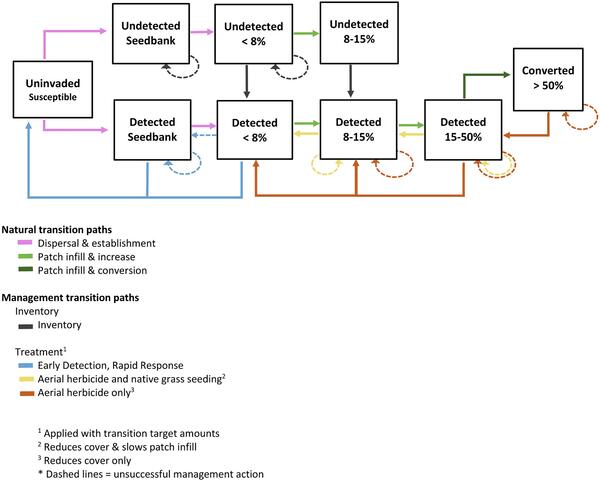
Over the course of a year, researchers hosted 13 expert elicitation meetings to gather information on invasive annual grass management actions and objectives and to define a set of management scenarios to be addressed by the simulations. Selected experts represented a variety of organizations working on invasive grass management across the sagebrush biome, including individuals with field experience and regional researchers studying sagebrush, wildfire, and invasive grass dynamics.
Working closely with resource managers allowed USGS scientists to match their scientific questions to managers’ needs. Further, managers offered invaluable insights for filling in gaps left by scientific uncertainty about the details of how the modeled system would be expected to change over time.
To start, experts identified three invasive annual grass management objectives for the sagebrush biome: preserving core sagebrush areas, minimizing the degradation of wildlife habitat, and reducing wildfire risk. Next, experts defined two scenarios of management relevance for simulation. In the first scenario, simulations would demonstrate invasive annual grass growth and spread without any management action, providing a baseline for comparison against any potential management actions. In the second scenario, simulations would demonstrate the potential for management actions to the spread of invasive annual grasses.
Researchers worked iteratively with resource managers over the course of a year to determine the type, extent, and frequency of management actions to simulate so that scenarios would accurately reflect historic practices and their potential outcomes. Researchers combined information from the experts and from the scientific literature to build the details of how the system would change over time, such as how quickly the invasive annual grass spreads and how management actions would affect annual grass cover over time. Finally, the experts identified relevant management scales across the sagebrush biome, including ecological regions, core sagebrush areas and management areas of interest identified by the Sagebrush Conservation Design, and sage-grouse population units.
Laying the groundwork for future simulations
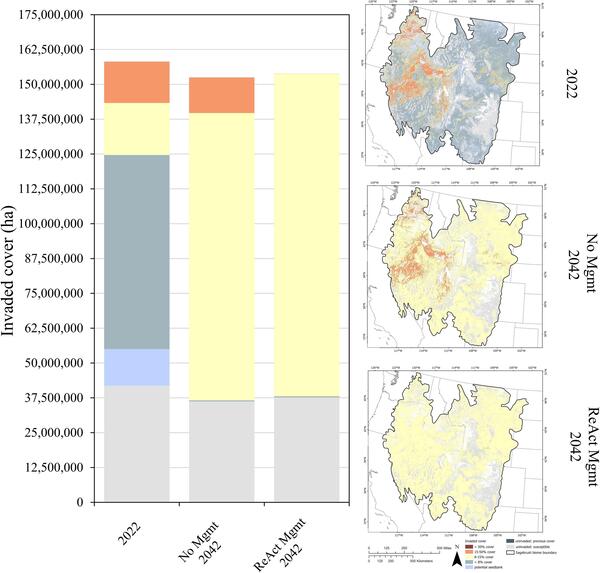
The simulation models and framework established in this study help quantify the risks invasive annual grasses pose to sagebrush ecosystems under different approaches to management.
This paper presents a first set of results that demonstrate the usefulness of the modeling framework. These results suggest that management practices focused on treating high levels of infestation may be effective at mitigating conversion of sagebrush to invasive annual grass-dominated ecosystems, but they may not reduce the spread of these grasses across the biome.
Moreover, the co-developed framework provides a foundation for future investigation into both the costs and effectiveness of novel or innovative invasive management practices, to help resource managers determine which actions are most cost-effective over space and time.
Related
Shrubland, Alpine and Grassland Ecology (SAGE) Wildlife Research Group

Economic assessment of addressing annual invasive grasses across the sagebrush biome
Related
Shrubland, Alpine and Grassland Ecology (SAGE) Wildlife Research Group