



Algal Community Composition within the Lower Norwalk River
Harmful algal blooms (HABs), fish kills, and shellfish contamination are increasingly affecting coastal estuaries like the Norwalk River. Understanding the microscopic algae responsible for these events is essential for protecting public health, local economies, and marine ecosystems. As the environmental conditions of estuaries continue to change from nutrient enrichment, warming temperatures, and shifting hydrologic patterns, natural resource managers need to learn more about the algal community dynamics of estuarine ecosystems.
The U.S. Geological Survey (USGS), in cooperation with the Connecticut Department of Energy and Environmental Protection (CT DEEP), is conducting a pilot study to characterize phytoplankton community composition in the tidal portion of the Norwalk River Estuary, a key tributary to Long Island Sound (LIS). This project will improve understanding of how algal communities respond to changing physical and chemical conditions throughout the estuarine system by evaluating phytoplankton species composition, abundance, and biovolume across environmental gradients in tidal river
The Value of Understanding Algal Communities
Phytoplankton, or free-floating, microscopic algae, form the base of many estuarine and coastal food webs, supporting commercially and ecologically important species of shellfish, zooplankton, and juvenile fish. Therefore, algal community composition is directly linked to the health and productivity of estuary and tidal river ecosystems.
The study of this topic is important because it directly affects the general public. Excessive algal growth can produce toxins harmful to humans and pets, cause fish kills through oxygen depletion (hypoxia), and lead to shellfish contamination that makes human consumption dangerous. Insufficient or unbalanced algal communities create different problems. Loss of nutritious phytoplankton can starve zooplankton and fish larvae, collapsing food webs and reducing productivity in commercially-important fisheries. Additionally, algal blooms impact local economies through beach and shellfish harvesting closures that reduce tourism and negatively impact nearby communities.
Understanding how and why algal communities change will inform water quality risks and management actions. Because algal community composition is influenced by a variety of environmental factors, including salinity, temperature, light, water column stratification, and nutrient availability, this project examines how algal communities vary along salinity gradients and respond to freshwater input, tides, and seasonal conditions.
The Norwalk River – How Tides Impact Phytoplankton
The Norwalk River is a tidal river, which means the tidal effects of a coastal water body at the mouth of the river affect the salinity and flow of the river. Upstream conditions in the Norwalk River are more greatly influenced by freshwater inputs and terrestrial drainage, while downstream conditions are affected by tidal variability and mixing with Long Island Sound.
In the lower Norwalk River, the interaction between freshwater and saltwater, coupled with watershed derived nutrients, can drive shifts in the abundance and diversity of algal species. For instance, HABs from nutrient enrichment degrade water quality and lower dissolved oxygen levels, negatively impacting aquatic organisms and fisheries.
Tidal rivers can vary greatly along vertical and lateral gradients affecting algal community composition, abundance, and distribution. Vertical stratification, driven by salinity and temperature differences in the Norwalk River, can reduce mixing between surface and bottom waters, resulting in distinct environmental conditions with depth. Surface waters are typically characterized by greater light availability, lower salinity, and nutrient inputs from upstream runoff promote rapid algal growth, while deeper waters, often have reduced light penetration, higher salinity, lower dissolved oxygen concentrations, and longer water residence times. Evaluating environmental conditions across vertical and lateral gradients in this project will help us better understand how variable conditions impact algal community structure.
Approach
Phytoplankton samples, paired with select nutrient data, will be used to evaluate relationships between community structure and nutrient conditions. Continuous water quality data from selected stations in the Norwalk River may be used to further evaluate relationships between algal dynamics and environmental conditions. Results for species composition, relative abundance, and biovolume can provide insight into the ecological processes and water quality conditions in tidal rivers connected to LIS.
Monitoring and Data Collection
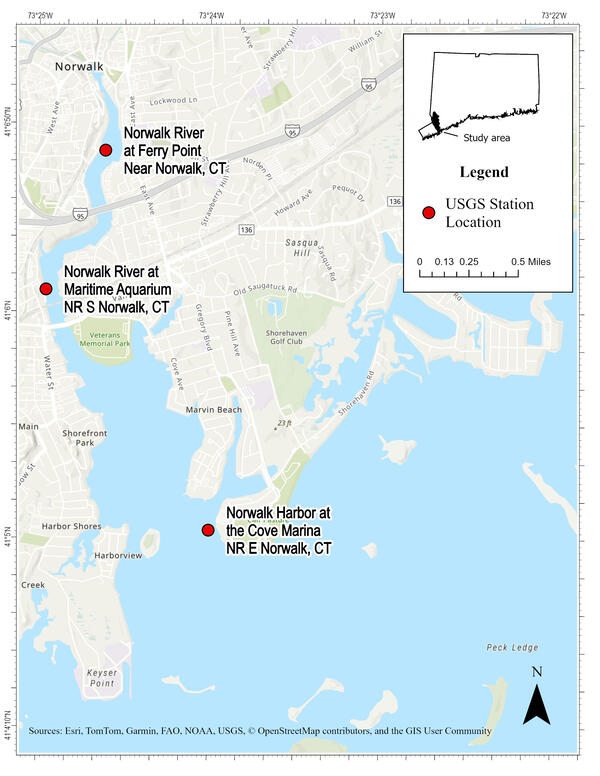
Table 1. Data collection sites
| Site Number | Site Name |
| 410643073243700 | Norwalk River at Ferry Point, CT |
| 410606073245700 | Norwalk River at Norwalk Aquarium nr S Norwalk, CT |
| 410502073236000 | Norwalk Harbor at the Cove Marina nr E Norwalk, CT |
Monitoring and sampling will occur at three sites within the Norwalk River embayment (Table 1): at Ferry Point, the Norwalk Aquarium, and the Norwalk Harbor at Cove Marina. (Figure 1). These sites are positioned in the Norwalk River along the natural salinity gradient within the tidal portion of the river representing variable conditions. Additionally, these monitoring locations provide consistent sampling access and are supported by continuous water quality monitoring stations that can be used to help identify periods of environmental change and algal bloom development, providing context for interpreting discrete nutrient and phytoplankton samples.
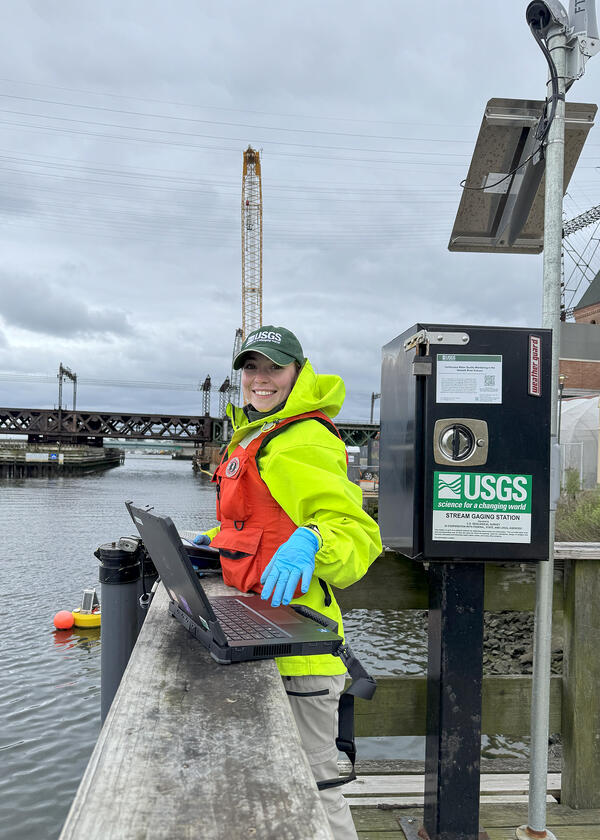
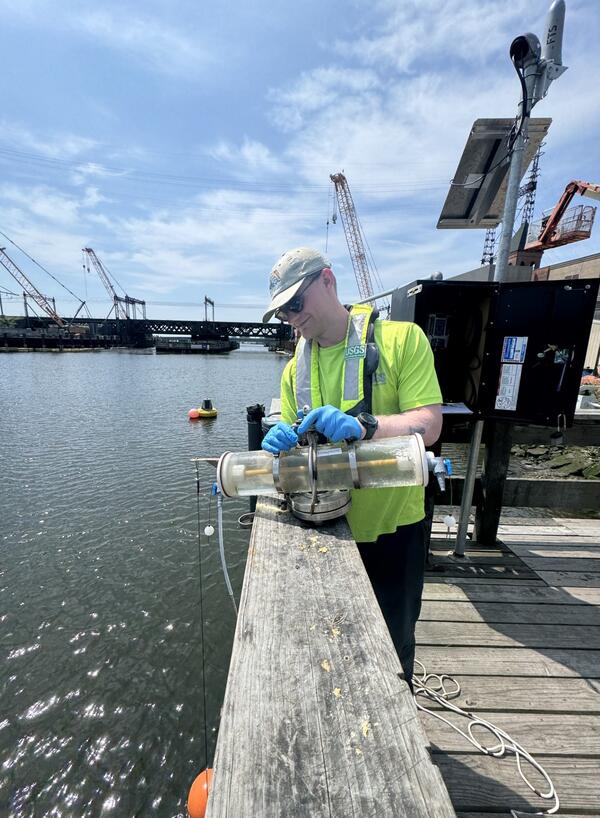
Monthly nutrient and phytoplankton samples are taken at these three sites. Sampling is collected from top and bottom layers of water at each site to capture environmental variability within the water column. Samples will be analyzed for algal community composition, abundance, and biovolume, as well as a limited nutrient analysis including Total Kjeldahl Nitrogen, and nitrate plus nitrite, which are used to determine total nitrogen, as well as total phosphorus. In addition, targeted sampling will be conducted to capture at least two algal bloom events, allowing for the evaluation of changes in species composition related to bloom events.
Continuous water quality data collected at Norwalk River at Norwalk Aquarium (410606073245700) and Norwalk Harbor at the Cove Marina (410502073236000) are leveraged by this project to track real-time bloom events and other water quality parameters. (Links to continuous water quality data for water temperature, specific conductance, dissolved oxygen, pH, turbidity, and chlorophyll a can be found in Table 1.)
Together, the collected data will support identification of changes in algal composition related to seasonal conditions, nutrient availability, and tidal influences.
Harmful algal blooms (HABs), fish kills, and shellfish contamination are increasingly affecting coastal estuaries like the Norwalk River. Understanding the microscopic algae responsible for these events is essential for protecting public health, local economies, and marine ecosystems. As the environmental conditions of estuaries continue to change from nutrient enrichment, warming temperatures, and shifting hydrologic patterns, natural resource managers need to learn more about the algal community dynamics of estuarine ecosystems.
The U.S. Geological Survey (USGS), in cooperation with the Connecticut Department of Energy and Environmental Protection (CT DEEP), is conducting a pilot study to characterize phytoplankton community composition in the tidal portion of the Norwalk River Estuary, a key tributary to Long Island Sound (LIS). This project will improve understanding of how algal communities respond to changing physical and chemical conditions throughout the estuarine system by evaluating phytoplankton species composition, abundance, and biovolume across environmental gradients in tidal river
The Value of Understanding Algal Communities
Phytoplankton, or free-floating, microscopic algae, form the base of many estuarine and coastal food webs, supporting commercially and ecologically important species of shellfish, zooplankton, and juvenile fish. Therefore, algal community composition is directly linked to the health and productivity of estuary and tidal river ecosystems.
The study of this topic is important because it directly affects the general public. Excessive algal growth can produce toxins harmful to humans and pets, cause fish kills through oxygen depletion (hypoxia), and lead to shellfish contamination that makes human consumption dangerous. Insufficient or unbalanced algal communities create different problems. Loss of nutritious phytoplankton can starve zooplankton and fish larvae, collapsing food webs and reducing productivity in commercially-important fisheries. Additionally, algal blooms impact local economies through beach and shellfish harvesting closures that reduce tourism and negatively impact nearby communities.
Understanding how and why algal communities change will inform water quality risks and management actions. Because algal community composition is influenced by a variety of environmental factors, including salinity, temperature, light, water column stratification, and nutrient availability, this project examines how algal communities vary along salinity gradients and respond to freshwater input, tides, and seasonal conditions.
The Norwalk River – How Tides Impact Phytoplankton
The Norwalk River is a tidal river, which means the tidal effects of a coastal water body at the mouth of the river affect the salinity and flow of the river. Upstream conditions in the Norwalk River are more greatly influenced by freshwater inputs and terrestrial drainage, while downstream conditions are affected by tidal variability and mixing with Long Island Sound.
In the lower Norwalk River, the interaction between freshwater and saltwater, coupled with watershed derived nutrients, can drive shifts in the abundance and diversity of algal species. For instance, HABs from nutrient enrichment degrade water quality and lower dissolved oxygen levels, negatively impacting aquatic organisms and fisheries.
Tidal rivers can vary greatly along vertical and lateral gradients affecting algal community composition, abundance, and distribution. Vertical stratification, driven by salinity and temperature differences in the Norwalk River, can reduce mixing between surface and bottom waters, resulting in distinct environmental conditions with depth. Surface waters are typically characterized by greater light availability, lower salinity, and nutrient inputs from upstream runoff promote rapid algal growth, while deeper waters, often have reduced light penetration, higher salinity, lower dissolved oxygen concentrations, and longer water residence times. Evaluating environmental conditions across vertical and lateral gradients in this project will help us better understand how variable conditions impact algal community structure.
Approach
Phytoplankton samples, paired with select nutrient data, will be used to evaluate relationships between community structure and nutrient conditions. Continuous water quality data from selected stations in the Norwalk River may be used to further evaluate relationships between algal dynamics and environmental conditions. Results for species composition, relative abundance, and biovolume can provide insight into the ecological processes and water quality conditions in tidal rivers connected to LIS.
Monitoring and Data Collection
Table 1. Data collection sites
| Site Number | Site Name |
| 410643073243700 | Norwalk River at Ferry Point, CT |
| 410606073245700 | Norwalk River at Norwalk Aquarium nr S Norwalk, CT |
| 410502073236000 | Norwalk Harbor at the Cove Marina nr E Norwalk, CT |
Monitoring and sampling will occur at three sites within the Norwalk River embayment (Table 1): at Ferry Point, the Norwalk Aquarium, and the Norwalk Harbor at Cove Marina. (Figure 1). These sites are positioned in the Norwalk River along the natural salinity gradient within the tidal portion of the river representing variable conditions. Additionally, these monitoring locations provide consistent sampling access and are supported by continuous water quality monitoring stations that can be used to help identify periods of environmental change and algal bloom development, providing context for interpreting discrete nutrient and phytoplankton samples.
Monthly nutrient and phytoplankton samples are taken at these three sites. Sampling is collected from top and bottom layers of water at each site to capture environmental variability within the water column. Samples will be analyzed for algal community composition, abundance, and biovolume, as well as a limited nutrient analysis including Total Kjeldahl Nitrogen, and nitrate plus nitrite, which are used to determine total nitrogen, as well as total phosphorus. In addition, targeted sampling will be conducted to capture at least two algal bloom events, allowing for the evaluation of changes in species composition related to bloom events.
Continuous water quality data collected at Norwalk River at Norwalk Aquarium (410606073245700) and Norwalk Harbor at the Cove Marina (410502073236000) are leveraged by this project to track real-time bloom events and other water quality parameters. (Links to continuous water quality data for water temperature, specific conductance, dissolved oxygen, pH, turbidity, and chlorophyll a can be found in Table 1.)
Together, the collected data will support identification of changes in algal composition related to seasonal conditions, nutrient availability, and tidal influences.