



Cryptosporidium Synoptic Study of the Raritan River Basin
The USGS New Jersey Water Science Center is partnering with New Jersey American Water (NJAW) on a project in the Raritan River Basin Study area to investigate the potential sources of Cryptosporidium in the Raritan River Basin.
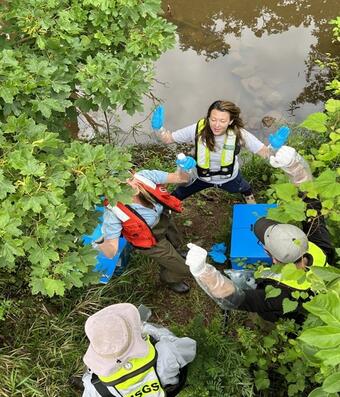
Cryptosporidium (Crypto) is a protozoan parasite of both domestic and wild animals that has been labeled as a pathogen of concern. Crypto may be introduced to waterbodies by point or non-point sources and is considered a leading cause of waterborne disease among humans in the United States. Potential human health risks have been noted for those using the Raritan River Basin for recreational activities as well as for sources of drinking water.
The USGS New Jersey Water Science Center is partnering with New Jersey American Water (NJAW) on a project in the Raritan River Basin Study area. The objective of the project is to investigate the occurrence and potential sources of Cryptosporidium from multiple rivers and tributaries to the main steam Raritan River.
Phase 1
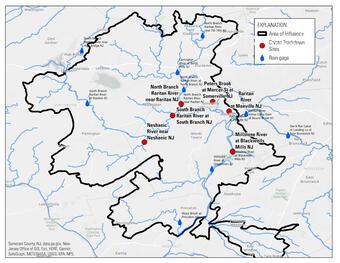
Phase 1 of the Raritan River Basin Cryptosporidium investigation focused on establishing the presence, spatial distribution, and variability of Cryptosporidium across six key sites in the basin. The study confirmed that Cryptosporidium was present throughout the system, with concentrations and sources influenced by both spatial and temporal factors. Findings from this phase supported broader efforts by New Jersey American Water (NJAW), the U.S. Environmental Protection Agency, and other partners to identify potential environmental and anthropogenic contributors to microbial contamination within the watershed.
Data and insights from Phase 1 are being compiled into a Scientific Investigations Report (SIR), which will provide comprehensive detail on contamination patterns, temporal trends, and potential upstream source locations. This report will inform management actions and guide targeted remediation of microbial contamination in the Raritan River Basin.
Phase 2
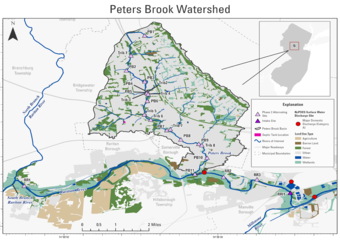
Phase 2 of the project focused on an expanded, targeted investigation within the Peters Brook sub‑basin, where Phase 1 results indicated elevated Cryptosporidium presence and potential source inputs. Sampling was conducted across 9–12 strategically selected sites along Peters Brook and its contributing tributaries. These sites were chosen to increase spatial resolution, capture potential upstream‑to‑downstream gradients, and isolate areas of interest identified during preliminary assessments. The expanded dataset supports identification of localized source areas, evaluation of land‑use influences, and improved understanding of how storm‑driven processes contribute to microbial contamination.
Methods
This study examines Cryptosporidium in the Raritan River Basin using a sampling strategy that includes baseline and event-driven hydrologic conditions. Both phases followed the same framework, collecting samples during low-to-normal and storm conditions to identify persistent and runoff-driven contamination.
Low‑to‑Normal Flow Sampling (Phase 1 & Phase 2)
- Conducted during stable base-flow periods to characterize background concentrations.
- Helps identify chronic or continuous sources within the watershed.
- Provides consistent spatial comparison across sites and phases.
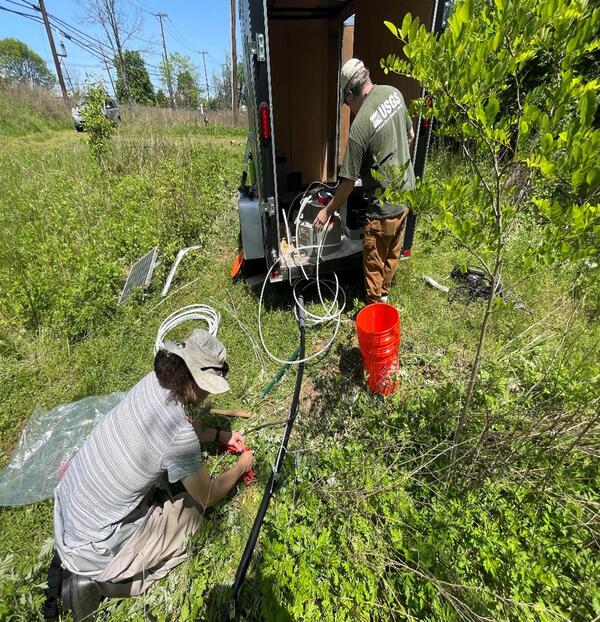
Storm‑Flow Sampling (Phase 1 & Phase 2)
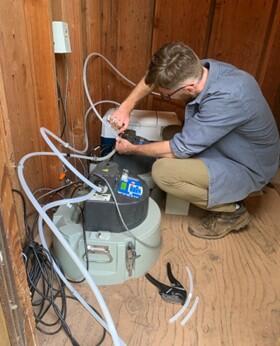
- Targets runoff‑driven conditions, including first‑flush and elevated‑discharge periods.
- Captures episodic contamination linked to rainfall, land‑use activities, overland flow, and resuspension.
- Essential for identifying non‑point sources and hydrologic drivers of microbial pulses.
Together, these methods ensure that both phases of the investigation assess how hydrologic conditions influence Cryptosporidium transport, variability, and potential source contributions throughout the Raritan River Basin.
The USGS New Jersey Water Science Center is partnering with New Jersey American Water (NJAW) on a project in the Raritan River Basin Study area to investigate the potential sources of Cryptosporidium in the Raritan River Basin.
Cryptosporidium (Crypto) is a protozoan parasite of both domestic and wild animals that has been labeled as a pathogen of concern. Crypto may be introduced to waterbodies by point or non-point sources and is considered a leading cause of waterborne disease among humans in the United States. Potential human health risks have been noted for those using the Raritan River Basin for recreational activities as well as for sources of drinking water.
The USGS New Jersey Water Science Center is partnering with New Jersey American Water (NJAW) on a project in the Raritan River Basin Study area. The objective of the project is to investigate the occurrence and potential sources of Cryptosporidium from multiple rivers and tributaries to the main steam Raritan River.
Phase 1
Phase 1 of the Raritan River Basin Cryptosporidium investigation focused on establishing the presence, spatial distribution, and variability of Cryptosporidium across six key sites in the basin. The study confirmed that Cryptosporidium was present throughout the system, with concentrations and sources influenced by both spatial and temporal factors. Findings from this phase supported broader efforts by New Jersey American Water (NJAW), the U.S. Environmental Protection Agency, and other partners to identify potential environmental and anthropogenic contributors to microbial contamination within the watershed.
Data and insights from Phase 1 are being compiled into a Scientific Investigations Report (SIR), which will provide comprehensive detail on contamination patterns, temporal trends, and potential upstream source locations. This report will inform management actions and guide targeted remediation of microbial contamination in the Raritan River Basin.
Phase 2
Phase 2 of the project focused on an expanded, targeted investigation within the Peters Brook sub‑basin, where Phase 1 results indicated elevated Cryptosporidium presence and potential source inputs. Sampling was conducted across 9–12 strategically selected sites along Peters Brook and its contributing tributaries. These sites were chosen to increase spatial resolution, capture potential upstream‑to‑downstream gradients, and isolate areas of interest identified during preliminary assessments. The expanded dataset supports identification of localized source areas, evaluation of land‑use influences, and improved understanding of how storm‑driven processes contribute to microbial contamination.
Methods
This study examines Cryptosporidium in the Raritan River Basin using a sampling strategy that includes baseline and event-driven hydrologic conditions. Both phases followed the same framework, collecting samples during low-to-normal and storm conditions to identify persistent and runoff-driven contamination.
Low‑to‑Normal Flow Sampling (Phase 1 & Phase 2)
- Conducted during stable base-flow periods to characterize background concentrations.
- Helps identify chronic or continuous sources within the watershed.
- Provides consistent spatial comparison across sites and phases.
Storm‑Flow Sampling (Phase 1 & Phase 2)
- Targets runoff‑driven conditions, including first‑flush and elevated‑discharge periods.
- Captures episodic contamination linked to rainfall, land‑use activities, overland flow, and resuspension.
- Essential for identifying non‑point sources and hydrologic drivers of microbial pulses.
Together, these methods ensure that both phases of the investigation assess how hydrologic conditions influence Cryptosporidium transport, variability, and potential source contributions throughout the Raritan River Basin.