U.S. flag

An official website of the United States government

Science

The New Jersey Water Science Center's mission is to collect, and disseminate reliable scientific information on issues affecting rivers, lakes, estuaries, groundwater, and water resources across the state of New Jersey and its neighbors. These data provide the scientific knowledge that engineers, planners, and managers can use to make informed water-resources decisions. 

Surface Water

Surface Water

Groundwater

Groundwater

Water Quality and Emerging Contaminants

Water Quality and Emerging Contaminants

Natural Hazards

Natural Hazards

Coastal Science

Coastal Science

Water Availability and Use

Water Availability and Use

Atmospheric

Atmospheric

Hydrologic Modeling

Hydrologic Modeling

Advanced Capabilities and Data Visualization

Advanced Capabilities and Data Visualization

Education

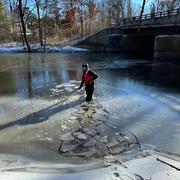
How does Ice on Rivers and Streams Affect USGS Streamflow Data​ How does Ice on Rivers and Streams Affect USGS Streamflow Data​

The USSG computes streamflow several different ways at a streamgage. One very common way is to build a stage-discharge relation that computes a discharge (flow) based on a corresponding stage (elevation of the water-surface). This method relies on a hydraulic feature in the river or stream to control that relationship. The control can be a concrete weir, or natural rock outcrop or riffle. ​
How does Ice on Rivers and Streams Affect USGS Streamflow Data​

How does Ice on Rivers and Streams Affect USGS Streamflow Data​

The USSG computes streamflow several different ways at a streamgage. One very common way is to build a stage-discharge relation that computes a discharge (flow) based on a corresponding stage (elevation of the water-surface). This method relies on a hydraulic feature in the river or stream to control that relationship. The control can be a concrete weir, or natural rock outcrop or riffle. ​
Learn More

Major aquifers in New Jersey Major aquifers in New Jersey

Major aquifers in New Jersey consist of regionally extensive areas where the geologic formation or group of formations provide sufficient quantity of groundwater to wells for potable water supply.
Major aquifers in New Jersey

Major aquifers in New Jersey

Major aquifers in New Jersey consist of regionally extensive areas where the geologic formation or group of formations provide sufficient quantity of groundwater to wells for potable water supply.
Learn More

Groundwater Response to Earthquakes Groundwater Response to Earthquakes

Did you know? Earthquakes can affect groundwater levels? We often see a response to large (and sometimes not so large) earthquakes in groundwater levels in wells. The USGS maintains a network of wells for monitoring various things like natural variability in water levels and response to pumping and climate change across the U.S.
Groundwater Response to Earthquakes

Groundwater Response to Earthquakes

Did you know? Earthquakes can affect groundwater levels? We often see a response to large (and sometimes not so large) earthquakes in groundwater levels in wells. The USGS maintains a network of wells for monitoring various things like natural variability in water levels and response to pumping and climate change across the U.S.
Learn More
Was this page helpful?