



Predicting chronic wasting disease spread in North American deer and understanding the role of deer movement
USGS scientists estimated how quickly chronic wasting disease was spreading in multiple regions of North America and compared those rates to model predictions based on deer movement data.
Chronic Wasting Disease
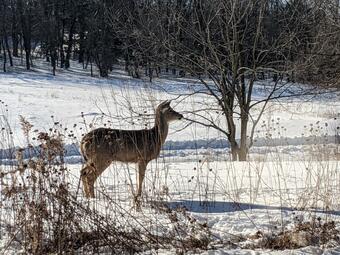
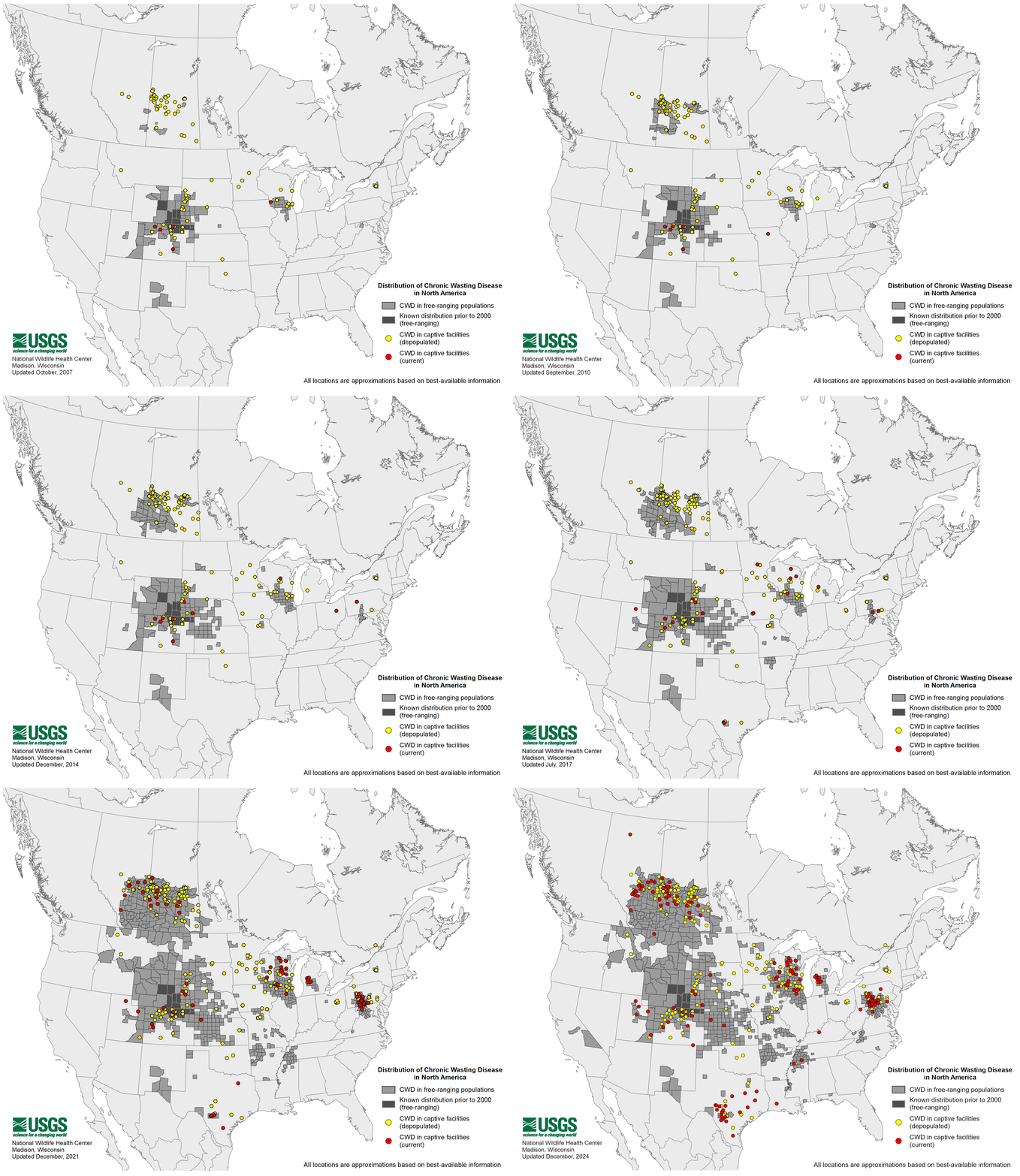
Chronic wasting disease (CWD) is a fatal disease caused by misfolded proteins called prions that affect members of the deer family, including white-tailed deer, mule deer, elk, and moose. There are no effective treatments or vaccines for CWD and as of July 2026, this disease has been detected in 37 U.S. states and five Canadian provinces. Despite extensive data on deer movements, including migrations, it remains unclear how best to use these data to predict future disease spread or explain past disease spread across big game populations. If deer movements do not play a major role in CWD spread, then other mechanisms, including human-mediated pathways that may be managed, warrant greater attention.
The Study
To assess the importance of deer movement in CWD spread, scientists from the USGS Northern Rocky Mountain Science Center (NOROCK) and Wyoming Cooperative Fish and Wildlife Research Unit, with a collaborator from the University of Alberta, used deer movement data to predict the rate of CWD spread in white-tailed and mule deer populations across regions of the U.S. and Canada. They then compared predicted and observed CWD rates of spread and assessed whether including deer movement improved predictions of CWD spread rates. To conduct the study, the authors:
- Identified CWD hotspots across the U.S. and Canada
- Used published white-tailed deer and mule deer movement data to inform models predicting CWD spread
- Focused on two types of long-distance deer movement—juvenile dispersal into new areas and seasonal migration between summer and winter ranges
- Used published CWD detections to estimate observed rates of CWD spread
CWD Spread Rate & the Role of Deer Movement
Overall, the observed rate of CWD spread from 2005-2022 was about 14 miles/year and that rate increased by about 1.4 miles/year during that time. The rate of CWD spread in the western regions (Alberta/Saskatchewan in Canada, and CO, WY, UT, ND, SD, KA, NE, MT) was faster at 9-11 miles/year than the eastern regions (VA, PA, WV, MI, WI), which was estimated to be about 3 miles/year.
- Models based on deer movements generally predicted slower rates of CWD spread than the observed rates. Movement data, including migration and dispersal, did not explain the differences between predicted and observed rates of spread.
- CWD spread fastest in the Canadian region, at about 11 miles per year, even though deer in that region had relatively short migrations averaging about 3-7 miles.
- In contrast, average migration distances were about 10 miles in Colorado and 31 miles in Wyoming. Despite these longer migrations – about 3-12 times those observed in the Canadian region – CWD spread more slowly in Colorado and Wyoming.
- Together, these findings suggest that deer movement alone does not explain observed rates of CWD spread and that other factors likely contribute to how the disease spreads across landscapes.
Importance for Wildlife Managers and Hunters
As big game species, white-tailed deer and mule deer contribute to local economies and are valued by hunters. However, CWD can threaten both white-tailed deer and mule deer populations. NOROCK science helps wildlife managers understand and address threats to deer populations and sustain opportunities for hunting and other outdoor recreation.
- This study helps understand the potential tradeoff between deer migration contributing to disease spread and supporting resilient and healthy wildlife populations.
- Understanding the relative importance of deer movements and human-associated pathways to CWD spread can help managers evaluate measures affecting hunters, game farms, or other human activities that could slow the disease’s advance.