



Fighting an Invasive Marine Threat to Coral Reefs
USGS scientists are developing and testing new tools to control an invasive species threatening coral reefs at Joint Base Pearl Harbor-Hickam and across the Hawaiian Islands.
What is the issue
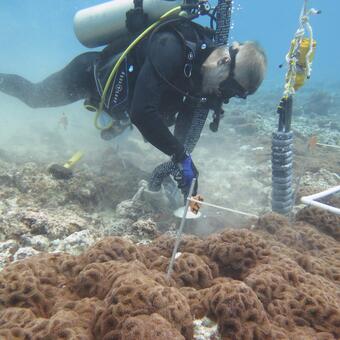
Coral reefs face a growing threat from invasive marine species, and few effective tools exist to stop their spread. Right now, Joint Base Pearl Harbor-Hickam (JBPHH) in Honolulu is battling an outbreak of Unomia, an invasive soft coral that smothers native reefs in the harbor. The State of Hawaii, NOAA, and the U.S. Fish and Wildlife Service are all concerned this species could spread across the islands and threaten reefs statewide.
What’s at stake
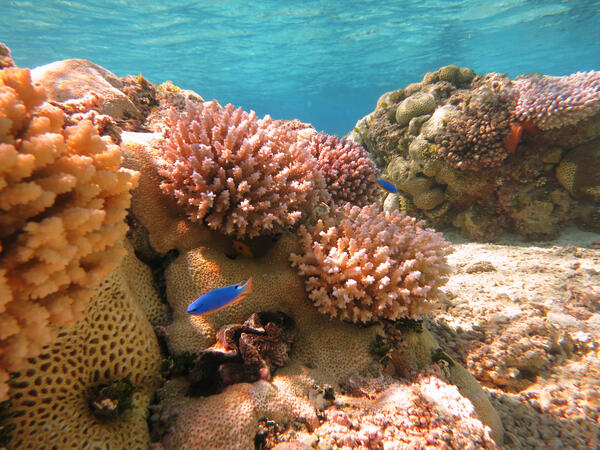
Coral reefs are worth protecting, not just ecologically, but economically. In the U.S. alone, reefs generate more than \$3.4 billion a year in value; worldwide, that figure reaches \$11 trillion. Reefs support tourism and fishing industries, and they act as natural barriers that prevent an estimated \$1.8 billion in property damage each year by buffering coastlines from storms, flooding, and erosion.
At JBPHH, Unomia and at least three other invasive coral species aren't just harming reef ecosystems, they also risk damaging naval base infrastructure. Controlling these species protects both the environment and the strategic value of a critical naval harbor.
What is our approach
Researchers at the USGS National Wildlife Health Center's Honolulu Field Station have tested several methods for eliminating invasive marine species. Hot water treatment has proven the most practical: it's easy to deploy, leaves no chemical residue, and kills invasive coral with 75% efficacy.
With support from a 2025–2026 Department of Defense grant, the team is scaling up this treatment to control, and potentially eliminate, invasive soft corals at JBPHH. If successful, the technology will be shared with the U.S. Navy for use throughout Pearl Harbor, and eventually with other Pacific ports facing similar threats, including Guam, the Commonwealth of the Northern Mariana Islands, and the Marshall Islands.
Recent Accomplishments
In September 2025, the team delivered two heat treatment units to JBPHH. The Navy used them to treat 2,000 square meters of affected reef, successfully eradicating three invasive coral species from the base. The units were then loaned to the State of Hawaii, where USGS used them to eliminate a newly discovered infestation of Capnella spicata in Kaneohe Bay.
The team also installed thermometer arrays at JBPHH to confirm that the heat treatment is environmentally safe, it doesn't harm nearby native corals, wildlife or leave lingering heat behind. A final report and user manual for the treatment units is currently under review by the Department of Defense.
Next steps
With work at Pearl Harbor nearing completion, the Honolulu Field Station team has met with leaders from the Hawaii Invasive Species Council, the State of Hawaii Division of Aquatic Resources, and the National Invasive Species Council to explore expanding these treatment methods to other parts of Hawaii. Meanwhile, USGS is helping Hawaii and Puerto Rico deploy a biodegradable paste treatment, already proven successful at Palmyra Atoll, to fight invasive coral at a larger scale in both regions.
USGS scientists are developing and testing new tools to control an invasive species threatening coral reefs at Joint Base Pearl Harbor-Hickam and across the Hawaiian Islands.
What is the issue
Coral reefs face a growing threat from invasive marine species, and few effective tools exist to stop their spread. Right now, Joint Base Pearl Harbor-Hickam (JBPHH) in Honolulu is battling an outbreak of Unomia, an invasive soft coral that smothers native reefs in the harbor. The State of Hawaii, NOAA, and the U.S. Fish and Wildlife Service are all concerned this species could spread across the islands and threaten reefs statewide.
What’s at stake
Coral reefs are worth protecting, not just ecologically, but economically. In the U.S. alone, reefs generate more than \$3.4 billion a year in value; worldwide, that figure reaches \$11 trillion. Reefs support tourism and fishing industries, and they act as natural barriers that prevent an estimated \$1.8 billion in property damage each year by buffering coastlines from storms, flooding, and erosion.
At JBPHH, Unomia and at least three other invasive coral species aren't just harming reef ecosystems, they also risk damaging naval base infrastructure. Controlling these species protects both the environment and the strategic value of a critical naval harbor.
What is our approach
Researchers at the USGS National Wildlife Health Center's Honolulu Field Station have tested several methods for eliminating invasive marine species. Hot water treatment has proven the most practical: it's easy to deploy, leaves no chemical residue, and kills invasive coral with 75% efficacy.
With support from a 2025–2026 Department of Defense grant, the team is scaling up this treatment to control, and potentially eliminate, invasive soft corals at JBPHH. If successful, the technology will be shared with the U.S. Navy for use throughout Pearl Harbor, and eventually with other Pacific ports facing similar threats, including Guam, the Commonwealth of the Northern Mariana Islands, and the Marshall Islands.
Recent Accomplishments
In September 2025, the team delivered two heat treatment units to JBPHH. The Navy used them to treat 2,000 square meters of affected reef, successfully eradicating three invasive coral species from the base. The units were then loaned to the State of Hawaii, where USGS used them to eliminate a newly discovered infestation of Capnella spicata in Kaneohe Bay.
The team also installed thermometer arrays at JBPHH to confirm that the heat treatment is environmentally safe, it doesn't harm nearby native corals, wildlife or leave lingering heat behind. A final report and user manual for the treatment units is currently under review by the Department of Defense.
Next steps
With work at Pearl Harbor nearing completion, the Honolulu Field Station team has met with leaders from the Hawaii Invasive Species Council, the State of Hawaii Division of Aquatic Resources, and the National Invasive Species Council to explore expanding these treatment methods to other parts of Hawaii. Meanwhile, USGS is helping Hawaii and Puerto Rico deploy a biodegradable paste treatment, already proven successful at Palmyra Atoll, to fight invasive coral at a larger scale in both regions.