



Ecology and Distribution of the Endangered Hawaiian Hoary Bat
The ‘ōpe‘ape‘a (Hawaiian hoary bat, Lasiurus semotus) is listed as endangered due to population declines and a lack of knowledge on its distribution, abundance, and habitat needs. In order to help inform management for and recovery of this species, USGS-PIERC in collaboration with other agencies has conducted studies on the bat’s distribution, abundance, population genetics, food habitats, and habitat use.
Overview:

The ‘ōpe‘ape‘a is the only extant land mammal native to the Hawaiian archipelago. This endangered species is present in many landscapes that include lands used for restoring forests, farming, grazing, and residential areas, and may therefore be affected by land use activities and modifications. Information generated is used in making management decisions by the U.S. Fish and Wildlife Service and by Hawai‘i Department of Lands and Natural Resources. To develop appropriate policy for land use practices and bat recovery, USGS-PIERC gathered detailed information on the bat’s distribution, abundance, population genetics, food habitats, disease, wind turbine collisions, monitoring methods, and habitat preferences.
Products from this work can be found in the Publications tab.
Habitat Use
- Acoustic monitoring on the Island of Hawai‘i showed ‘ōpe‘ape‘a prefer coastal lowlands during breeding season (May to October) and move to interior highlands in winter, with habitat occupancy peaking in mid-September during the post-lactation and fledging period. Occupancy was highest in mature forest cover and remained stable or slightly increased throughout the 5-year study.
- A radio-tracking study across the Island of Hawai‘i found bat captures highest at mid-elevations, with females captured most during the reproductive season (May to September), whereas it was highest for males during the non-reproductive season (October to April). Playbacks of ‘ōpe‘ape‘a vocalizations enhanced capture rates of males relative to females.
- Radio-tracking showed ‘ōpe‘ape‘a home ranges (over 2–3-week sampling periods) averaged 231 ha in extent, with core areas of 26 ha (about 11% of the range) and a mean along an axis of 3,391 m. Adult male core areas rarely overlapped, while subadult core areas overlapped with other individuals. Chasing behavior indicated structured use of space.
- Radio-tracking showed ‘ōpe‘ape‘a selected a wide variety of tree species as roosts in both native and non-native landcovers, using trees in a manner that may offer predator avoidance and temperature regulation.
- ‘Ōpe‘ape‘a generally showed strong roost fidelity, most notably juveniles and reproductive females. Non-reproductive adults changed roosts more often, but some trees were used long-term, including roosts consisting of multiple maternity groups. Roosting behaviors such as emergence and time at sites varied among individuals but did not differ by sex or season.
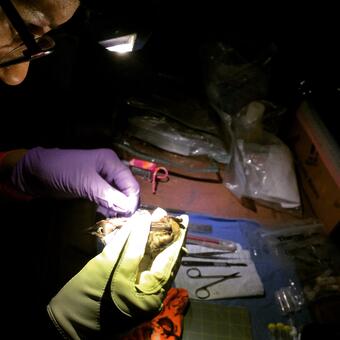
Genetics
- Genetic analysis of ‘ōpe‘ape‘a found population differentiation across the Hawaiian Islands, with Maui showing the greatest genetic diversity, possibly indicating it as the founding population. Limited gene flow and male-biased dispersal were observed on Maui, and genetic bottlenecks were apparent in all populations except on the Island of Hawai‘i.
- Whole-genome SNP (single-nucleotide polymorphism) data confirmed Hawaiian hoary bats are distinct from northern hoary bats (Lasiurus cinereus) and formed a monophyletic group from a single colonization 1.3 million years ago, with inter-island divergence beginning 0.5 million years ago.
Wind Energy
- Bats suffer at times from being struck by wind turbine blades, and fatalities complicate both alternative energy production and wildlife conservation. Acoustic and videographic monitoring of ‘ōpe‘ape‘a at a wind energy facility on Maui recorded brief, infrequent bat occurrence near turbines. Bat occurrence was greater in the first half of the night and correlated with low wind speeds, less rainfall, and intermittent turbine operation. The low correlation between detections derived from visual and acoustic sampling indicated that the latter method underestimated bat occurrence.
- Experimental evidence demonstrated that bat species can perceive ultraviolet (UV) light, but tests of dim UV lighting at a Colorado wind facility showed no significant deterrent effect to bat activity at wind turbines.
Diet
- Genetic analysis of ‘ōpe‘ape‘a guano acquired across the Hawaiian Islands demonstrated a diverse diet of beetles, moths, flies, hemipterans, and termites that comprised both native and non-native species and some agricultural pests.
- Lepidoptera taxa were a particularly important diet item, and native plants identified as hosting moth larva can be incorporated into habitat restoration to support local bat populations.
Disease
- A survey of lava-tube caves on the Island of Hawai‘i found no evidence of the introduced fungus Pseudogymnoascus destructans that causes white-nose syndrome in many bat species in North America.
Monitoring Methods
- A study of multi-state occupancy modeling, which differentiated between detections of foraging ‘ōpe‘ape‘a from those actively capturing or attempting to capture prey, determined the method was effective for assessing habitat suitability. The study found thermal videography provided a more accurate estimate of activity (such as feeding) than acoustic sampling, and bat acoustic activity was associated with beetle biomass.
- Occupancy analysis at an island-wide scale was also effective at demonstrating habitat preferences, distribution, and population trend. However, despite the importance of acoustic sampling methods in bat research, flying ‘ōpe‘ape‘a have been shown to sometimes forgo echolocation with implications for monitoring bat presence and activity.
The ‘ōpe‘ape‘a (Hawaiian hoary bat, Lasiurus semotus) is listed as endangered due to population declines and a lack of knowledge on its distribution, abundance, and habitat needs. In order to help inform management for and recovery of this species, USGS-PIERC in collaboration with other agencies has conducted studies on the bat’s distribution, abundance, population genetics, food habitats, and habitat use.
Overview:
The ‘ōpe‘ape‘a is the only extant land mammal native to the Hawaiian archipelago. This endangered species is present in many landscapes that include lands used for restoring forests, farming, grazing, and residential areas, and may therefore be affected by land use activities and modifications. Information generated is used in making management decisions by the U.S. Fish and Wildlife Service and by Hawai‘i Department of Lands and Natural Resources. To develop appropriate policy for land use practices and bat recovery, USGS-PIERC gathered detailed information on the bat’s distribution, abundance, population genetics, food habitats, disease, wind turbine collisions, monitoring methods, and habitat preferences.
Products from this work can be found in the Publications tab.
Habitat Use
- Acoustic monitoring on the Island of Hawai‘i showed ‘ōpe‘ape‘a prefer coastal lowlands during breeding season (May to October) and move to interior highlands in winter, with habitat occupancy peaking in mid-September during the post-lactation and fledging period. Occupancy was highest in mature forest cover and remained stable or slightly increased throughout the 5-year study.
- A radio-tracking study across the Island of Hawai‘i found bat captures highest at mid-elevations, with females captured most during the reproductive season (May to September), whereas it was highest for males during the non-reproductive season (October to April). Playbacks of ‘ōpe‘ape‘a vocalizations enhanced capture rates of males relative to females.
- Radio-tracking showed ‘ōpe‘ape‘a home ranges (over 2–3-week sampling periods) averaged 231 ha in extent, with core areas of 26 ha (about 11% of the range) and a mean along an axis of 3,391 m. Adult male core areas rarely overlapped, while subadult core areas overlapped with other individuals. Chasing behavior indicated structured use of space.
- Radio-tracking showed ‘ōpe‘ape‘a selected a wide variety of tree species as roosts in both native and non-native landcovers, using trees in a manner that may offer predator avoidance and temperature regulation.
- ‘Ōpe‘ape‘a generally showed strong roost fidelity, most notably juveniles and reproductive females. Non-reproductive adults changed roosts more often, but some trees were used long-term, including roosts consisting of multiple maternity groups. Roosting behaviors such as emergence and time at sites varied among individuals but did not differ by sex or season.
Genetics
- Genetic analysis of ‘ōpe‘ape‘a found population differentiation across the Hawaiian Islands, with Maui showing the greatest genetic diversity, possibly indicating it as the founding population. Limited gene flow and male-biased dispersal were observed on Maui, and genetic bottlenecks were apparent in all populations except on the Island of Hawai‘i.
- Whole-genome SNP (single-nucleotide polymorphism) data confirmed Hawaiian hoary bats are distinct from northern hoary bats (Lasiurus cinereus) and formed a monophyletic group from a single colonization 1.3 million years ago, with inter-island divergence beginning 0.5 million years ago.
Wind Energy
- Bats suffer at times from being struck by wind turbine blades, and fatalities complicate both alternative energy production and wildlife conservation. Acoustic and videographic monitoring of ‘ōpe‘ape‘a at a wind energy facility on Maui recorded brief, infrequent bat occurrence near turbines. Bat occurrence was greater in the first half of the night and correlated with low wind speeds, less rainfall, and intermittent turbine operation. The low correlation between detections derived from visual and acoustic sampling indicated that the latter method underestimated bat occurrence.
- Experimental evidence demonstrated that bat species can perceive ultraviolet (UV) light, but tests of dim UV lighting at a Colorado wind facility showed no significant deterrent effect to bat activity at wind turbines.
Diet
- Genetic analysis of ‘ōpe‘ape‘a guano acquired across the Hawaiian Islands demonstrated a diverse diet of beetles, moths, flies, hemipterans, and termites that comprised both native and non-native species and some agricultural pests.
- Lepidoptera taxa were a particularly important diet item, and native plants identified as hosting moth larva can be incorporated into habitat restoration to support local bat populations.
Disease
- A survey of lava-tube caves on the Island of Hawai‘i found no evidence of the introduced fungus Pseudogymnoascus destructans that causes white-nose syndrome in many bat species in North America.
Monitoring Methods
- A study of multi-state occupancy modeling, which differentiated between detections of foraging ‘ōpe‘ape‘a from those actively capturing or attempting to capture prey, determined the method was effective for assessing habitat suitability. The study found thermal videography provided a more accurate estimate of activity (such as feeding) than acoustic sampling, and bat acoustic activity was associated with beetle biomass.
- Occupancy analysis at an island-wide scale was also effective at demonstrating habitat preferences, distribution, and population trend. However, despite the importance of acoustic sampling methods in bat research, flying ‘ōpe‘ape‘a have been shown to sometimes forgo echolocation with implications for monitoring bat presence and activity.