



Mercury exposure to northern elephant seal pups in utero is high and affected by the oceanic foraging behavior of their moms
USGS researchers led a 10-year collaborative research effort to see how maternal foraging strategies affect the transfer of mercury to their offspring.
Mercury is a potent neurotoxin that can also negatively affect the immune and endocrine systems in animals. Deep-ocean foraging species may be particularly vulnerable to mercury contamination because mercury is pervasive in marine food webs within this region of the ocean and there are few pathways by which animals can remove this contaminant from their bodies. One of the ways that adult female animals can offload a portion of their contaminant burden is into their offspring (maternal transfer). Northern elephant seals consume fish and squid in remote depths of the North Pacific Ocean, linking the mercury contamination in mesopelagic food webs (200–1000-meter depths) to their pups through the maternal transfer of mercury during gestation (in utero).
USGS researchers led a collaborative research effort over 10 years to collect samples from northern elephant seal pups and their mothers to examine how maternal foraging strategies affect the transfer of mercury to offspring during a critical period of development. The transfer of mercury to developing seal pups was related to the mercury contamination of adult females and was strongly affected by the foraging behavior of their mothers. Fetal mercury exposure was affected by the geographic location and the depths at which the adult female seals foraged – mercury concentrations were highest in the deepest diving, and most open ocean foraging females. Importantly, the mercury concentrations in pups were strongly repeatable among successive pups of individual females, suggesting that adult females were relative consistent in their foraging behavior over time, and this resulted in relative consistency within individual females in how much mercury they passed to their pups. In other words, females with a foraging strategy that resulted in lower mercury concentrations tended to have pups year after year with lower mercury concentrations and the females with foraging strategies that exposed their pups to higher levels of mercury contamination tended to have pups with higher mercury concentrations year after year.
Pups of the oldest females in the population had the highest mercury concentrations. There is a subset of ‘supermoms’ (6 percent of females) within the northern elephant seal population at the Año Nuevo colony that live the longest and produce the most pups (55 percent of all pups). Based on the levels of repeatability in mercury contamination among pups of the same female and differences in mercury contamination among female foraging strategies, it is possible that many of the most successful females have a foraging strategy that exposes their offspring to the highest mercury concentrations during development. Additionally, some variation in fetal mercury contamination was observed among years of the study, with the highest pup mercury concentrations observed during the years where a marine heatwave occurred in the North Pacific – mercury exposure could have been affected through some dietary shifts of foraging female seals or changes in mesopelagic mercury cycles.
Although toxicological benchmarks are not well validated for pinnipeds, 70 percent of seal pups exceeded the currently established benchmark for aquatic mammals of 20 µg/g (micrograms per gram) of dry hair. Mercury concentrations in the hair of seal pups (grown in utero) were among the highest observed worldwide for young pinnipeds (mean 23.01 µg/g, range 8.03-63.09 µg/g; n=373); thus, pups in this population may be at an elevated risk of sub-lethal adverse health effects.
Food webs in the eastern North Pacific Ocean support many other species of long-lived animals, including seabirds, large predatory fish species (such as tuna and sharks), and cryptic marine mammals, such as toothed whales (odontocetes) like the beaked whales, melon-headed whales, and pygmy sperm whales. Northern elephant seal pups can serve as biosentinels of mercury contamination of the marine environment, and our results suggest that mercury within these deep North Pacific food webs may pose an elevated risk to other mesopelagic-foraging predators and their offspring.
Maternal foraging strategies and pup mercury concentrations in northern elephant seals
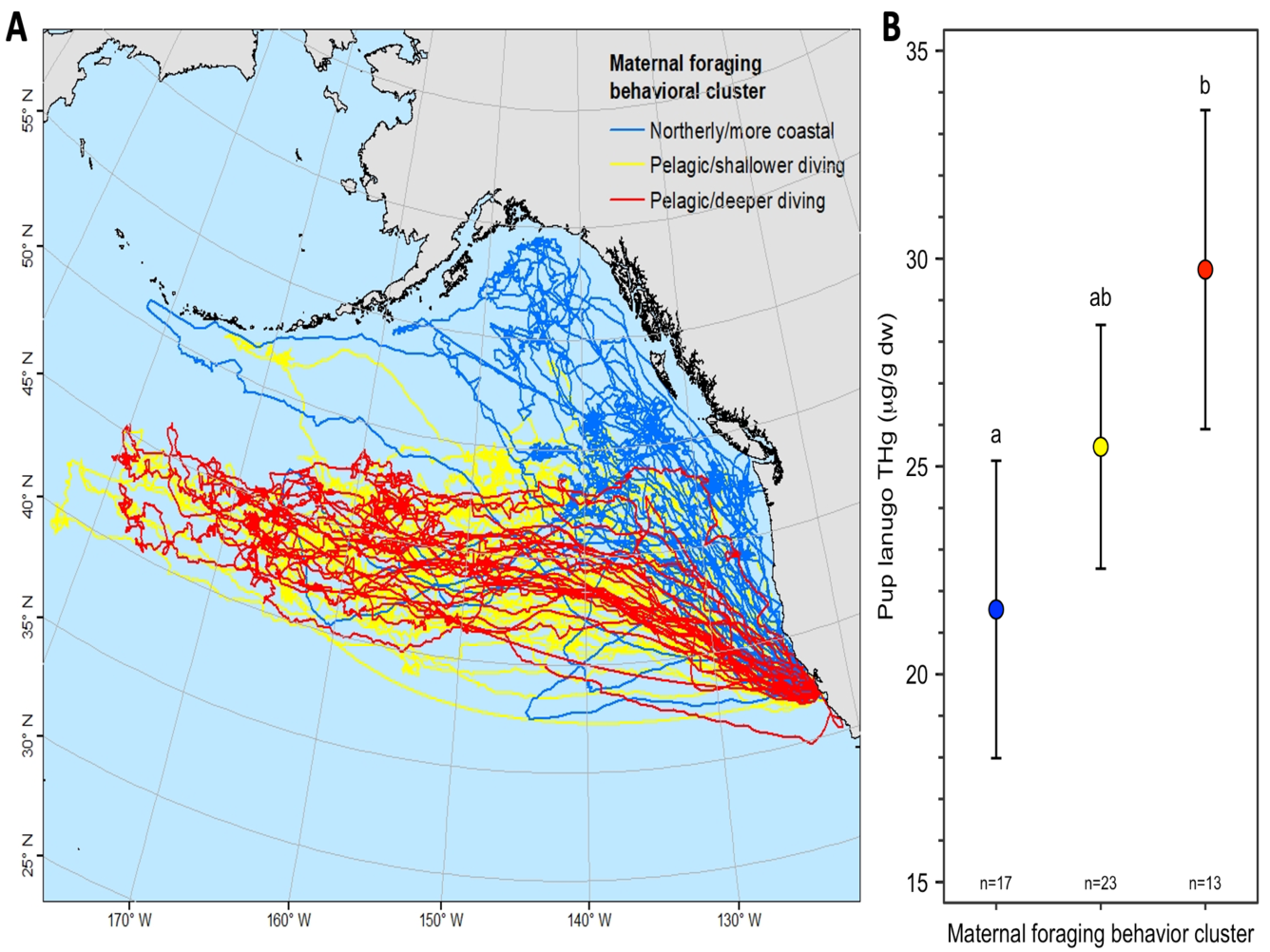
Ecotoxicological Implications:
- Mercury concentrations in hair suggest that northern elephant seal pups may be at toxicological risk for negative health effects of mercury contamination because many pups exceeded the proposed toxicological benchmarks for aquatic mammals.
- Variation in mercury concentrations among maternal foraging regions suggests that mesopelagic predators in some regions of the deep ocean may be at elevated risk of mercury contamination.
- Continued biomonitoring northern elephant seal pups may be harnessed to learn more about deep ocean mercury contamination and inter-annual variation in contamination that may relate to changing ocean conditions.