



Exploring the Feasibility of Genetic Biocontrol Applications for the Invasive Burmese Python in the Greater Everglades of Florida
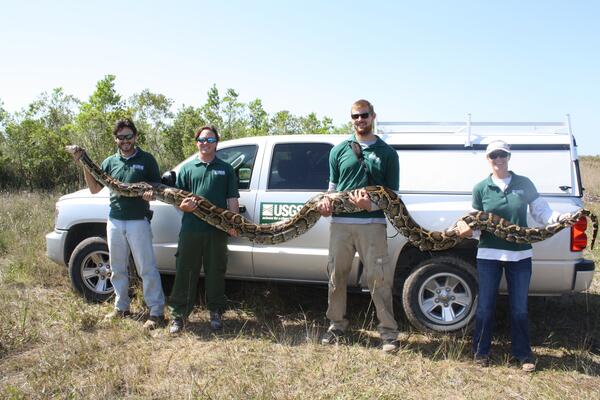
The USGS is exploring possible genetic methods to help address the invasive Burmese python in southern Florida.
The Science Issue and Relevance: The establishment of invasive reptiles across the state of Florida has been documented for decades. Traditional biocontrol methods of removing invasive reptiles from the landscape, such as visual searching and trapping, have struggled to mitigate the adverse effects these invaders have on native ecosystems. The need for effective control tools is particularly urgent in the Greater Everglades region, an ecosystem of international significance where restoration efforts are a high domestic priority. Innovative genetic biocontrol technologies could potentially be developed to support current traditional control methods and address the numerous limitations ecosystem managers currently face removing invasive reptiles from the landscape.
Methodology for Addressing the Issue: Due to their complex scientific and ethical nature, the development and responsible implementation of genetic biocontrol tools requires a large degree of communication, community engagement, permitting, regulation, and logistical facilitation. For projects of this nature, it is critical to adhere to a commitment to open science by the researchers, and active collaboration with the affected human communities at all stages of development and implementation. This work is exploring potential genetic targets that can be modified by CRISPR-Cas-based to alter the ratio of males and females in such a way that with subsequent generations, the number of offspring produced will decrease suppressing population growth.
Future Steps: Scientists at the USGS WARC established a tissue culture station and procured cultured Burmese python cardiac muscle cells to conduct in the lab work to test effective methods to genetically manipulate cell cultures. The first goal was to evaluate the optimal conditions for mutating Burmese python cells using different methods to move material into the cell nucleus. The mutation potential of Burmese python cell cultures is being evaluated gradually from basic methods that test transient expression of a fluorescent reporter to the more complex incorporation of a CRISPR-Cas ribonucleoprotein (RNP) complex.
Simultaneously, USGS WARC will continue to host a series of workshops and seminars with multi-agency stakeholders to discuss the outlined immediate research needs and progress. These meetings will be complemented by active outreach to the broader community.
Glossary:
Mutagenesis – the process by which an organism’s deoxyribonucleic acids (DNA) change, resulting in a gene mutation
Transfection – the process of deliberately introducing purified nucleic acids (such as DNA or RNA) into eukaryotic cells
Nucleofection – is a transfection method which enables transfer of nucleic acids (such as DNA and RNA) into cells by applying a specific voltage and reagents
Lipofection – is a transfection method which enables transfer of nucleic acids (such as DNA and RNA) into cells using a lipid complex to deliver the genetic material
The USGS is exploring possible genetic methods to help address the invasive Burmese python in southern Florida.
The Science Issue and Relevance: The establishment of invasive reptiles across the state of Florida has been documented for decades. Traditional biocontrol methods of removing invasive reptiles from the landscape, such as visual searching and trapping, have struggled to mitigate the adverse effects these invaders have on native ecosystems. The need for effective control tools is particularly urgent in the Greater Everglades region, an ecosystem of international significance where restoration efforts are a high domestic priority. Innovative genetic biocontrol technologies could potentially be developed to support current traditional control methods and address the numerous limitations ecosystem managers currently face removing invasive reptiles from the landscape.
Methodology for Addressing the Issue: Due to their complex scientific and ethical nature, the development and responsible implementation of genetic biocontrol tools requires a large degree of communication, community engagement, permitting, regulation, and logistical facilitation. For projects of this nature, it is critical to adhere to a commitment to open science by the researchers, and active collaboration with the affected human communities at all stages of development and implementation. This work is exploring potential genetic targets that can be modified by CRISPR-Cas-based to alter the ratio of males and females in such a way that with subsequent generations, the number of offspring produced will decrease suppressing population growth.
Future Steps: Scientists at the USGS WARC established a tissue culture station and procured cultured Burmese python cardiac muscle cells to conduct in the lab work to test effective methods to genetically manipulate cell cultures. The first goal was to evaluate the optimal conditions for mutating Burmese python cells using different methods to move material into the cell nucleus. The mutation potential of Burmese python cell cultures is being evaluated gradually from basic methods that test transient expression of a fluorescent reporter to the more complex incorporation of a CRISPR-Cas ribonucleoprotein (RNP) complex.
Simultaneously, USGS WARC will continue to host a series of workshops and seminars with multi-agency stakeholders to discuss the outlined immediate research needs and progress. These meetings will be complemented by active outreach to the broader community.
Glossary:
Mutagenesis – the process by which an organism’s deoxyribonucleic acids (DNA) change, resulting in a gene mutation
Transfection – the process of deliberately introducing purified nucleic acids (such as DNA or RNA) into eukaryotic cells
Nucleofection – is a transfection method which enables transfer of nucleic acids (such as DNA and RNA) into cells by applying a specific voltage and reagents
Lipofection – is a transfection method which enables transfer of nucleic acids (such as DNA and RNA) into cells using a lipid complex to deliver the genetic material