



Hydrophone data from gravel-bedded rivers in Washington and Idaho, 2019 to 2024
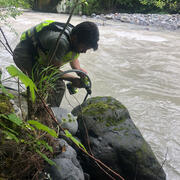
Hydrophones have been proposed as a potential surrogate for bedload transport, operating on the principle that particle collisions generate sound that scales in intensity with transport rate (for example, Geay and others, 2017). To assess that potential, the U.S. Geological Survey (USGS) partnered with the Washington Department of Transportation (WSDOT) in 2019 to install hydrophones on three different gravel-bedded rivers in the Pacific Northwest, including Glacier Creek and the Methow River in Washington State and the Big Wood River in Idaho. The hydrophones were designed and built by Matt Marineau, as described in Marineau and others (2016). McBain and Associates conducted concurrent bedload sampling on the Methow River and attempted to do so in the Big Wood River, but no significant transport was detected. No bedload sampling was attempted at Glacier Creek.
The hydrophones were then transferred to two sites on the Skagit River, Washington, in the fall of 2021 and operated with support from both WSDOT and Seattle City Light. One site was near the city of Marblemount, and the other was near Illabot Creek. McBain and Associates attempted bedload sampling at the site near Illabot Creek but no significant transport was detected. The USGS then sampled bedload at the Marblemount site several times between May, 2022 and January, 2024. Separately, the USGS installed hydrophones on Vance Creek, Washington in the fall of 2019, to test the technology at a location where bedload sampling was on-going (Anderson, 2022). This data release contains the processed output of the hydrophone monitoring efforts spread across these six sites.
The raw outputs of the hydrophones are sequential one-minute stereo audio files, with the two stereo channels containing recordings from two independent hydrophone sensors. Those audio files are not included in this data release. The processed output presented here are CSV summaries of acoustic pressure as a function of frequency, or spectrograms, from each stereo channel of each audio file, organized by monitoring location. Most monitoring locations included two distinct installations, most commonly on opposing banks. At the three sites where bedload data were available (Methow River, Skagit River at Marblemount, and Vance Creek), this data release also includes a summary of those bedload measurements. At all sites, discharge was available either from co-located USGS streamgages, or could be estimated from gage records at nearby locations using simple drainage area scaling.
Any use of trade, firm, or product names is for descriptive purposes only and does not imply endorsement by the U.S. Government. These data are marked with a Creative Commons Zero v1.0 Universal (CC0-1.0) public domain dedication and do not have any use constraints.
Citation Information
| Publication Year | 2026 |
|---|---|
| Title | Hydrophone data from gravel-bedded rivers in Washington and Idaho, 2019 to 2024 |
| DOI | 10.5066/P9XEISWS |
| Authors | Scott W Anderson, Mathieu D Marineau, Cygnia Foruzani, Caitlin Keady, Christopher G Bird, Elowyn Yager |
| Product Type | Data Release |
| Record Source | USGS Asset Identifier Service (AIS) |
| USGS Organization | Washington Water Science Center |
| Rights | This work is marked with CC0 1.0 Universal |
Related
Assessment of bedload monitoring methods
Related