



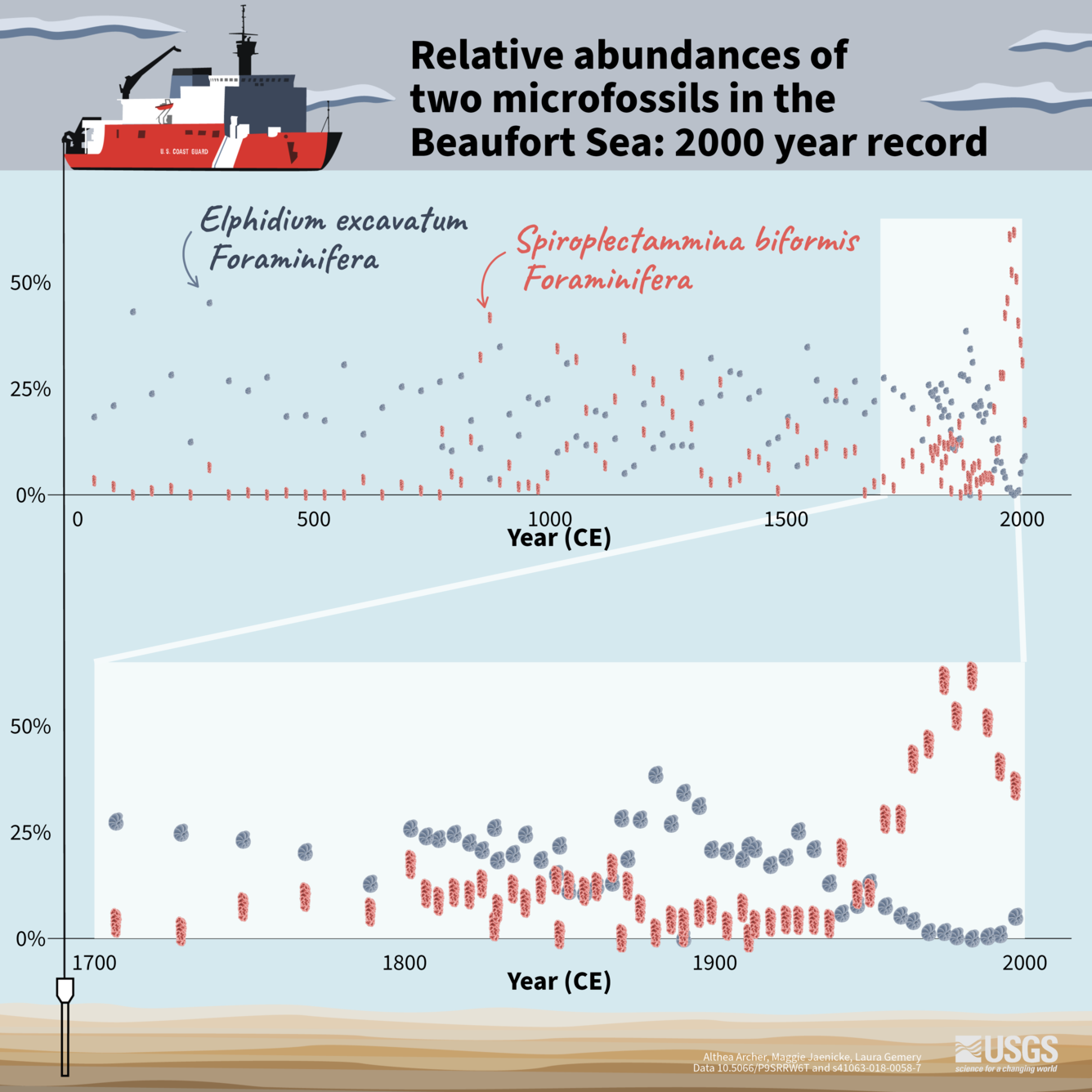
Relative abundances of two microfossils in the Beaufort Sea for the last 2000 years.


Detailed Description
Our scientists are digging deep—literally—to understand how our climate has changed over the past 2,000 years.
By studying tiny, fossilized organisms (called Foraminifera) preserved in layers of Arctic seafloor mud, they can track changes in ocean conditions like temperature and sea ice.
The relative abundance of two key Formanifera species, Elphidium excavatum and Spiroplectammina biformis, stayed relatively steady for centuries—until recently. In the last 100 years or so, their numbers suddenly shift. This timeframe corresponds with the recent loss of summer sea ice in the Beaufort Sea. Changes in species abundance and composition of tiny organisms can reveal changes in the ocean environment.
By studying microfossils, USGS scientists can connect past climate patterns with the changes we're seeing in the Arctic today.
Explore this research story on the Earth is in Flux chart gallery.
Timeseries - Fossils #30DayChartChallenge
Sources/Usage
Public Domain.