



Photo & Video Chronology – August 18, 2025 – UAS and field observations at the north vent of Halemaʻumaʻu crater.
Moderate glow and sustained tremor indicate that magma remains at relatively shallow depths beneath the active vents. On August 18, USGS Hawaiian Volcano Observatory staff conducted a UAS (uncrewed aircraft systems) flight and field observations of the north vent in Halemaʻumaʻu crater at Kīlauea volcano.
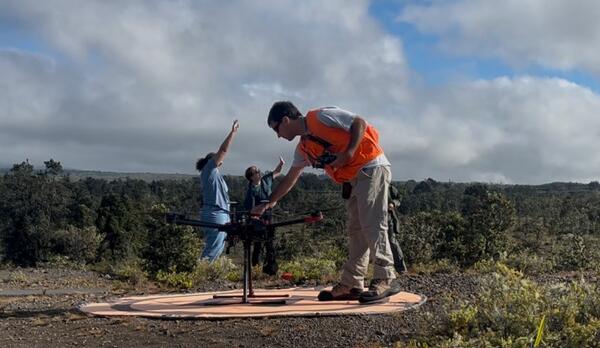
On August 18, USGS Scientist Mike Zoeller with the Hawaiian Volcano Observatory, a Hawai‘i Volcanoes National Park Public park ranger, and two researchers from the University of Colorado conducted UAS (uncrewed aircraft system) work in the vicinity of Halemaʻumaʻu crater at Kīlauea volcano. In this photo, the UAS is being prepared for launch while observers spot for birds and other aircraft. UAS flights are conducted for aerial views into the north vent within Halemaʻumaʻu and to characterize volcanic gas emissions during eruptive pauses, UAS flights are conducted with the permission of Hawai‘i Volcanoes National Park and contribute to the Hawaiian Volcano Observatory's mission to monitor active volcanoes in Hawaii, assess their hazards, issue warnings, and advance scientific understanding to reduce the impacts of eruptions. Unauthorized launching, landing, or operating of a UAS from or on lands and waters administered by the National Park Service is prohibited under 36 CFR Closures & Public Use. USGS photo by H. Weiss-Racine.
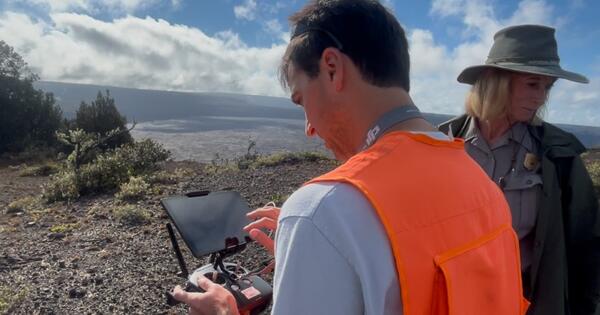
On August 18, USGS Scientist Mike Zoeller with the Hawaiian Volcano Observatory, a Hawai‘i Volcanoes National Park park ranger, and two researchers from the University of Colorado conducted UAS (uncrewed aircraft system) work in the vicinity of Halemaʻumaʻu crater at Kīlauea volcano. In this photo, staff monitor the UAS remotely and take photos for analysis. UAS flights are conducted for aerial views into the north vent within Halemaʻumaʻu and to characterize volcanic gas emissions during eruptive pauses, UAS flights are conducted with the permission of Hawai‘i Volcanoes National Park and contribute to the Hawaiian Volcano Observatory's mission to monitor active volcanoes in Hawaii, assess their hazards, issue warnings, and advance scientific understanding to reduce the impacts of eruptions. Unauthorized launching, landing, or operating of a UAS from or on lands and waters administered by the National Park Service is prohibited under 36 CFR Closures & Public Use. USGS photo by H. Weiss-Racine.

This close-up view of the Kīlauea summit eruption's north vent was captured during an uncrewed aircraft system (UAS) overflight conducted by Hawaiian Volcano Observatory scientists on August 18. Looking down to the southwest, the Halema‘uma‘u crater wall is out of view to the top of the frame. Lava was visible within the vent, with its height fluctuating in gas piston cycles every 10 minutes. During high stands, lava was flowing into a void in the eastern (lower-left) part of the vent. The scientists estimated that the lava pond measured approximately 15 meters (50 feet) across. USGS photo by M. Zoeller.
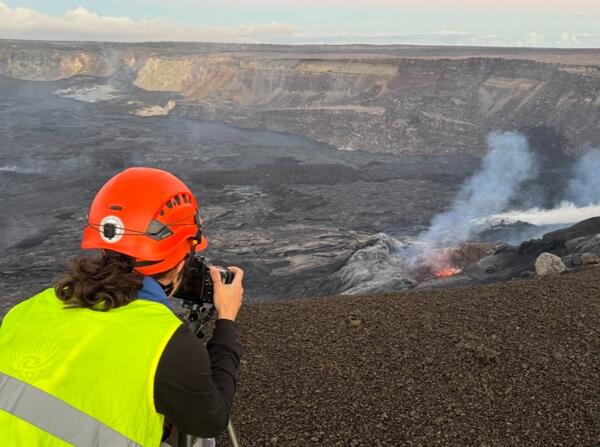
On August 18, USGS scientists visited the rim of Halemaʻumaʻu crater at the summit of Kīlauea volcano to view the north vent. When scientists work in the closed area of Hawaiʻi Volcanoes National Park southwest of Halemaʻumaʻu crater, they wear personal protective equipment (PPE) due to the potential for them to encounter volcanic hazards such as volcanic gas. In this photo, you can see the plume of steam and volcanic gas blowing to the south of the scientists based on the prevailing wind direction. USGS photo by M. Patrick.
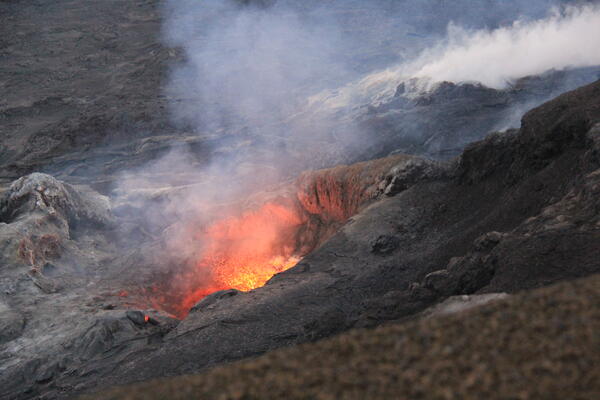
On August 18, field observations at the summit of Kīlauea confirmed that lava was moving up inside the north vent. While perched lava was not observed, lava spatter was visible intermittently during gas pistoning events. USGS photo by H. Weiss-Racine.
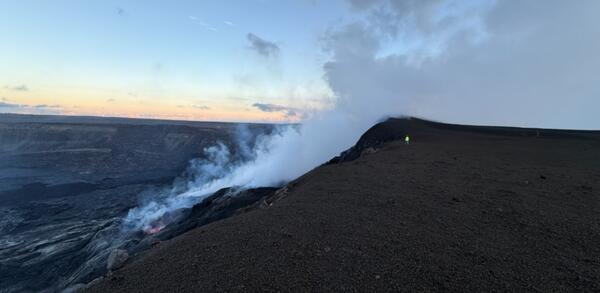
This photo was taken on August 18, looking southeast toward the large tephra deposit that has accumulated since the episodic eruptions at Halemaʻumaʻu crater at Kīlauea volcano began in late December of 2024. The tephra deposit is now about 75 feet (about 23 meters) thick. In the photo, you can see a small bright dot against the dark tephra pile, this is a USGS Hawaiian Volcano Observatory geologist who is about six-feet tall (1.8 meters) for reference. USGS photo by Q. Hayes.