
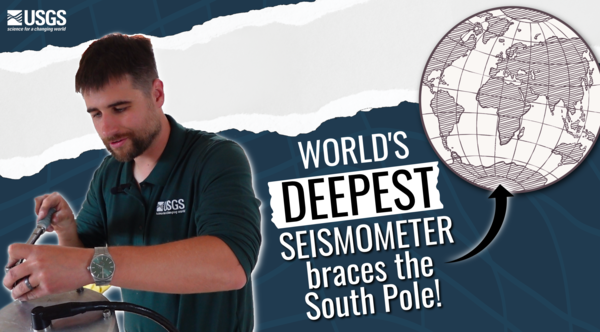
David Wilson
David Wilson is the director of the Global Seismographic Network.
Science and Products
Photo Journal: Global Seismographic Network (GSN) Field Engineers Visit the Northernmost Town in the World
In October 2022 GSN field engineers from the Albuquerque Seismic Lab visited the northernmost town in the world, Longyearbyen (Svalbard, Norway) on their way north to GSN station IU-KBS for a station upgrade. GSN station IU-KBS is located in Svalbard, a Norwegian archipelago.
Seismic Network Detection Modeling Seismic Network Detection Modeling
This DOI points to the code repository for codes used in David C. Wilson, Emily Wolin, William L. Yeck, Robert E. Anthony, Adam T. Ringler; Modeling Seismic Network Detection Thresholds Using Production Picking Algorithms. Seismological Research Letters 2021; 93 1: doi: https://doi.org/10.1785/0220210192
Filter Total Items: 51
U.S. Geological Survey geomagnetic variometer data: Capitalizing on seismic infrastructure U.S. Geological Survey geomagnetic variometer data: Capitalizing on seismic infrastructure
The U.S. Geological Survey’s Geomagnetism Program is collaborating with the Earthquake Hazards Program and Global Seismographic Network Program to densify magnetic field observations. This collaboration focuses on the installation of magnetometers, or magnetic variometers, at existing seismic stations. Along with improving the density of space weather observations for hazard monitoring...
Authors
Adam Ringler, Andrew Holcomb, E. Rigler, Spencer Wilbur, C. Balch, Corey Beutel, Brendan Geels, J. Guerra, A. Horton, Edward Kromer, Kristen Lewis, Jeffrey Love, Yolando Root, Claudia Rossavik, N. Shavers, John Spritzer, Tyler Storm, Alexandra Wernle, David Wilson
Revisiting seismological discoveries of the inner core Revisiting seismological discoveries of the inner core
Seismology has been used as a tool for understanding the current physical properties of the interior of the Earth and its dynamic evolution with remarkable success over the last century. Much of this progress is due to the ever‐expanding set of high‐quality quantitative observations of teleseismic waveforms recorded at seismographic stations worldwide. In this work, we revisit historical
Authors
Adam Ringler, Pritwiraj Moulik, Thomas Lee, David Wilson, Robert Anthony
Perspectives on transportable array Alaska background noise levels Perspectives on transportable array Alaska background noise levels
Background seismic noise fundamentally sets a lower bound on our ability to record signals arising from earthquakes. The background noise spectrum at a station is a combination of cultural noise, ocean-generated microseism noise, intrinsic instrument self-noise, and the sensitivity of the instrument to nonseismic noise sources. The USArray-Transportable Array Alaska deployed 195 stations...
Authors
Adam Ringler, Kasey Aderhold, Robert Anthony, Robert W. Busby, Andy Frassetto, Toshiro Tanimoto, David Wilson
Uncertainty and spatial correlation in station measurements for mb magnitude estimation Uncertainty and spatial correlation in station measurements for mb magnitude estimation
The body‐wave magnitude () is a long‐standing network‐averaged, amplitude‐based magnitude used to estimate the magnitude of seismic sources from teleseismic observations. The U.S. Geological Survey National Earthquake Information Center (NEIC) relies on in its global real‐time earthquake monitoring mission. Although waveform modeling‐based moment magnitudes are the modern standard to
Authors
William Yeck, Adam Ringler, David Shelly, Paul Earle, Harley Benz, David Wilson
Preface to focus section on new frontiers and advances in global seismology Preface to focus section on new frontiers and advances in global seismology
Over the last century, many of the fundamental advances in our understanding of the solid Earth have been underpinned by seismic observations recorded on long‐running networks of globally distributed seismic instruments (e.g., Agnew et al., 1976; Romanowicz et al., 1984; Hanka and Kind, 1994; Peterson and Hutt, 2014; Ringler et al., 2022a). During this time, seismic data quality and the...
Authors
Robert Anthony, Nicolas Leroy, Robert Mellors, Adam Ringler, Joachim Saul, Martin Vallee, David Wilson
Noise constraints on global body‐wave measurement thresholds Noise constraints on global body‐wave measurement thresholds
Intermediate sized earthquakes (≈M4–6.5) are often measured using the teleseismic body‐wave magnitude (𝑚b). 𝑚b measurements are especially critical at the lower end of this range when teleseismic waveform modeling techniques (i.e., moment tensor analysis) are difficult. The U.S. Geological Survey National Earthquake Information Center (NEIC) determines the location and magnitude of all...
Authors
Adam Ringler, David Wilson, Paul Earle, William Yeck, David Mason, Justin T. Wilgus
Background seismic noise levels among the Caribbean network and the role of station proximity to coastline Background seismic noise levels among the Caribbean network and the role of station proximity to coastline
The amplitude and frequency content of background seismic noise is highly variable with geographic location. Understanding the characteristics and behavior of background seismic noise as a function of location can inform approaches to improve network performance and in turn increase earthquake detection capabilities. Here, we calculate power spectral density estimates in one‐hour windows...
Authors
Justin T. Wilgus, Adam Ringler, Brandon Schmandt, David Wilson, Robert Anthony
Global seismic networks operated by the U.S. Geological Survey Global seismic networks operated by the U.S. Geological Survey
The U.S. Geological Survey (USGS) Global Seismographic Network (GSN) Program operates two thirds of the GSN, a network of state‐of‐the‐art, digital seismological and geophysical sensors with digital telecommunications. This network serves as a multiuse scientific facility and a valuable resource for research, education, and monitoring. The other one third of the GSN is funded by the...
Authors
David Wilson, Charles Hutt, Lind Gee, Adam Ringler, Robert Anthony
Comment on “A new decade in seismoacoustics (2010–2022)” by Fransiska Dannemann Dugick, Clinton Koch, Elizabeth Berg, Stephen Arrowsmith, and Sarah Albert Comment on “A new decade in seismoacoustics (2010–2022)” by Fransiska Dannemann Dugick, Clinton Koch, Elizabeth Berg, Stephen Arrowsmith, and Sarah Albert
An increase in seismic stations also having microbarographs has led to increased interest in the field of seismoacoustics. A review of the recent advances in this field can be found in Dannemann Dugick et al. (2023). The goal of this note is to draw the attention of the readers of Dannemann Dugick et al. (2023) to several additional interactions between the solid Earth and atmosphere...
Authors
Adam Ringler, Robert Anthony, Brian Shiro, Toshiro Tanimoto, David Wilson
Earth’s upper crust seismically excited by infrasound from the 2022 Hunga Tonga–Hunga Ha’apai eruption, Tonga Earth’s upper crust seismically excited by infrasound from the 2022 Hunga Tonga–Hunga Ha’apai eruption, Tonga
Records of pressure variations on seismographs were historically considered unwanted noise; however, increased deployments of collocated seismic and acoustic instrumentation have driven recent efforts to use this effect induced by both wind and anthropogenic explosions to invert for near‐surface Earth structure. These studies have been limited to shallow structure because the pressure...
Authors
Robert Anthony, Adam Ringler, Toshiro Tanimoto, Robin Matoza, Silvio De Angelis, David Wilson
The global seismographic network reveals atmospherically coupled normal modes excited by the 2022 Hunga Tonga eruption The global seismographic network reveals atmospherically coupled normal modes excited by the 2022 Hunga Tonga eruption
The eruption of the submarine Hunga Tonga-Hunga Haʻapai (Hunga Tonga) volcano on 15 January 2022, was one of the largest volcanic explosions recorded by modern geophysical instrumentation. The eruption was notable for the broad range of atmospheric wave phenomena it generated and for their unusual coupling with the oceans and solid Earth. The event was recorded worldwide across the...
Authors
Adam Ringler, Robert Anthony, Rick Aster, T. Taira, Brian Shiro, David Wilson, S. De Angelis, C. Ebeling, Matthew Haney, R. Matoza, H. Ortiz
Characteristics, relationships and precision of direct acoustic-to-seismic coupling measurements from local explosions Characteristics, relationships and precision of direct acoustic-to-seismic coupling measurements from local explosions
Acoustic energy originating from explosions, sonic booms, bolides and thunderclaps have been recorded on seismometers since the 1950s. Direct pressure loading from the passing acoustic wave has been modelled and consistently observed to produce ground deformations of the near surface that have retrograde elliptical particle motions. In the past decade, increased deployments of colocated
Authors
Robert Anthony, Josh Watzak, Adam Ringler, David Wilson
Seismic Network Detection Modeling Seismic Network Detection Modeling
This DOI points to the code repository for codes used in David C. Wilson, Emily Wolin, William L. Yeck, Robert E. Anthony, Adam T. Ringler; Modeling Seismic Network Detection Thresholds Using Production Picking Algorithms. Seismological Research Letters 2021; 93 1: doi: https://doi.org/10.1785/0220210192
ASL Sensor Test Suite ASL Sensor Test Suite
This program is used to analyze various aspects of seismic sensor data in order to determine information about their configuration, such as gain and orientation.
Science and Products
Photo Journal: Global Seismographic Network (GSN) Field Engineers Visit the Northernmost Town in the World
In October 2022 GSN field engineers from the Albuquerque Seismic Lab visited the northernmost town in the world, Longyearbyen (Svalbard, Norway) on their way north to GSN station IU-KBS for a station upgrade. GSN station IU-KBS is located in Svalbard, a Norwegian archipelago.
Seismic Network Detection Modeling Seismic Network Detection Modeling
This DOI points to the code repository for codes used in David C. Wilson, Emily Wolin, William L. Yeck, Robert E. Anthony, Adam T. Ringler; Modeling Seismic Network Detection Thresholds Using Production Picking Algorithms. Seismological Research Letters 2021; 93 1: doi: https://doi.org/10.1785/0220210192
Filter Total Items: 51
U.S. Geological Survey geomagnetic variometer data: Capitalizing on seismic infrastructure U.S. Geological Survey geomagnetic variometer data: Capitalizing on seismic infrastructure
The U.S. Geological Survey’s Geomagnetism Program is collaborating with the Earthquake Hazards Program and Global Seismographic Network Program to densify magnetic field observations. This collaboration focuses on the installation of magnetometers, or magnetic variometers, at existing seismic stations. Along with improving the density of space weather observations for hazard monitoring...
Authors
Adam Ringler, Andrew Holcomb, E. Rigler, Spencer Wilbur, C. Balch, Corey Beutel, Brendan Geels, J. Guerra, A. Horton, Edward Kromer, Kristen Lewis, Jeffrey Love, Yolando Root, Claudia Rossavik, N. Shavers, John Spritzer, Tyler Storm, Alexandra Wernle, David Wilson
Revisiting seismological discoveries of the inner core Revisiting seismological discoveries of the inner core
Seismology has been used as a tool for understanding the current physical properties of the interior of the Earth and its dynamic evolution with remarkable success over the last century. Much of this progress is due to the ever‐expanding set of high‐quality quantitative observations of teleseismic waveforms recorded at seismographic stations worldwide. In this work, we revisit historical
Authors
Adam Ringler, Pritwiraj Moulik, Thomas Lee, David Wilson, Robert Anthony
Perspectives on transportable array Alaska background noise levels Perspectives on transportable array Alaska background noise levels
Background seismic noise fundamentally sets a lower bound on our ability to record signals arising from earthquakes. The background noise spectrum at a station is a combination of cultural noise, ocean-generated microseism noise, intrinsic instrument self-noise, and the sensitivity of the instrument to nonseismic noise sources. The USArray-Transportable Array Alaska deployed 195 stations...
Authors
Adam Ringler, Kasey Aderhold, Robert Anthony, Robert W. Busby, Andy Frassetto, Toshiro Tanimoto, David Wilson
Uncertainty and spatial correlation in station measurements for mb magnitude estimation Uncertainty and spatial correlation in station measurements for mb magnitude estimation
The body‐wave magnitude () is a long‐standing network‐averaged, amplitude‐based magnitude used to estimate the magnitude of seismic sources from teleseismic observations. The U.S. Geological Survey National Earthquake Information Center (NEIC) relies on in its global real‐time earthquake monitoring mission. Although waveform modeling‐based moment magnitudes are the modern standard to
Authors
William Yeck, Adam Ringler, David Shelly, Paul Earle, Harley Benz, David Wilson
Preface to focus section on new frontiers and advances in global seismology Preface to focus section on new frontiers and advances in global seismology
Over the last century, many of the fundamental advances in our understanding of the solid Earth have been underpinned by seismic observations recorded on long‐running networks of globally distributed seismic instruments (e.g., Agnew et al., 1976; Romanowicz et al., 1984; Hanka and Kind, 1994; Peterson and Hutt, 2014; Ringler et al., 2022a). During this time, seismic data quality and the...
Authors
Robert Anthony, Nicolas Leroy, Robert Mellors, Adam Ringler, Joachim Saul, Martin Vallee, David Wilson
Noise constraints on global body‐wave measurement thresholds Noise constraints on global body‐wave measurement thresholds
Intermediate sized earthquakes (≈M4–6.5) are often measured using the teleseismic body‐wave magnitude (𝑚b). 𝑚b measurements are especially critical at the lower end of this range when teleseismic waveform modeling techniques (i.e., moment tensor analysis) are difficult. The U.S. Geological Survey National Earthquake Information Center (NEIC) determines the location and magnitude of all...
Authors
Adam Ringler, David Wilson, Paul Earle, William Yeck, David Mason, Justin T. Wilgus
Background seismic noise levels among the Caribbean network and the role of station proximity to coastline Background seismic noise levels among the Caribbean network and the role of station proximity to coastline
The amplitude and frequency content of background seismic noise is highly variable with geographic location. Understanding the characteristics and behavior of background seismic noise as a function of location can inform approaches to improve network performance and in turn increase earthquake detection capabilities. Here, we calculate power spectral density estimates in one‐hour windows...
Authors
Justin T. Wilgus, Adam Ringler, Brandon Schmandt, David Wilson, Robert Anthony
Global seismic networks operated by the U.S. Geological Survey Global seismic networks operated by the U.S. Geological Survey
The U.S. Geological Survey (USGS) Global Seismographic Network (GSN) Program operates two thirds of the GSN, a network of state‐of‐the‐art, digital seismological and geophysical sensors with digital telecommunications. This network serves as a multiuse scientific facility and a valuable resource for research, education, and monitoring. The other one third of the GSN is funded by the...
Authors
David Wilson, Charles Hutt, Lind Gee, Adam Ringler, Robert Anthony
Comment on “A new decade in seismoacoustics (2010–2022)” by Fransiska Dannemann Dugick, Clinton Koch, Elizabeth Berg, Stephen Arrowsmith, and Sarah Albert Comment on “A new decade in seismoacoustics (2010–2022)” by Fransiska Dannemann Dugick, Clinton Koch, Elizabeth Berg, Stephen Arrowsmith, and Sarah Albert
An increase in seismic stations also having microbarographs has led to increased interest in the field of seismoacoustics. A review of the recent advances in this field can be found in Dannemann Dugick et al. (2023). The goal of this note is to draw the attention of the readers of Dannemann Dugick et al. (2023) to several additional interactions between the solid Earth and atmosphere...
Authors
Adam Ringler, Robert Anthony, Brian Shiro, Toshiro Tanimoto, David Wilson
Earth’s upper crust seismically excited by infrasound from the 2022 Hunga Tonga–Hunga Ha’apai eruption, Tonga Earth’s upper crust seismically excited by infrasound from the 2022 Hunga Tonga–Hunga Ha’apai eruption, Tonga
Records of pressure variations on seismographs were historically considered unwanted noise; however, increased deployments of collocated seismic and acoustic instrumentation have driven recent efforts to use this effect induced by both wind and anthropogenic explosions to invert for near‐surface Earth structure. These studies have been limited to shallow structure because the pressure...
Authors
Robert Anthony, Adam Ringler, Toshiro Tanimoto, Robin Matoza, Silvio De Angelis, David Wilson
The global seismographic network reveals atmospherically coupled normal modes excited by the 2022 Hunga Tonga eruption The global seismographic network reveals atmospherically coupled normal modes excited by the 2022 Hunga Tonga eruption
The eruption of the submarine Hunga Tonga-Hunga Haʻapai (Hunga Tonga) volcano on 15 January 2022, was one of the largest volcanic explosions recorded by modern geophysical instrumentation. The eruption was notable for the broad range of atmospheric wave phenomena it generated and for their unusual coupling with the oceans and solid Earth. The event was recorded worldwide across the...
Authors
Adam Ringler, Robert Anthony, Rick Aster, T. Taira, Brian Shiro, David Wilson, S. De Angelis, C. Ebeling, Matthew Haney, R. Matoza, H. Ortiz
Characteristics, relationships and precision of direct acoustic-to-seismic coupling measurements from local explosions Characteristics, relationships and precision of direct acoustic-to-seismic coupling measurements from local explosions
Acoustic energy originating from explosions, sonic booms, bolides and thunderclaps have been recorded on seismometers since the 1950s. Direct pressure loading from the passing acoustic wave has been modelled and consistently observed to produce ground deformations of the near surface that have retrograde elliptical particle motions. In the past decade, increased deployments of colocated
Authors
Robert Anthony, Josh Watzak, Adam Ringler, David Wilson
Seismic Network Detection Modeling Seismic Network Detection Modeling
This DOI points to the code repository for codes used in David C. Wilson, Emily Wolin, William L. Yeck, Robert E. Anthony, Adam T. Ringler; Modeling Seismic Network Detection Thresholds Using Production Picking Algorithms. Seismological Research Letters 2021; 93 1: doi: https://doi.org/10.1785/0220210192
ASL Sensor Test Suite ASL Sensor Test Suite
This program is used to analyze various aspects of seismic sensor data in order to determine information about their configuration, such as gain and orientation.