



The Pribilof Rock Sandpiper (Calidris ptilocnemis ptilocnemis) is endemic to the Bering Sea Region and only breeds on the islands of St. Matthew, Hall, St. Paul, and St. George. The Rock Sandpiper is one of two focal species monitored as part of a long-term population study led by USGS Alaska Science Center, U.S.
Rachel M Richardson
Rachel is a Wildlife Biologist for the Alaska Science Center.
Science and Products
Filter Total Items: 15

Landbird Research in Alaska
On this page, learn about USGS work with the Alaska Landbird Monitoring Survey (ALMS), Beak Deformities in Landbirds, and Boreal Partners in Flight (BPIF).

Alaska Landbird Monitoring Survey
Alaska provides breeding habitat for more than 140 regularly occurring species of landbirds, half of which breed predominantly north of the U.S.–Canada border. The road-based North American Breeding Bird Survey (BBS) provides some data on population trends in Alaska, but most northern species are inadequately monitored by that continental program because of a paucity of roads. Boreal Partners in...

Beak Deformities in Landbirds
Over the past 26 years, Alaskans have witnessed a startling increase of beak deformities among Black-capped Chickadees and other species of resident birds. This disease, called avian keratin disorder (AKD), is characterized by debilitating beak overgrowth and other abnormalities of keratinized tissues. Affected birds have difficulty feeding and preening and may suffer high rates of mortality. If...

Links Related to Beak Deformity Research
Links, videos, and news articles related to beak deformity research.
Possible Causes of Beak Deformities
Beak deformities can be caused by a variety of factors, including contaminants, nutritional deficiencies, disease, parasites, blunt trauma, or genetic abnormalities. In 2016, we identified a novel picornavirus (Poecivirus) in Black-capped Chickadees with avian keratin disorder (AKD). Our results suggest that Poecivirus is the most likely factor responsible for beak deformities in Alaskan birds...

Literature Cited for Beak Deformities
Literature Cited in the Beak Deformity web pages

Physical Description of Beak Deformities
The most commonly observed physical abnormalities among Alaskan birds are overgrown or crossed beaks.

Prevalence, Distribution and Timing of Beak Deformities in Birds
The rates of beak deformities documented in Black-capped Chickadees and American Crows in Alaska are the highest ever recorded within a wild bird population anywhere.

Effects of Beak Deformities on Birds
Birds with beak deformities often have difficulty foraging and preening and may not be able to keep themselves warm and well-fed during cold winter months. Although some birds with beak deformities breed successfully, they typically encounter more challenges than normal birds.

Species Affected by Beak Deformities
At least 30 Alaskan bird species are affected by beak deformities and the geographic extent of the problem appears to be growing. In addition to Alaskan observations, we have received increasing numbers of reports from other parts of North America and Europe.

Bird Conservation Areas
Five Bird Conservation Regions (BCRs) were designated in Alaska as part of the North American Bird Conservation Initiative in order to provide a framework that would facilitate coordinated conservation and evaluations of major bird initiatives.

Conservation of Landbirds in Alaska
Alaska lies at the convergence of four major global migration flyways and encompasses a diverse array of important landbird habitats. Temperate rainforests tower along the southern coast, boreal forests span the vast interior, and low-lying tundra blankets the continent’s northern and western fringes.
Filter Total Items: 54
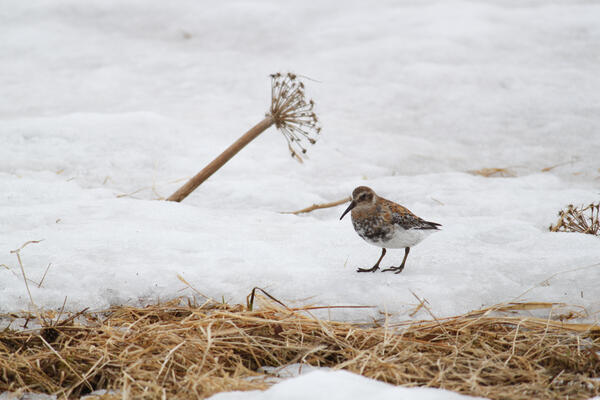
Female Pribilof Rock Sandpiper Foraging on Snow
The Pribilof Rock Sandpiper (Calidris ptilocnemis ptilocnemis) is endemic to the Bering Sea Region and only breeds on the islands of St. Matthew, Hall, St. Paul, and St. George. The Rock Sandpiper is one of two focal species monitored as part of a long-term population study led by USGS Alaska Science Center, U.S.

Male McKay's Bunting Foraging on Snow
The McKay's Bunting (Plectrophenax hyperboreus) is endemic to the Bering Sea Region and only breeds on St. Matthew and Hall islands. Designated as a species of high conservation concern due to its small population size, surveys show that the species has continued to decline since the initial survey effort in 2003.
The McKay's Bunting (Plectrophenax hyperboreus) is endemic to the Bering Sea Region and only breeds on St. Matthew and Hall islands. Designated as a species of high conservation concern due to its small population size, surveys show that the species has continued to decline since the initial survey effort in 2003.
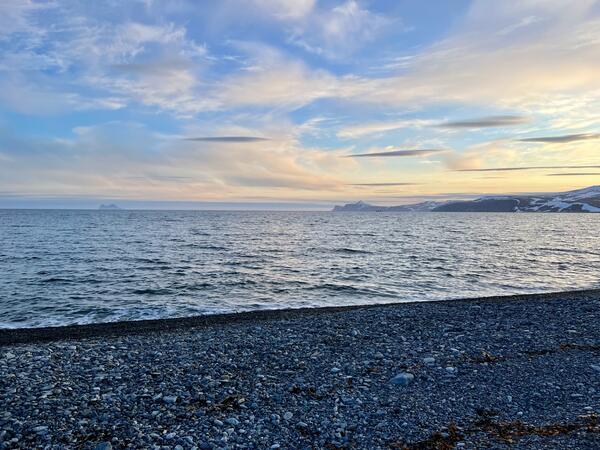
Summer sunset on St. Matthew Island
During the summer months on St. Matthew Island the sun never truly sets. The amber hues on the horizon serve as the perfect backdrop to a long, yet successful, day conducting Rock Sandpiper and McKay's Bunting distance-sampling surveys. The sunset photo was taken at 12:10am.
During the summer months on St. Matthew Island the sun never truly sets. The amber hues on the horizon serve as the perfect backdrop to a long, yet successful, day conducting Rock Sandpiper and McKay's Bunting distance-sampling surveys. The sunset photo was taken at 12:10am.
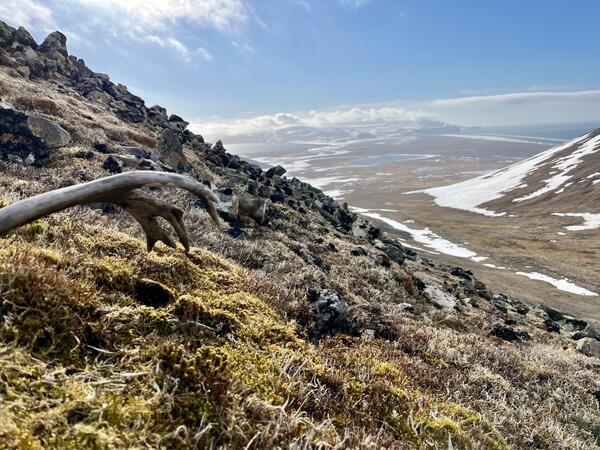
The Rise and Fall of St. Matthew Reindeer
In August of 1944, 29 Nunivak Island reindeer were transported to St. Matthew Island via barge as a free-range food source for the Coast Guard officials that maintained the long-range navigation site (Loran) during World War II. At the peak, 6,000 reindeer roamed the island at a density of 47 animals per square mile.
In August of 1944, 29 Nunivak Island reindeer were transported to St. Matthew Island via barge as a free-range food source for the Coast Guard officials that maintained the long-range navigation site (Loran) during World War II. At the peak, 6,000 reindeer roamed the island at a density of 47 animals per square mile.

Female McKay's Bunting with berry stained feathers
Female McKay's Bunting with berry stained feathersFemale McKay's Bunting with berry stained feathers on St. Matthew Island, Alaska.
Female McKay's Bunting with berry stained feathers
Female McKay's Bunting with berry stained feathersFemale McKay's Bunting with berry stained feathers on St. Matthew Island, Alaska.

Red fox kits on St. Matthew Island, Alaska
Red fox kits on St. Matthew Island, Alaska
Red fox kits on St. Matthew Island, Alaska

Female Pribilof rock sandpiper, St. Matthew Island, Bering Sea
Female Pribilof rock sandpiper, St. Matthew Island, Bering SeaIn 2018, biologists conducted a second population survey to reassess the population status and habitat associations of Pribilof rock sandpipers breeding on St. Matthew and Hall Islands in the Bering Sea, Alaska. Previous work estimated the population size at approximately 19,800 birds (Ruthrauff et al. 2012).
Female Pribilof rock sandpiper, St. Matthew Island, Bering Sea
Female Pribilof rock sandpiper, St. Matthew Island, Bering SeaIn 2018, biologists conducted a second population survey to reassess the population status and habitat associations of Pribilof rock sandpipers breeding on St. Matthew and Hall Islands in the Bering Sea, Alaska. Previous work estimated the population size at approximately 19,800 birds (Ruthrauff et al. 2012).

Bull Seal Point on St. Matthew Island, Alaska
Bull Seal Point on St. Matthew Island, Alaska.
Bull Seal Point on St. Matthew Island, Alaska.

Female McKay's Bunting on St. Matthew Island
Female McKay's Bunting on St. Matthew Island.
Female McKay's Bunting on St. Matthew Island.

Male McKay's Bunting on St. Matthew Island
Male McKay's Bunting on St. Matthew Island
Male McKay's Bunting on St. Matthew Island

Setting up a weatherport on St. Matthew Island, Alaska
Setting up a weatherport on St. Matthew Island, AlaskaScientists setting up a weatherport for shelter while conducting research on St. Matthew Island Alaska.
Setting up a weatherport on St. Matthew Island, Alaska
Setting up a weatherport on St. Matthew Island, AlaskaScientists setting up a weatherport for shelter while conducting research on St. Matthew Island Alaska.

Male Wilson's Warbler on the Seward Peninsula, Alaska
Male Wilson's Warbler on the Seward Peninsula, AlaskaMale Wilson's Warbler on the Seward Peninsula, Alaska. This photo was taken on the Seward Peninsula as part of the Changing Arctic Ecosystem Boreal-Arctic Transition Zone program.
Male Wilson's Warbler on the Seward Peninsula, Alaska
Male Wilson's Warbler on the Seward Peninsula, AlaskaMale Wilson's Warbler on the Seward Peninsula, Alaska. This photo was taken on the Seward Peninsula as part of the Changing Arctic Ecosystem Boreal-Arctic Transition Zone program.

Male Wilson's Warbler in a shrub on the Seward Peninsula, Alaska
Male Wilson's Warbler in a shrub on the Seward Peninsula, AlaskaMale Wilson's Warbler. This photo was taken on the Seward Peninsula as part of the Changing Arctic Ecosystem Boreal-Arctic Transition Zone program.
Male Wilson's Warbler in a shrub on the Seward Peninsula, Alaska
Male Wilson's Warbler in a shrub on the Seward Peninsula, AlaskaMale Wilson's Warbler. This photo was taken on the Seward Peninsula as part of the Changing Arctic Ecosystem Boreal-Arctic Transition Zone program.

Lone male Yellow Warbler on the Seward Peninsula, Alaska
Lone male Yellow Warbler on the Seward Peninsula, AlaskaLone male Yellow Warbler on the Seward Peninsula, Alaska. This photo was taken on the Seward Peninsula as part of the Changing Arctic Ecosystem Boreal-Arctic Transition Zone program.
Lone male Yellow Warbler on the Seward Peninsula, Alaska
Lone male Yellow Warbler on the Seward Peninsula, AlaskaLone male Yellow Warbler on the Seward Peninsula, Alaska. This photo was taken on the Seward Peninsula as part of the Changing Arctic Ecosystem Boreal-Arctic Transition Zone program.

Black-capped Chickadee with a deformed crossed beak
Black-capped Chickadee with a deformed crossed beakA Black-capped Chickadee with a beak that has grown long and crossed
Black-capped Chickadee with a deformed crossed beak
Black-capped Chickadee with a deformed crossed beakA Black-capped Chickadee with a beak that has grown long and crossed

Red-breasted Nuthatch with an elongated deformed beak
Red-breasted Nuthatch with an elongated deformed beakA female Red-breasted Nuthatch with an elongated deformed beak. It was captured in Anchorage as part of the beak deformity research project. Avian keratin disorder (AKD) is a disease characterized by debilitating beak overgrowth and other abnormalities of keratinized tissues.
Red-breasted Nuthatch with an elongated deformed beak
Red-breasted Nuthatch with an elongated deformed beakA female Red-breasted Nuthatch with an elongated deformed beak. It was captured in Anchorage as part of the beak deformity research project. Avian keratin disorder (AKD) is a disease characterized by debilitating beak overgrowth and other abnormalities of keratinized tissues.

Bristle-thighed Curlew in Alaska
A Bristle-thighed Curlew on the tundra. This photo was taken during the Changing Arctic Ecosystems Boreal-Arctic Transition program.
A Bristle-thighed Curlew on the tundra. This photo was taken during the Changing Arctic Ecosystems Boreal-Arctic Transition program.

Male Lapland Longspur in dwarf shrub mat habitat
Male Lapland Longspur in dwarf shrub mat habitat. This photo was taken on the Seward Peninsula as part of the Changing Arctic Ecosystem Boreal-Arctic Transition Zone program.
Male Lapland Longspur in dwarf shrub mat habitat. This photo was taken on the Seward Peninsula as part of the Changing Arctic Ecosystem Boreal-Arctic Transition Zone program.
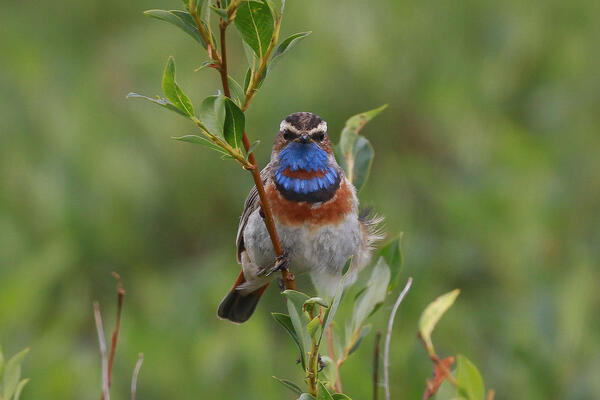
Male Bluethroat on the Seward Peninsula, Alaska
Male Bluethroat on the Seward Peninsula, Alaska. This photo was taken on the Seward Peninsula as part of the Changing Arctic Ecosystem Boreal-Arctic Transition Zone program.
Male Bluethroat on the Seward Peninsula, Alaska. This photo was taken on the Seward Peninsula as part of the Changing Arctic Ecosystem Boreal-Arctic Transition Zone program.

Short-eared Owl on the Seward Peninsula, Alaska
Short-eared Owl. This photo was taken on the Seward Peninsula as part of the Changing Arctic Ecosystem Boreal-Arctic Transition Zone program.
Short-eared Owl. This photo was taken on the Seward Peninsula as part of the Changing Arctic Ecosystem Boreal-Arctic Transition Zone program.

A male Willow Ptarmigan
A closeup of a male Willow Ptarmigan.
A closeup of a male Willow Ptarmigan.
Science and Products
Filter Total Items: 15
Landbird Research in Alaska
On this page, learn about USGS work with the Alaska Landbird Monitoring Survey (ALMS), Beak Deformities in Landbirds, and Boreal Partners in Flight (BPIF).
Alaska Landbird Monitoring Survey
Alaska provides breeding habitat for more than 140 regularly occurring species of landbirds, half of which breed predominantly north of the U.S.–Canada border. The road-based North American Breeding Bird Survey (BBS) provides some data on population trends in Alaska, but most northern species are inadequately monitored by that continental program because of a paucity of roads. Boreal Partners in...
Beak Deformities in Landbirds
Over the past 26 years, Alaskans have witnessed a startling increase of beak deformities among Black-capped Chickadees and other species of resident birds. This disease, called avian keratin disorder (AKD), is characterized by debilitating beak overgrowth and other abnormalities of keratinized tissues. Affected birds have difficulty feeding and preening and may suffer high rates of mortality. If...
Links Related to Beak Deformity Research
Links, videos, and news articles related to beak deformity research.
Possible Causes of Beak Deformities
Beak deformities can be caused by a variety of factors, including contaminants, nutritional deficiencies, disease, parasites, blunt trauma, or genetic abnormalities. In 2016, we identified a novel picornavirus (Poecivirus) in Black-capped Chickadees with avian keratin disorder (AKD). Our results suggest that Poecivirus is the most likely factor responsible for beak deformities in Alaskan birds...
Literature Cited for Beak Deformities
Literature Cited in the Beak Deformity web pages
Physical Description of Beak Deformities
The most commonly observed physical abnormalities among Alaskan birds are overgrown or crossed beaks.
Prevalence, Distribution and Timing of Beak Deformities in Birds
The rates of beak deformities documented in Black-capped Chickadees and American Crows in Alaska are the highest ever recorded within a wild bird population anywhere.
Effects of Beak Deformities on Birds
Birds with beak deformities often have difficulty foraging and preening and may not be able to keep themselves warm and well-fed during cold winter months. Although some birds with beak deformities breed successfully, they typically encounter more challenges than normal birds.
Species Affected by Beak Deformities
At least 30 Alaskan bird species are affected by beak deformities and the geographic extent of the problem appears to be growing. In addition to Alaskan observations, we have received increasing numbers of reports from other parts of North America and Europe.
Bird Conservation Areas
Five Bird Conservation Regions (BCRs) were designated in Alaska as part of the North American Bird Conservation Initiative in order to provide a framework that would facilitate coordinated conservation and evaluations of major bird initiatives.
Conservation of Landbirds in Alaska
Alaska lies at the convergence of four major global migration flyways and encompasses a diverse array of important landbird habitats. Temperate rainforests tower along the southern coast, boreal forests span the vast interior, and low-lying tundra blankets the continent’s northern and western fringes.
Filter Total Items: 54
Female Pribilof Rock Sandpiper Foraging on Snow
The Pribilof Rock Sandpiper (Calidris ptilocnemis ptilocnemis) is endemic to the Bering Sea Region and only breeds on the islands of St. Matthew, Hall, St. Paul, and St. George. The Rock Sandpiper is one of two focal species monitored as part of a long-term population study led by USGS Alaska Science Center, U.S.
The Pribilof Rock Sandpiper (Calidris ptilocnemis ptilocnemis) is endemic to the Bering Sea Region and only breeds on the islands of St. Matthew, Hall, St. Paul, and St. George. The Rock Sandpiper is one of two focal species monitored as part of a long-term population study led by USGS Alaska Science Center, U.S.
Male McKay's Bunting Foraging on Snow
The McKay's Bunting (Plectrophenax hyperboreus) is endemic to the Bering Sea Region and only breeds on St. Matthew and Hall islands. Designated as a species of high conservation concern due to its small population size, surveys show that the species has continued to decline since the initial survey effort in 2003.
The McKay's Bunting (Plectrophenax hyperboreus) is endemic to the Bering Sea Region and only breeds on St. Matthew and Hall islands. Designated as a species of high conservation concern due to its small population size, surveys show that the species has continued to decline since the initial survey effort in 2003.
Summer sunset on St. Matthew Island
During the summer months on St. Matthew Island the sun never truly sets. The amber hues on the horizon serve as the perfect backdrop to a long, yet successful, day conducting Rock Sandpiper and McKay's Bunting distance-sampling surveys. The sunset photo was taken at 12:10am.
During the summer months on St. Matthew Island the sun never truly sets. The amber hues on the horizon serve as the perfect backdrop to a long, yet successful, day conducting Rock Sandpiper and McKay's Bunting distance-sampling surveys. The sunset photo was taken at 12:10am.
The Rise and Fall of St. Matthew Reindeer
In August of 1944, 29 Nunivak Island reindeer were transported to St. Matthew Island via barge as a free-range food source for the Coast Guard officials that maintained the long-range navigation site (Loran) during World War II. At the peak, 6,000 reindeer roamed the island at a density of 47 animals per square mile.
In August of 1944, 29 Nunivak Island reindeer were transported to St. Matthew Island via barge as a free-range food source for the Coast Guard officials that maintained the long-range navigation site (Loran) during World War II. At the peak, 6,000 reindeer roamed the island at a density of 47 animals per square mile.
Female McKay's Bunting with berry stained feathers
Female McKay's Bunting with berry stained feathersFemale McKay's Bunting with berry stained feathers on St. Matthew Island, Alaska.
Female McKay's Bunting with berry stained feathers
Female McKay's Bunting with berry stained feathersFemale McKay's Bunting with berry stained feathers on St. Matthew Island, Alaska.
Red fox kits on St. Matthew Island, Alaska
Red fox kits on St. Matthew Island, Alaska
Red fox kits on St. Matthew Island, Alaska
Female Pribilof rock sandpiper, St. Matthew Island, Bering Sea
Female Pribilof rock sandpiper, St. Matthew Island, Bering SeaIn 2018, biologists conducted a second population survey to reassess the population status and habitat associations of Pribilof rock sandpipers breeding on St. Matthew and Hall Islands in the Bering Sea, Alaska. Previous work estimated the population size at approximately 19,800 birds (Ruthrauff et al. 2012).
Female Pribilof rock sandpiper, St. Matthew Island, Bering Sea
Female Pribilof rock sandpiper, St. Matthew Island, Bering SeaIn 2018, biologists conducted a second population survey to reassess the population status and habitat associations of Pribilof rock sandpipers breeding on St. Matthew and Hall Islands in the Bering Sea, Alaska. Previous work estimated the population size at approximately 19,800 birds (Ruthrauff et al. 2012).
Bull Seal Point on St. Matthew Island, Alaska
Bull Seal Point on St. Matthew Island, Alaska.
Bull Seal Point on St. Matthew Island, Alaska.
Female McKay's Bunting on St. Matthew Island
Female McKay's Bunting on St. Matthew Island.
Female McKay's Bunting on St. Matthew Island.
Male McKay's Bunting on St. Matthew Island
Male McKay's Bunting on St. Matthew Island
Male McKay's Bunting on St. Matthew Island
Setting up a weatherport on St. Matthew Island, Alaska
Setting up a weatherport on St. Matthew Island, AlaskaScientists setting up a weatherport for shelter while conducting research on St. Matthew Island Alaska.
Setting up a weatherport on St. Matthew Island, Alaska
Setting up a weatherport on St. Matthew Island, AlaskaScientists setting up a weatherport for shelter while conducting research on St. Matthew Island Alaska.
Male Wilson's Warbler on the Seward Peninsula, Alaska
Male Wilson's Warbler on the Seward Peninsula, AlaskaMale Wilson's Warbler on the Seward Peninsula, Alaska. This photo was taken on the Seward Peninsula as part of the Changing Arctic Ecosystem Boreal-Arctic Transition Zone program.
Male Wilson's Warbler on the Seward Peninsula, Alaska
Male Wilson's Warbler on the Seward Peninsula, AlaskaMale Wilson's Warbler on the Seward Peninsula, Alaska. This photo was taken on the Seward Peninsula as part of the Changing Arctic Ecosystem Boreal-Arctic Transition Zone program.
Male Wilson's Warbler in a shrub on the Seward Peninsula, Alaska
Male Wilson's Warbler in a shrub on the Seward Peninsula, AlaskaMale Wilson's Warbler. This photo was taken on the Seward Peninsula as part of the Changing Arctic Ecosystem Boreal-Arctic Transition Zone program.
Male Wilson's Warbler in a shrub on the Seward Peninsula, Alaska
Male Wilson's Warbler in a shrub on the Seward Peninsula, AlaskaMale Wilson's Warbler. This photo was taken on the Seward Peninsula as part of the Changing Arctic Ecosystem Boreal-Arctic Transition Zone program.
Lone male Yellow Warbler on the Seward Peninsula, Alaska
Lone male Yellow Warbler on the Seward Peninsula, AlaskaLone male Yellow Warbler on the Seward Peninsula, Alaska. This photo was taken on the Seward Peninsula as part of the Changing Arctic Ecosystem Boreal-Arctic Transition Zone program.
Lone male Yellow Warbler on the Seward Peninsula, Alaska
Lone male Yellow Warbler on the Seward Peninsula, AlaskaLone male Yellow Warbler on the Seward Peninsula, Alaska. This photo was taken on the Seward Peninsula as part of the Changing Arctic Ecosystem Boreal-Arctic Transition Zone program.
Black-capped Chickadee with a deformed crossed beak
Black-capped Chickadee with a deformed crossed beakA Black-capped Chickadee with a beak that has grown long and crossed
Black-capped Chickadee with a deformed crossed beak
Black-capped Chickadee with a deformed crossed beakA Black-capped Chickadee with a beak that has grown long and crossed
Red-breasted Nuthatch with an elongated deformed beak
Red-breasted Nuthatch with an elongated deformed beakA female Red-breasted Nuthatch with an elongated deformed beak. It was captured in Anchorage as part of the beak deformity research project. Avian keratin disorder (AKD) is a disease characterized by debilitating beak overgrowth and other abnormalities of keratinized tissues.
Red-breasted Nuthatch with an elongated deformed beak
Red-breasted Nuthatch with an elongated deformed beakA female Red-breasted Nuthatch with an elongated deformed beak. It was captured in Anchorage as part of the beak deformity research project. Avian keratin disorder (AKD) is a disease characterized by debilitating beak overgrowth and other abnormalities of keratinized tissues.
Bristle-thighed Curlew in Alaska
A Bristle-thighed Curlew on the tundra. This photo was taken during the Changing Arctic Ecosystems Boreal-Arctic Transition program.
A Bristle-thighed Curlew on the tundra. This photo was taken during the Changing Arctic Ecosystems Boreal-Arctic Transition program.
Male Lapland Longspur in dwarf shrub mat habitat
Male Lapland Longspur in dwarf shrub mat habitat. This photo was taken on the Seward Peninsula as part of the Changing Arctic Ecosystem Boreal-Arctic Transition Zone program.
Male Lapland Longspur in dwarf shrub mat habitat. This photo was taken on the Seward Peninsula as part of the Changing Arctic Ecosystem Boreal-Arctic Transition Zone program.
Male Bluethroat on the Seward Peninsula, Alaska
Male Bluethroat on the Seward Peninsula, Alaska. This photo was taken on the Seward Peninsula as part of the Changing Arctic Ecosystem Boreal-Arctic Transition Zone program.
Male Bluethroat on the Seward Peninsula, Alaska. This photo was taken on the Seward Peninsula as part of the Changing Arctic Ecosystem Boreal-Arctic Transition Zone program.
Short-eared Owl on the Seward Peninsula, Alaska
Short-eared Owl. This photo was taken on the Seward Peninsula as part of the Changing Arctic Ecosystem Boreal-Arctic Transition Zone program.
Short-eared Owl. This photo was taken on the Seward Peninsula as part of the Changing Arctic Ecosystem Boreal-Arctic Transition Zone program.
A male Willow Ptarmigan
A closeup of a male Willow Ptarmigan.
A closeup of a male Willow Ptarmigan.
*Disclaimer: Listing outside positions with professional scientific organizations on this Staff Profile are for informational purposes only and do not constitute an endorsement of those professional scientific organizations or their activities by the USGS, Department of the Interior, or U.S. Government