



Capability
The BASCORE Lab houses two state-of-the-art core loggers: a GeoTek MSCL-S for line-scan imaging and whole-core logging, and an MSCL-XZ for split-core logging and measurement of discrete samples.
MSCL-S: Logging of whole cores and line-scan imaging of split cores
Line-scan imaging: The GeoTek MSCL-S has a GeoScan V imaging system that can collect line-scan images at resolutions of 25 µm, 50 µm, and 100 µm pixel widths. The line-scan technology produces high-quality images that do not exhibit “stitching” effects and are free from the distortion often observed with traditional photography methods. Polarizing filters on the camera lens and the LED lamp lights reduce glare effects for wet samples. RGB color values are collected with each image.
Gamma density: A 137Cs gamma ray source and gamma detector are mounted on the GeoTek MSCL-S for measuring bulk density based on gamma attenuation through core samples. Gamma density is typically measured on lined whole cores or on unlined whole rock cores every 0.5 or 1 cm, and is calibrated to grams per cubic centimeter using an aluminum calibration piece mounted inside an empty scrap of the same liner material containing the core sample (if applicable). Gamma density can be measured on split cores under special circumstances.
Magnetic susceptibility: The GeoTek MSCL-S has a Bartington MS2C loop sensor with a diameter of 100 mm used to collect magnetic susceptibility data on whole cores. Note that magnetic susceptibility is not collected on cores with metal (e.g., aluminum) liners.
P-wave velocity and amplitude: The GeoTek MSCL-S is equipped with two acoustic rolling transducers for measuring p-wave velocity and amplitude on whole lined cores, or may alternatively be equipped with two piston transducers for measuring p-wave velocity and amplitude on bare rock cores or split cores. P-wave measurements are typically measured on whole cores every 0.5 or 1 cm.
MSCL-XZ: Logging of split cores and discrete samples
Magnetic susceptibility: The GeoTek MSCL-XZ has a Bartington MS2E point sensor for collecting measurements on split cores. Magnetic susceptibility measurements are typically collected every 0.5 or 1 cm with 1 or 10 second dwell times. Note that magnetic susceptibility is not collected on cores with metal (e.g., aluminum) liners.
Visible (color) and near-infrared spectrophotometry: The GeoTek MSCL-XZ has a Malvern Panalytical ASD LabSpec that can collect measurements of visible (400 to 700 nm) and near-infrared (750 to 2500 nm) wavelengths of spectrophotometric data at up to 0.5 cm resolution. Data can be exported in both 1 and 10 nm increments, as well as greyscale, L*a*b*, and XYZ values on split core surfaces and bulk samples.
The GeoTek MSCL-XZ may alternatively be equipped with a Konica Minolta CM-700d spectrophotometer (an alternative to the LabSpec) that collects measurements for the visible color spectrum only. These measurements are typically collected every 0.5 to 1 cm, and data output includes percent reflectance at wavelengths between 400 and 700 nm, RGB values, L*a*b* values, XYZ values, and Munsell color values. The Minolta instrument is generally only used in special circumstances for comparison to legacy data.
X-ray fluorescence: 34 elements, Mg to U, are detected and quantified in counts per second (cps) or parts per million (ppm) up to every 0.5 cm with an Olympus Vanta M Series handheld XRF mounted on the GeoTek MSCL-XZ system. X-ray energies of 9 and 40 keV are sequentially released from the XRF for a measurement time of up to 30 seconds per beam to maximize elemental counts for a variety of sediment core types with varying water and organic content.
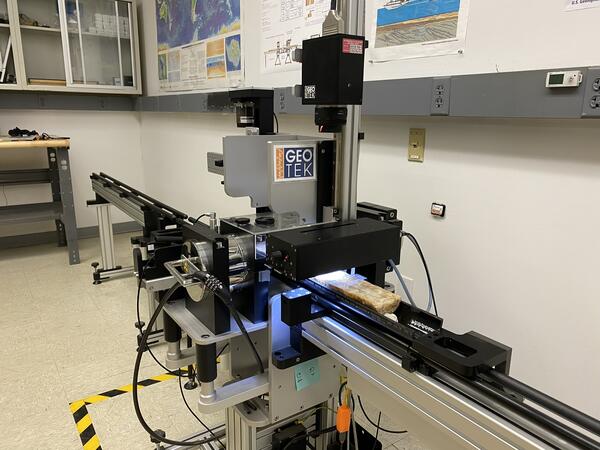
GeoTek MSCL-S
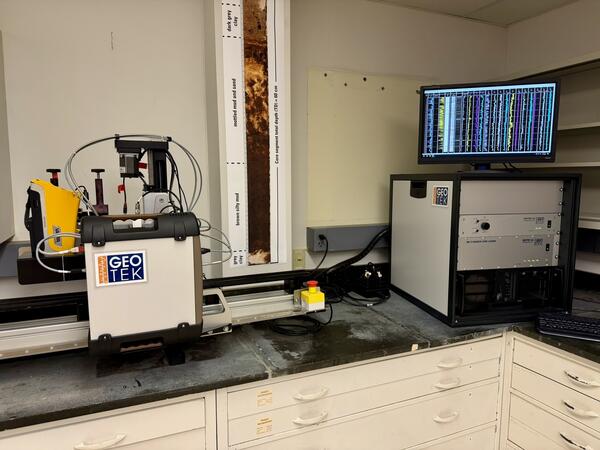
GeoTek MSCL-XZ