



Climate warming and methane emissions
By Woods Hole Coastal and Marine Science Center
2008 (approx.)


Detailed Description
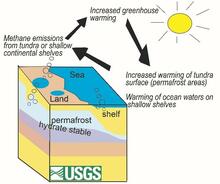
Schematic depicting the possible synergy among climate warming and increased methane emissions (including from gas hydrate dissociation) in the Arctic.
Sources/Usage
Public Domain.
Related

U.S. Geological Survey Gas Hydrates Project
The USGS Gas Hydrates Project has been making contributions to advance understanding of US and international gas hydrates science for at least three decades. The research group working on gas hydrates at the USGS is among the largest in the US and has expertise in all the major geoscience disciplines, as well as in the physics and chemistry of gas hydrates, the geotechnical properties of hydrate...

Gas Hydrates-Environment Interactions
The USGS Gas Hydrates Project focuses on the study of natural gas hydrates in deepwater marine systems and permafrost areas. Breakdown of gas hydrates due to short- or long-term warming may release methane to the ocean-atmosphere system. As a potent greenhouse gas, methane plays a role in climate warming.
Related
U.S. Geological Survey Gas Hydrates Project
The USGS Gas Hydrates Project has been making contributions to advance understanding of US and international gas hydrates science for at least three decades. The research group working on gas hydrates at the USGS is among the largest in the US and has expertise in all the major geoscience disciplines, as well as in the physics and chemistry of gas hydrates, the geotechnical properties of hydrate...
Gas Hydrates-Environment Interactions
The USGS Gas Hydrates Project focuses on the study of natural gas hydrates in deepwater marine systems and permafrost areas. Breakdown of gas hydrates due to short- or long-term warming may release methane to the ocean-atmosphere system. As a potent greenhouse gas, methane plays a role in climate warming.