



Cobb Mountain and The Geysers geothermal field


Detailed Description
At over 4700ft (1440 m), Cobb Mountain is the tallest peak in the Mayacamas Mountains. Cobb Mountain is comprised entirely of ~ 1 million-year-old silica-rich volcanic rocks related to the Clear Lake volcanic field. At around the same time the flows of Cobb Mountain were erupting as slow-moving, sticky lavas, the rhyolite (silica rich igneous rock) of Bonanza Springs erupted explosively. The deposits of this rock can be seen today along Hwy. 175, just down the hill from Our Lady of the Lake church.
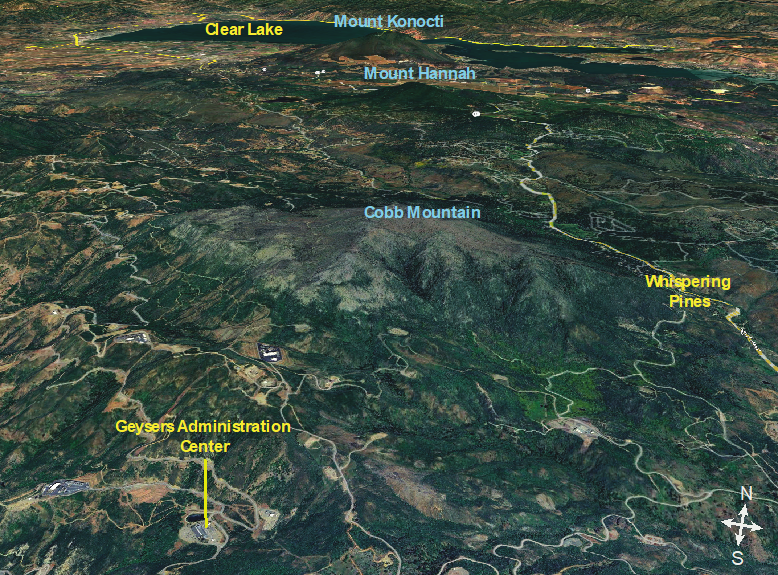
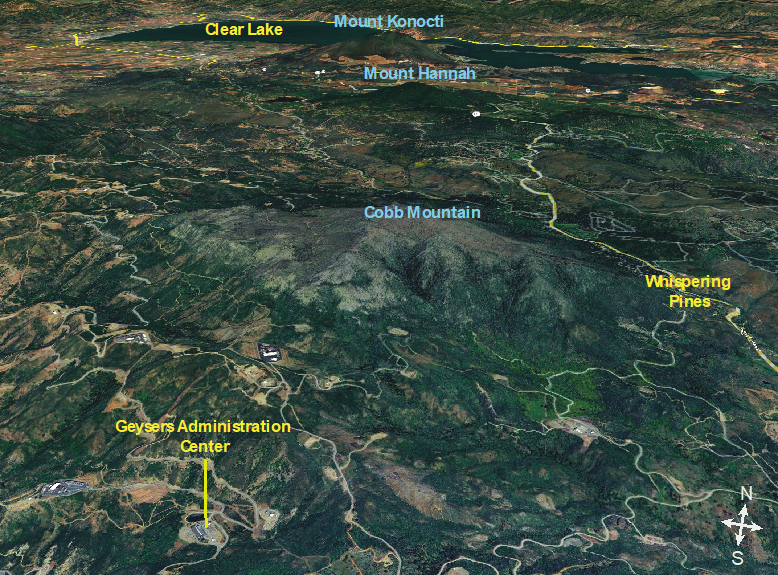
Extensive well drilling and geophysical modeling associated with development of the Geysers geothermal resource, which wraps around the northwest and south sides of Cobb Mountain, has revealed an interesting feature beneath the mountain, as well. This subsurface rock sampling and imaging has located intrusive igneous body, called the “Felsite,” which turns out to be generally the same age and chemical composition as the lavas of Cobb Mountain. The Felsite is much larger than Cobb Mountain and is thought to be in the unerupted equivalent to the volcanic flows present at the surface. This image of Cobb Mountain is looking approximately northward. A few powerplants associated with the Geysers geothermal complex can be seen, as can Mount Hannah and Mount Konocti, both of which are comprised of volcanic rocks of the Clear Lake volcanic field. Google Earth image illustrated by Seth Burgess.
Sources/Usage
Public Domain.