



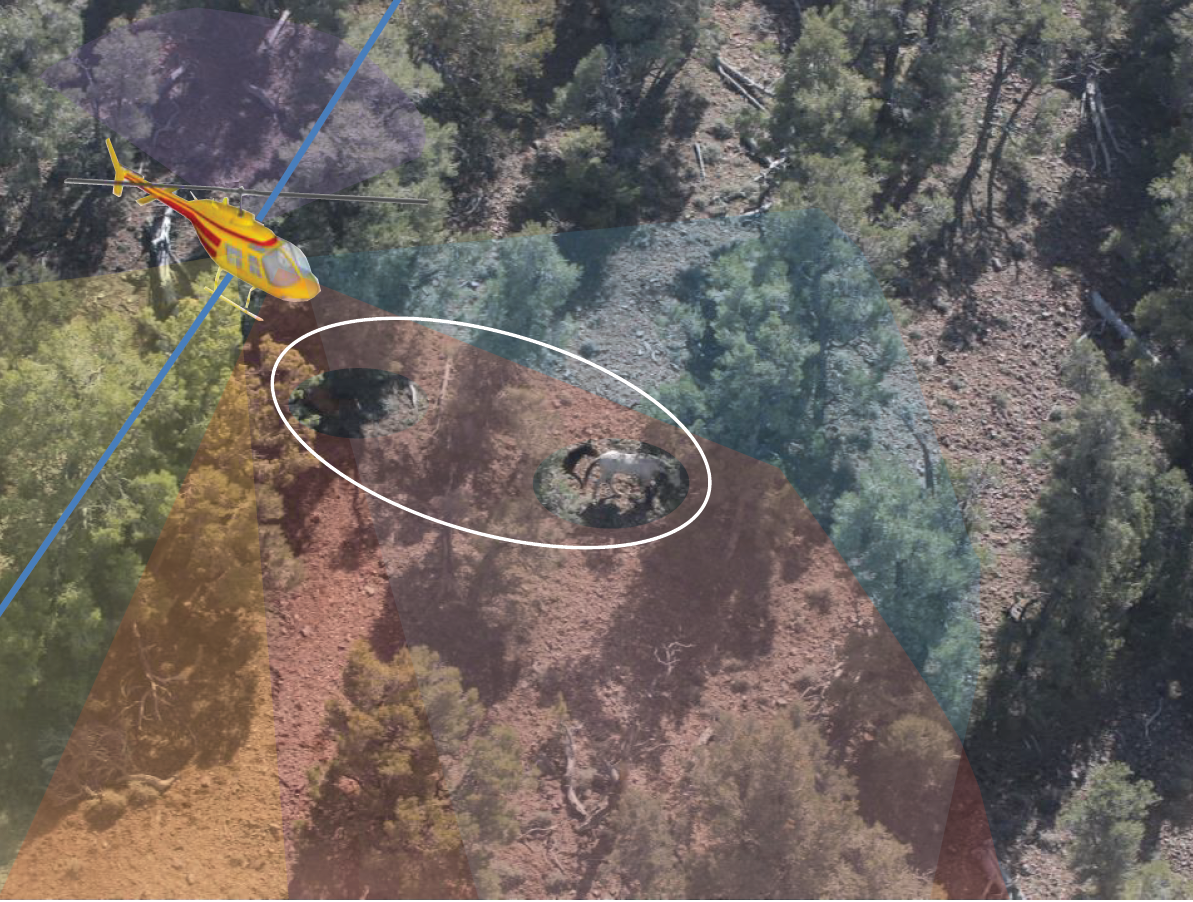
Diagram of aerial horse surveying



Detailed Description
A diagram of a helicopter’s initial approach near a horse group, circled in white. The horse group is visible to front seat observers, but back seat observers may not yet have had a chance to detect the horse group. At this point, the front seat observer and pilot should stay silent, and the pilot should keep flying straight. The fields of view for the four aircrew members/observers are suggested by colored shading: yellow for the aircrew member/observer in the right back seat, red for the aircrew member/pilot in the right front seat, blue for the aircrew member/observer in the left front seat, and purple for the aircrew member/observer in the left back seat. The blue line suggests an axis that is perpendicular to the helicopter flight path. When horses are behind this axis, they are said to be “past perpendicular,” or “abeam” of the flight path. Photograph by Bureau of Land Management. Figure from Griffin, P.C., Ekernas, L.S., Schoenecker, K.A., and Lubow, B.C., 2020, Standard operating procedures for wild horse and burro double-observer aerial surveys: U.S. Geological Survey Techniques and Methods, book 2, chap. A16, 76 p., https://doi.org/10.3133/tm2A16.
Sources/Usage
Public Domain.
Related
Science for management of America’s iconic wild horses and burros
Related