



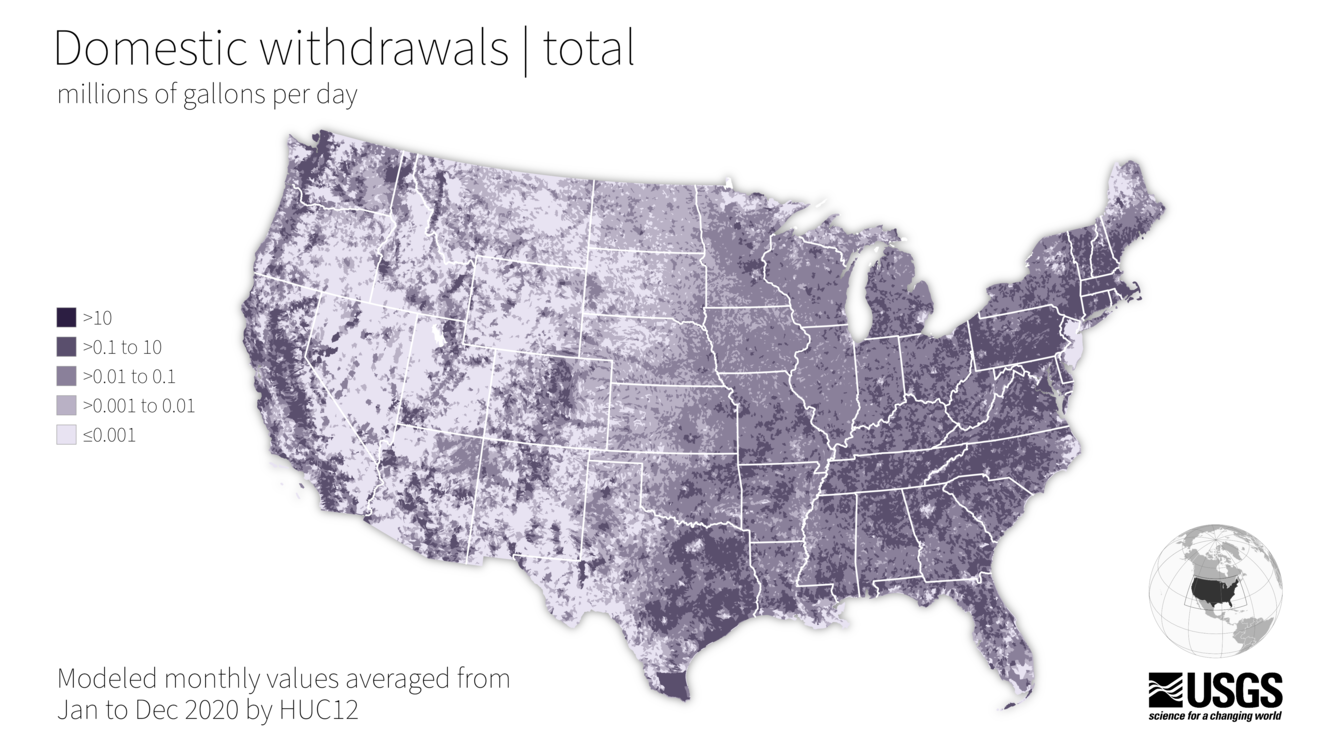
Domestic self-supplied water use map, monthly averages for 2020 by watershed


Detailed Description
This map represents the average amount of water withdrawn each month for domestic self-supply use for all subwatersheds (12-digit Hydrologic Unit Codes or HUC12s) in the conterminous United States (CONUS).
Domestic self-supplied water is water used at home that does not come from a public water utility. This can include potable and non-potable water. The most common source of self-supplied water is a well. Less common self-supplied water sources include rainwater captured in a cistern or spring water piped to a home or outdoor faucet. Domestic self-supplied water is used for all home water uses such as watering gardens, drinking water, or household functions.
Data from ScienceBase (https://doi.org/10.5066/P13BILQT).
Sources/Usage
Public Domain.
Related

Domestic Self-Supplied Water Use
Domestic self-supplied water is water used at home that does not come from a public water utility. This can include potable and non-potable water. The most common source of self-supplied water is a well. Other self-supplied water sources include capturing rainwater in a cistern, private surface water diversions (intakes), piping spring water to a home or outdoor faucet, or hauling jugs of water...

Accessing Water Use Data
The USGS provides historic and recent water use data for the United States including the District of Columbia, Puerto Rico, and the U.S. Virgin Islands. This page provides an up-to-date guide to accessing, downloading, and using USGS water use data.
Domestic Self-Supplied Water Use
Domestic self-supplied water is water used at home that does not come from a public water utility. This can include potable and non-potable water. The most common source of self-supplied water is a well. Other self-supplied water sources include capturing rainwater in a cistern, private surface water diversions (intakes), piping spring water to a home or outdoor faucet, or hauling jugs of water...

Water Use in the United States
Since 1950, the USGS has regularly produced nationwide water‑use data, creating one of the most comprehensive pictures of how water is used across the United States. Building on this rich historical record, these data give water managers a critical foundation to evaluate long‑term trends, plan strategically, and identify and quantify water availability so they can design more adaptive, resilient...
Related
Domestic Self-Supplied Water Use
Domestic self-supplied water is water used at home that does not come from a public water utility. This can include potable and non-potable water. The most common source of self-supplied water is a well. Other self-supplied water sources include capturing rainwater in a cistern, private surface water diversions (intakes), piping spring water to a home or outdoor faucet, or hauling jugs of water...
Accessing Water Use Data
The USGS provides historic and recent water use data for the United States including the District of Columbia, Puerto Rico, and the U.S. Virgin Islands. This page provides an up-to-date guide to accessing, downloading, and using USGS water use data.
Domestic Self-Supplied Water Use
Domestic self-supplied water is water used at home that does not come from a public water utility. This can include potable and non-potable water. The most common source of self-supplied water is a well. Other self-supplied water sources include capturing rainwater in a cistern, private surface water diversions (intakes), piping spring water to a home or outdoor faucet, or hauling jugs of water...
Water Use in the United States
Since 1950, the USGS has regularly produced nationwide water‑use data, creating one of the most comprehensive pictures of how water is used across the United States. Building on this rich historical record, these data give water managers a critical foundation to evaluate long‑term trends, plan strategically, and identify and quantify water availability so they can design more adaptive, resilient...