
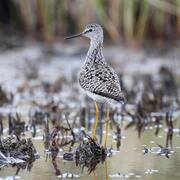
Lesser Yellowlegs foraging for aquatic insects
Detailed Description
Lesser Yellowlegs typically consume insects, such as flies, beetles, and mayflies, small fish, crustaceans, aquatic worms, mollusks, spiders, and seeds. Lesser Yellowlegs are active foragers and are commonly observed walking rapidly through shallow wetlands while pursuing prey.
Sources/Usage
Public Domain.
Permission via email for USGS to use photos taken by Laura McDuffie while an employee of USFWS Migratory Bird Management. Photos may be used in public data releases, multimedia pages, webpages, and social media.
Related
U.S. Fish and Wildlife Service Tracking Data for Lesser Yellowlegs (Tringa flavipes)
Available here are tracking data of Lesser Yellowlegs ( Tringa flavipes). These data were collected to inform the spatiotemporal migratory patterns of Lesser Yellowlegs between subarctic breeding areas in Alaska and Canada and wintering areas in South America, the Caribbean, Central America, and the contiguous United States.
Flyway-scale GPS tracking reveals migratory routes and key stopover and non-breeding locations of lesser yellowlegs Flyway-scale GPS tracking reveals migratory routes and key stopover and non-breeding locations of lesser yellowlegs
Many populations of long-distance migrant shorebirds are declining rapidly. Since the 1970s, the lesser yellowlegs (Tringa flavipes) has experienced a pronounced reduction in abundance of ~63%. The potential causes of the species' decline are complex and interrelated. Understanding the timing of migration, seasonal routes, and important stopover and non-breeding locations used by this...
Authors
Laura Anne McDuffie, Katherine S. Christie, Audrey R. Taylor, Erica Nol, Christian Friis, Christopher M. Harwood, Jennie Rausch, Benoit Laliberte, Callie Gesmundo, James R. Wright, James A. Johnson
Related
U.S. Fish and Wildlife Service Tracking Data for Lesser Yellowlegs (Tringa flavipes)
Available here are tracking data of Lesser Yellowlegs ( Tringa flavipes). These data were collected to inform the spatiotemporal migratory patterns of Lesser Yellowlegs between subarctic breeding areas in Alaska and Canada and wintering areas in South America, the Caribbean, Central America, and the contiguous United States.
Flyway-scale GPS tracking reveals migratory routes and key stopover and non-breeding locations of lesser yellowlegs Flyway-scale GPS tracking reveals migratory routes and key stopover and non-breeding locations of lesser yellowlegs
Many populations of long-distance migrant shorebirds are declining rapidly. Since the 1970s, the lesser yellowlegs (Tringa flavipes) has experienced a pronounced reduction in abundance of ~63%. The potential causes of the species' decline are complex and interrelated. Understanding the timing of migration, seasonal routes, and important stopover and non-breeding locations used by this...
Authors
Laura Anne McDuffie, Katherine S. Christie, Audrey R. Taylor, Erica Nol, Christian Friis, Christopher M. Harwood, Jennie Rausch, Benoit Laliberte, Callie Gesmundo, James R. Wright, James A. Johnson