



Overview of how CRISPR biosensors work
By Wetland and Aquatic Research Center
October 2024 (approx.)


Detailed Description
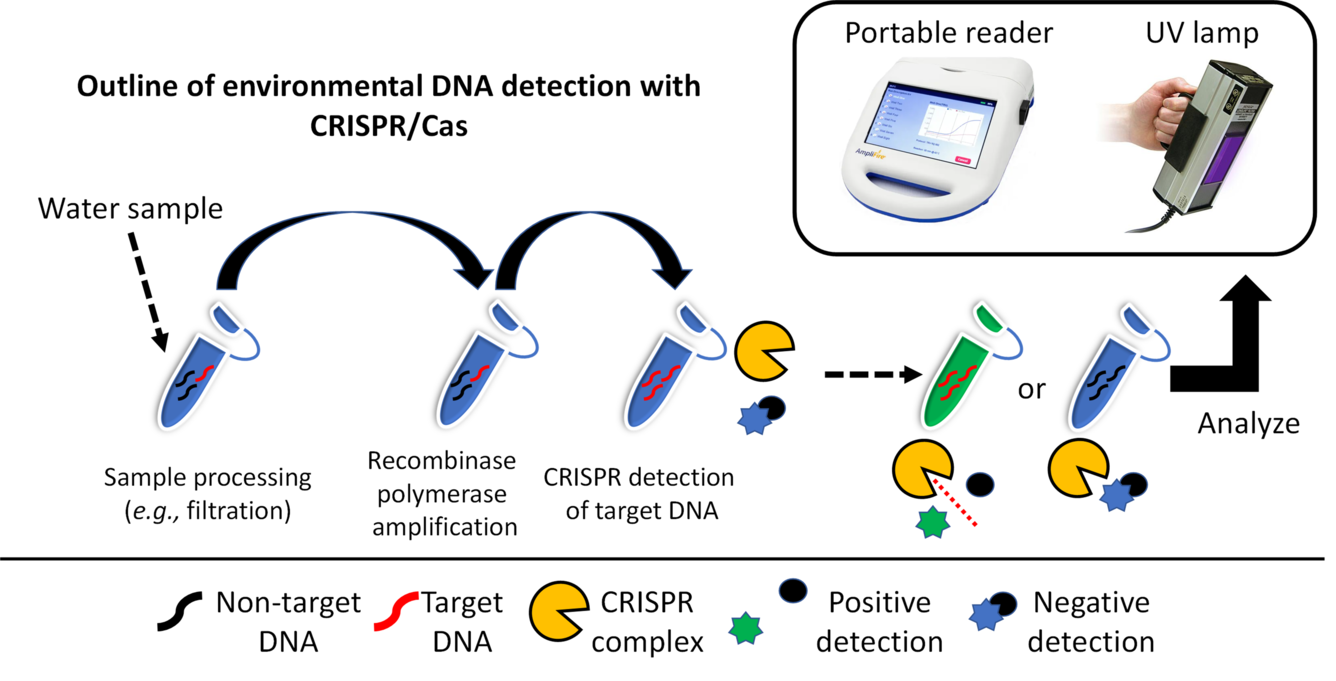
Overview of how CRISPR biosensors work. A sample of water is passed through aa filter to collect samples that may contain environmental DNA. The sample is then subjected to a recombinase polymerase amplification step to increase the pool of target DNA. A CRISPR complex is then employed to accurately discriminate between target and non-target DNA. Upon target detection, the CRISPR complex will generate a fluorescence signal that can be measured with a portable reader or a UV lamp.
Sources/Usage
Public Domain.
Related

Development of Environmental DNA (eDNA) Detection Tools to Track the Obligate Coral Predator Coralliophila galea to Support Coral Outplant Site Selection
With the support of the Mote Marine Laboratory and Aquarium, USGS researchers will develop and optimize a CRISPR biosensor to detect C. galea eDNA in the field. The development of this tool could assist coral restoration managers and stakeholders to more effectively inform decisions on coral outplant site selection, based on coral predator presence.
Related
Development of Environmental DNA (eDNA) Detection Tools to Track the Obligate Coral Predator Coralliophila galea to Support Coral Outplant Site Selection
With the support of the Mote Marine Laboratory and Aquarium, USGS researchers will develop and optimize a CRISPR biosensor to detect C. galea eDNA in the field. The development of this tool could assist coral restoration managers and stakeholders to more effectively inform decisions on coral outplant site selection, based on coral predator presence.