



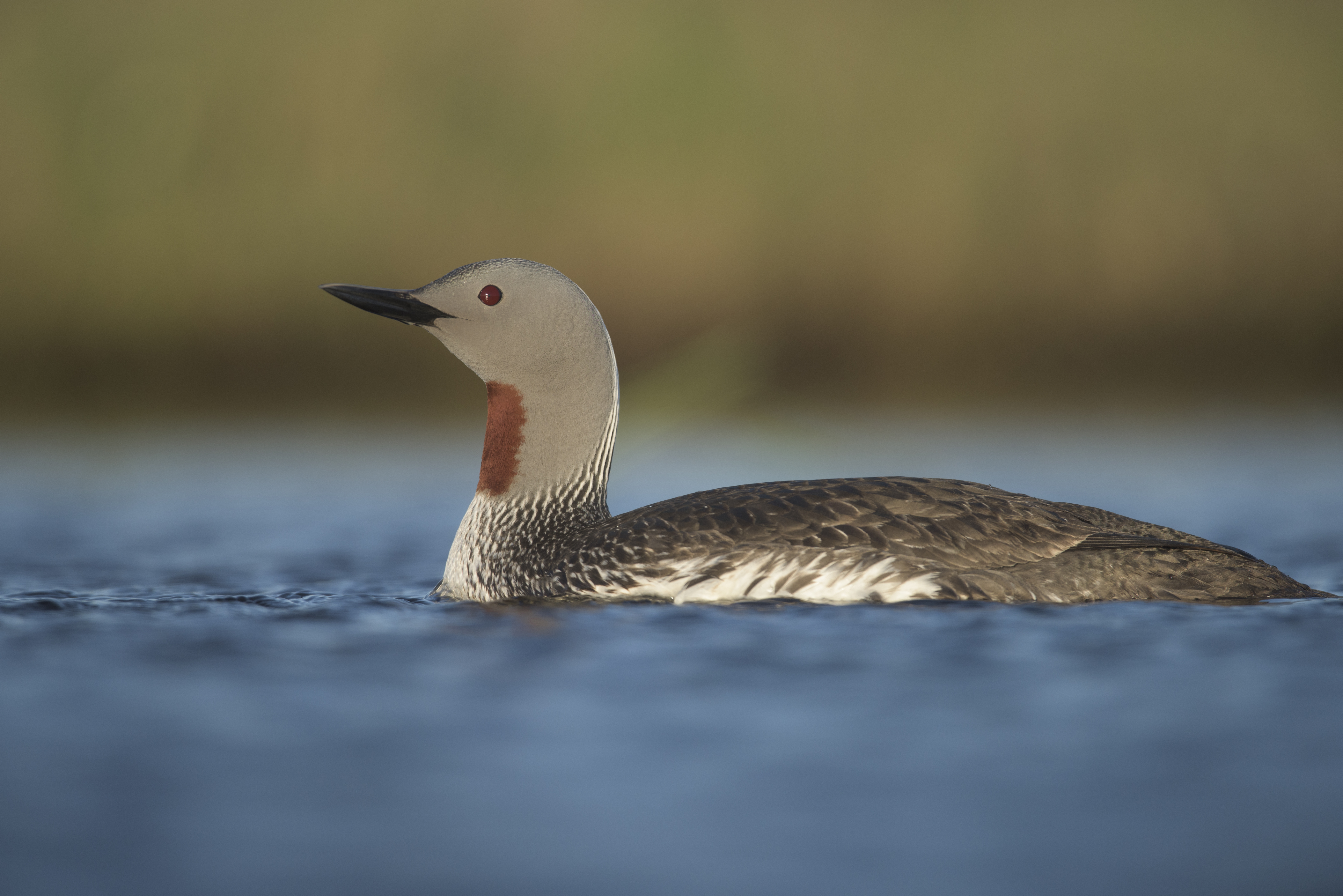
Red-throated Loon swimming near the Colville River, Alaska


Detailed Description
A Red-throated Loon swimming in a small lake on the Colville River Delta.
Sources/Usage
Public Domain.
Related

Does fish prey influence red-throated loon productivity?
This study will evaluate the nearshore marine feeding areas of breeding adult red-throated loons and assess the response of loon reproductive success to differences in the relative abundance, composition, and nutritional content of nearshore fish communities that vary in space and time.

Loon Research
Scientists at the USGS Alaska Science Center have conducted research on Alaska’s three loon species since the late 1970s. Loons rely on freshwater lakes for nesting habitat and fish and invertebrates inhabiting lakes and marine ecosystems for food. All three loon species in Alaska occur within the National Petroleum Reserve-Alaska (NPR-A) on Alaska’s northern coast. Research by the USGS is...

Q&A: Marine Ecosystems Research at the USGS Alaska Science Center
The USGS Alaska Science Center is a leader and collaborator in marine ecosystems research on topics ranging from ocean bottom-dwelling invertebrates and small pelagic forage fish (food for Pacific walrus, sea otters, and marine birds) to polar bears (an apex predator in the Arctic). Here, we highlight current research by the USGS Alaska Science Center that focuses on marine ecosystems of Alaska.

Collaborative Science for Priority Information Needs
One of the primary missions of the USGS is to address the science needs of Department of Interior bureaus, particularly those that manage natural resources and lands. This mission is fulfilled through the research and other activities of USGS scientists but also specifically through three USGS nationally-funded programs listed below.
Related
Does fish prey influence red-throated loon productivity?
This study will evaluate the nearshore marine feeding areas of breeding adult red-throated loons and assess the response of loon reproductive success to differences in the relative abundance, composition, and nutritional content of nearshore fish communities that vary in space and time.
Loon Research
Scientists at the USGS Alaska Science Center have conducted research on Alaska’s three loon species since the late 1970s. Loons rely on freshwater lakes for nesting habitat and fish and invertebrates inhabiting lakes and marine ecosystems for food. All three loon species in Alaska occur within the National Petroleum Reserve-Alaska (NPR-A) on Alaska’s northern coast. Research by the USGS is...
Q&A: Marine Ecosystems Research at the USGS Alaska Science Center
The USGS Alaska Science Center is a leader and collaborator in marine ecosystems research on topics ranging from ocean bottom-dwelling invertebrates and small pelagic forage fish (food for Pacific walrus, sea otters, and marine birds) to polar bears (an apex predator in the Arctic). Here, we highlight current research by the USGS Alaska Science Center that focuses on marine ecosystems of Alaska.
Collaborative Science for Priority Information Needs
One of the primary missions of the USGS is to address the science needs of Department of Interior bureaus, particularly those that manage natural resources and lands. This mission is fulfilled through the research and other activities of USGS scientists but also specifically through three USGS nationally-funded programs listed below.