



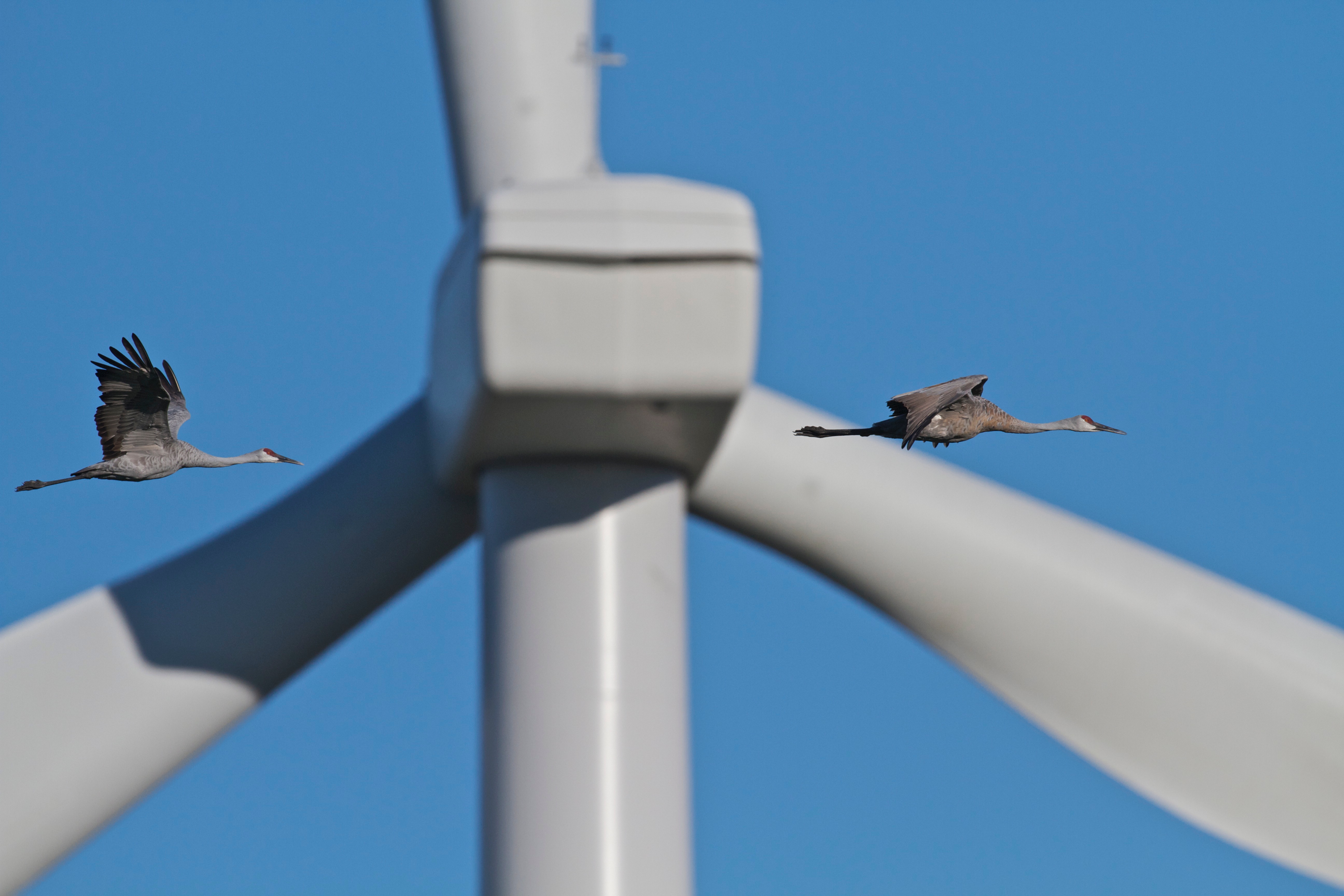
Sandhill Cranes Near Wind Turbines
By Northern Rocky Mountain Science Center
2012 (approx.)

Detailed Description
Sandhill Cranes fly in close proximity to wind turbines near Horicon National Wildlife Refuge in east-central Wisconsin, but to date no crane mortality has been associated with turbines in this area.
Sources/Usage
Image courtesy of J. Bartholmai.
Related

USGS Energy and Wildlife Research Update (Sept 2025-March 2026)
Every year, USGS scientists work with partners across the country to better understand how energy development intersects with the natural world. The research summarized here highlights new findings from the first half of FY26, spanning topics from wildlife and habitat responses to oil, gas, wind, solar, and hydropower infrastructure to advances in ecological forecasting, restoration, and species...
Energy development and the airspace
Today, the alternative energy and telecommunications industries are developing the airspace much the way metropolitan growth and mechanized agriculture develop the landscape. NOROCK scientists and partners are using both historical and traditional technologies in new and innovative ways to observe wildlife behaviors in response to these changing habitats.
Related
USGS Energy and Wildlife Research Update (Sept 2025-March 2026)
Every year, USGS scientists work with partners across the country to better understand how energy development intersects with the natural world. The research summarized here highlights new findings from the first half of FY26, spanning topics from wildlife and habitat responses to oil, gas, wind, solar, and hydropower infrastructure to advances in ecological forecasting, restoration, and species...
Energy development and the airspace
Today, the alternative energy and telecommunications industries are developing the airspace much the way metropolitan growth and mechanized agriculture develop the landscape. NOROCK scientists and partners are using both historical and traditional technologies in new and innovative ways to observe wildlife behaviors in response to these changing habitats.